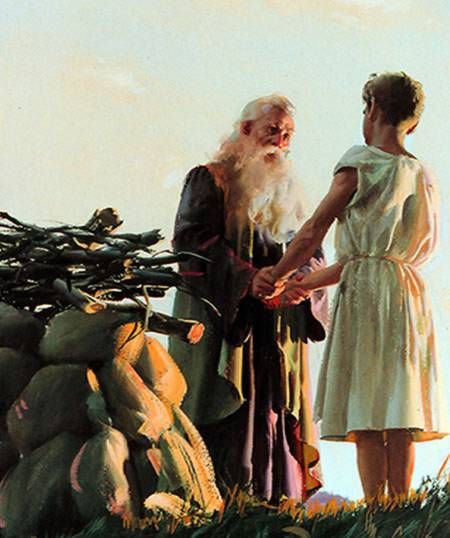
A King Wants to “Friend” Abraham

We first met Abimelech in one of the “wife-sister” episodes. (Follow the link, you can scroll down to the subheading Abimelech King of Gerar: Another Unwitting John?) After sending Hagar and Ishmael away, Abraham encounters him again (Genesis 21:22-34).

At that time Abimelech, with Phicol the commander of his army, said to Abraham, “God is with you in all that you do; now therefore swear to me here by God that you will not deal falsely with me or with my offspring or with my posterity, but as I have dealt loyally with you, you will deal with me and with the land where you have resided as an alien.”

And Abraham said, “I swear it.”

(Gen 21:22-24 NRS)
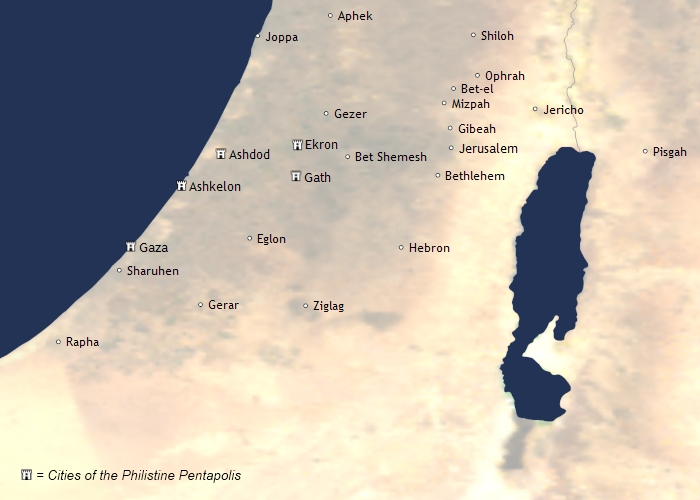
Map of Five Cities of Philistia, et al.
The Bible identifies five Philistine cities: Gaza, Ashdod, Ashkelon, Ekron and Gath. Gerar is identified as part of “the land of the Philistines” in the time of Abraham.

Abimelech was king of Gerar at that time. Why is he so keen to make Abraham an ally, even though he resides there as an alien? He had taken Sarah into his palace, because Abraham told him she was his sister (didn’t mention she was his wife). God appeared to him and told him the only reason God did not kill him was he did not know Sarah was his wife. God told Abimelech to return Sarah to her husband and ask him to pray for God to forgive him. That was how he concluded God is with you in all that you do.

Since God is with Abraham, and he almost lost his life because Abraham had dealt falsely with him, he wants to be sure Abraham understands I have dealt loyally with you, so you will deal [loyally] with me. When he first came there, Abraham thought people in this area had no fear of God. Clearly, they do now. Either he wants to remind Abraham he dealt loyally with him, or he wants to be sure Abraham understands, “You know how you told me Sarah was your sister but didn’t tell me she was your wife? Don’t ever do that again. You may have thought we don’t fear God, but you know better now.”

Yes, Abimelech, and by the Way…

When Abraham complained to Abimelech about a well of water that Abimelech’s servants had seized, Abimelech said, “I do not know who has done this; you did not tell me, and I have not heard of it until today.”

(Gen 21:25-26 NRS)

When Abraham complained to Abimelech… A better translation would be, But Abraham complained to Abimelech… (NAS), or Abraham, however, reproached Abimelech (NAB; see Translation Notes). Abimelech says he didn’t know about it. He also says, you did not tell me. Why? I understand why he wants to be sure Abraham knows he did not order that or even know about it. It was the same defense he gave to God. “I did not know. He did not tell me.” It was true then. I guess we have to assume it is true now as well.
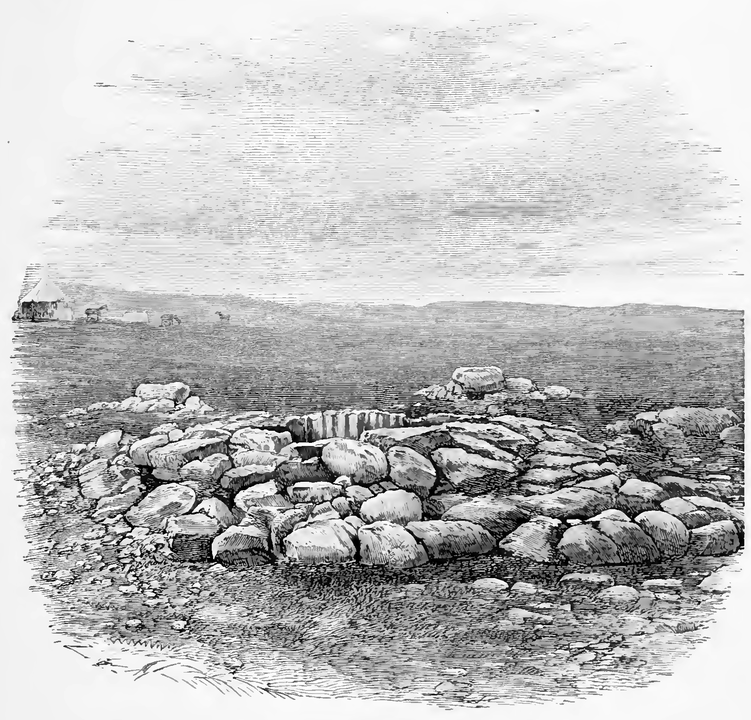
Artist's rendersing of Abraham's Well, 1855
Artist’s rendering of Abraham’s Well, 1855

Certain Details Left out

So Abraham took sheep and oxen and gave them to Abimelech, and the two men made a covenant.

Abraham set apart seven ewe lambs of the flock. And Abimelech said to Abraham, “What is the meaning of these seven ewe lambs that you have set apart?”

He said, “These seven ewe lambs you shall accept from my hand, in order that you may be a witness for me that I dug this well.”

Therefore that place was called Beer-sheba; because there both of them swore an oath.

(Gen 21:27-31 NRS)

It is not clear at first that they are making covenant. Or maybe for them, it was clear when Abimelech asked him to swear to me here by God. I’m not sure how this particular covenant ceremony works. Abraham took sheep and oxen and gave them to Abimelech. Did they cut them in half and each walk between in turn, swearing the terms of the covenant (Gen 15:9-21)? If so, why did Abraham set apart seven ewe lambs of the flock? Maybe they slaughtered them for the covenant.

But then why did he say, “These seven ewe lambs you shall accept from my hand,” as if they were a gift? Did he give them or slaughter them? Which animals were slaughtered and how? That was normally how a covenant would be sealed. Was the agreement sealed with the gift of oxen and sheep, or the gift of the seven ewe lambs?

This is one of the difficulties in reading not just the Bible but any text from a culture that is markedly different from ours. I bet the original audience was so familiar with this type of covenant that the author did not need to explain those details to them. So unless archeologists find some more specific accounts of similar ceremonies, those details are lost to us.

They Invoked the Seven

But however they ratified the covenant, setting apart seven ewe lambs was important to this origin story of how Beer-sheba got its name. In Hebrew, be’er = “well,” and sheba` = 1) seven; 2) oath. The oath was sealed by setting apart seven ewe lambs. This is one of those moments that makes the Hebrew text much more intriguing than the translation. The fact that sheba` is the root of both “take an oath” and the number seven indicates there was probably an ancient connection between seven and giving an oath. One of my professors said in the ancient Canaanite (or other local) pantheon, there was a team of seven gods associated with oaths, sort of like in Greek mythology, there were three fates and three furies, who were for the most part inseparable. To “invoke the seven” meant to make an oath.

First it says Abraham gave Abimelech sheep and oxen in order to secure his claim to the well. Then Abraham says, “These seven ewe lambs you shall accept from my hand, in order that you may be a witness for me that I dug this well.” That’s what makes the details of the ceremony confusing. What did he give to Abimelech? Were any of the animals slaughtered for the ceremony?

Once again, I think I may be confused because the original audience did not need these details explained to them.

From Oral to Written

Maybe there were two accounts of this story, one where Abraham gave an unspecified number of sheep and oxen, and one where he gave seven ewe lambs. The author did not want to choose one and leave out the other, so he put them both in, i.e., looks like another doublet.

The terms of the covenant are 1) they will each deal truthfully and loyally with each other, and 2) Abimelech recognizes this well belongs to Abraham. And once again, they are at peace.

Therefore that place was called Beer-sheba. Abraham and Abimelech get credit for naming the place. Later, as with the wife-sister episode, we have almost the exact same story between Isaac and Abimelech (Gen 26:26-33). Isaac is given credit there for naming the place Beer-sheba, and it is also based on an oath between him and Abimelech of Gerar. Even the name of the commander of his army, Phicol, is the same in the Isaac account. Pharaoh was the title not the name for the king of Egypt. Abimelech could similarly be a title not a name. But could Phicol be the title of the commander of the army? I doubt it.

So the wife-sister episode was not the only case where we have the same story, same characters, but switch Isaac for Abraham. It is extremely unlikely this exact same story happened to both Abraham and Isaac. Again, this looks like a doublet. I attribute this to the fact that these stories circulated orally for a long time, probably hundreds of years, before they were written down. In that time, Abraham could change to Isaac in some localities. Any other differences in those stories could be attributed to the same thing.

Anachronisms

When they had made a covenant at Beer-sheba, Abimelech, with Phicol the commander of his army, left and returned to the land of the Philistines.

Abraham planted a tamarisk tree in Beer-sheba, and called there on the name of the LORD, the Everlasting God. And Abraham resided as an alien many days in the land of the Philistines.

(Gen 21:32-34 NRS)

Beer-sheba was an important location in the Negev Desert. It marked the southern extent of the land of Canaan. The biblical site is believed to have been at Tel Be’er-sheva, which is a few kilometers east of the modern city. Archeological excavations indicate it became a major city in the tenth century BC, with streets laid out in a grid and separate areas for administrative, commercial, military, and residential use. This again is centuries after Abraham. Archeologists found evidence for settlements as early as the fourth millennium BC, but there appears to be a gap in settlement from about 3200-1100 BC.

Tel Beer-sheva archeological site

It appears to be the earliest planned city in the region. “From Dan to Beersheba” became a common expression for the entire cultivated land of Israel. Several wells were dug there, many of them attributed to Abraham and Isaac.

Map of Beersheba and surrounding area
On the banks of the Nahal Beersheva (the main wadi of Beersheba)

The river on the map is called the Nahal Beersheva. It is actually a wadi, so it is dry during the summer months. However, the wells plus a cistern to collect water during the wet months ensure water supplies year round. Its water sources made it a target for conquest, and it was destroyed and rebuilt many times.

The Land of the Philistines

The Philistines did not appear in the land until hundreds of years later. They are not listed among the nations Abraham’s descendants will displace in Gen 15:18-21, and from lists of nations Moses says the Israelites would conquer (Deu 7:1 and 20:17). In the time of the Judges, they were among the deadliest of Israel’s enemies. They are associated with “the sea peoples” in Egyptian texts.

The most commonly held belief is they came from Crete in the twelfth century BC. They settled mostly along the Mediterranean coast in the area today called the Gaza Strip. The most famous Philistines from the Bible are Delilah and Goliath.

This type of anachronism might give us a clue to when the stories were first written down, at a time when the Philistines were active in the area. Another possibility the Rabbis propose is that “the Philistines” Abraham encountered were actually a different people than the ones who dominated the Israelites during the time of the Judges.

Abraham Planted a Tree…

A tamarisk tree most likely refers to the Tamarix aphylla species, typically found in northern Africa and western Asia. It grows needles instead of leaves (the meaning of aphylla) and can grow to a height of fifty feet. It is also called an athel tree, athel pine, or salt cedar (because it excretes salt on the needles, making them sometimes appear white). The shade provided coolness and increased the moisture in the air underneath. As the dew collected on the needles in the morning, they could provide a source of salt. As the moisture evaporated during the day, it would cool the shade even more.

Tamarix aphylla in its natural habitat in Revivim, Israel
Abraham planted a tamarisk tree in Beer-sheba, and called there on the name of the LORD, the Everlasting God. (Gen 21:33 NRS)

Most other times when Abraham called on the name of the LORD, he built an altar. This is the only place where the Bible says Abraham planted a tree. It think it is significant that this takes place after Isaac was born. Planting a tree is something you do not just for yourself but for future generations. Now that he has secured his claim to this well, the tree will provide shade not only for himself but for Isaac, his children, and grandchildren.

…and Called on the Name of the LORD

Abraham…called there on the name of the LORD, the Everlasting God. There is obviously a special meaning to this. Beersheba later became a major cultic center of Israel.
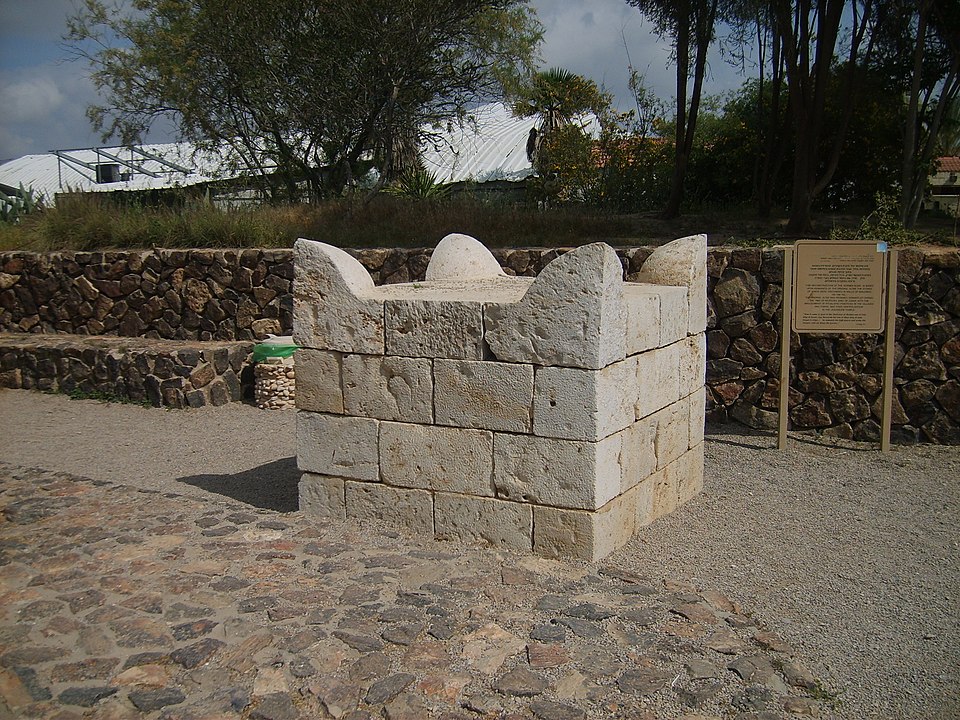
Four-horned altar, replica of one excavated at Tel Be'er Sheva
Replica of a Four-horned altar found at Tel Be’er Sheva

The LORD spoke to Hagar, Isaac, and Jacob there. When Abraham called on the name of the LORD, it was probably under that tree. Calling on the name of the LORD, along with creating physical landmarks to worship the LORD (altars or a tree), may have referred to his actions to make the LORD known to his neighbors. We also have this from the NET translation notes,

Heb “he called there in the name of the LORD.” The expression refers to worshiping the LORD through prayer and sacrifice (see Gen 4:26; Gen 12:8; Gen 13:4; Gen 26:25). See G. J. Wenham, Genesis (WBC), 1:116, 281.

NET, tn 64.

The Everlasting God

In Hebrew, this is ‘el olam (See Translation Notes). Olam does not always mean “eternal” or “everlasting,” but as an attribute of God, I think it is appropriate to translate it that way. A comma separates “the everlasting God” from the LORD. That indicates he uses this phrase to describe the God he has come to know as Yahweh, “the LORD.” I wonder, though, if this could be a name for God, the LORD God Everlasting.

Olam can also be spatial, meaning “the world,” or “the universe.” On that note, I will close with this from Matthew Henry.

In calling on the Lord, we must eye him as the everlasting God, the God of the world, so some. Though God had made himself known to Abraham as his God in particular, and in covenant with him, yet he forgets not to give glory to him as the Lord of all: The everlasting God, who was, before all worlds, and will be, when time and days shall be no more. See Isa. xl. 28.

Commentary on Genesis 21:33.

PSA: Easiest Way to Plant a Tree (or Several) Like Abraham

The earth has become so politicized that too many Christians treat caring for the land, air, and water as completely opposite from worshiping God. How did that happen? Abraham planted a tree AND called on the name of the LORD, probably from under that same tree. Why not? Didn’t God create trees and call them good (Gen 1:12)? You do believe God created heaven and earth and everything in it (plants, animals, land, water, and humans), don’t you?

We’ve cut down a lot of trees in the last century, but here’s an easy way to help replace some of them. The Arbor Day Foundation has a new campaign. For each dollar you donate, they will plant a tree. Their goal is to raise $20 million to plant 20 million new trees. Go to teamtrees.org or #teamtrees, and like Abraham, for just a few dollars you won’t even miss, you can leave something that will benefit the earth, your children, grandchildren, and generations to come.

“How we gonna breathe without them trees?”

Translation Notes

וְהוֹכִ֥חַ אַבְרָהָ֖ם (Gen 21:25 WTT) But Abraham complained…. The vav at the beginning is translated “When” in the NRSV and ESV. That makes it sound like this could have taken place at a later time. But, however, or then makes it clearer that Abraham said this following Abimelech’s request.

The verb yakach is a hiphil perfect 3rd person masculine singular. It means to complain, reprove, or reproach.

Hol3332  יכח  

hif.: pf. –1. set s.one right, reprove: a) abs. Jb 3212; b) w. acc. Is 113; w. l® Is 114; c) w. ±al (+ person) reproach s.one for s.thg Jb 195, w. °el go to law with Jb 133; w. b® requite s.thg 2K 194.

Halladay

The LORD. When the “Lord” appears in all capital letters, it refers to “the divine name,” YHWH, pronounced Yahweh. Most Jews do not speak or write the divine name out of reverence. They will often use the Hebrew word for “Lord” (Adonai) or “the Name” (Ha-shem) instead.


The everlasting God, Heb ‘el `olam. אֵ֥ל עוֹלָֽם׃ (Gen 21:33 WTT).

El is the most common word for “God” in the Hebrew Bible. Olam, translated here “everlasting.” As an attribute of God or part of God’s name, it could refer to either God’s eternal nature or the scope of God’s sovereignty as “the world” or “the universe.”

References

Bible Map: Beersheba

Carolyn Roth, “Abraham Planted Tamarisk Trees,” God as a Gardener (blog), Carolyn Roth Ministries, March 24, 2011, https://godasagardener.com/2011/03/24/abraham-the-tamarisk/

Gill, N.S. “Understanding the Philistines: An Overview and Definition.” Learn Religions, Apr. 17, 2019, https://learnreligions.com/the-philistines-117390  

Tel Beer Sheva National Park (brochure).

Who Was Delilah in the Bible?” Got Questions. Accessed October 31, 2019, https://www.gotquestions.org/Delilah-in-the-Bible.html

Wikipedia

Beersheba

Goliath

Philistines

Tamarix

Ishmael, a Different Destiny

About last week’s post, it occurs to me you might have been confused. I talked about Lot’s daughters and how their actions were complete folly. Then I told you about Genesis Rabbah, a Rabbinic commentary which suggests:

  • Lot may have been fooled the first time his daughters got him drunk, but not the second.
  • Lot’s daughters somehow knew they were part of the bloodline of the Messiah.
  • Lot deliberately isolated his daughters, so he would be their only option for continuing the bloodline.

That is a much different impression you get from reading the English translation. There, it looks like the daughters got him so drunk he did not know what happened, and that they foolishly believed they and their father were the last people on earth. But the Rabbis who put together the Genesis Rabbah saw things in the Hebrew text I would never have seen.

  1. They conclude Lot was not as drunk as we thought because there is a dot over the last word in the verse. According to the Rabbis, the dot over the last word changes the meaning of the end of Genesis 19:33 from “[he did not know when she lay down] or when she arose,” to “[he did not know when she lay down], but he knew when she arose.” That changes Lot from clueless to complicit. (See Translation Notes).
  2. They conclude the daughters knew they were part of the bloodline because the elder said to the younger, “so that we may preserve offspring through our father” (Gen 19:32 NRS), not “so that we may keep a child alive from our father.” They say this means their concern was not just to have a child but to “preserve offspring,” i.e., the bloodline of the Messiah.
  3. The Rabbis point to this verse, “Whoever isolates himself seeks his own desire” (Pro 18:1 ESV). Lot isolated himself with his daughters. They conclude Lot had it in mind to have children through his daughters when he took them to live in a cave in the hills.

The Rabbis make Lot look a lot worse, and his daughters look a lot better, than any English version of this passage. This is maybe the greatest example of “lost in translation” I have ever seen. I’m not sure I agree with all the Rabbis’ conclusions. But considering they had a lot more experience than I do in reading the Hebrew texts of the Bible, they know the editorial marks I don’t, and they know subtleties and nuances in the text I don’t, I can’t dismiss any of it.

All of that is to say if it was confusing how I started out as if I was going to conclude one thing about Lot and his daughters and then went in an entirely different direction, sorry. I wish I could promise that will be the last time I do that, but…anyway, on to the next lesson.

God Brings Laughter for Sarah

When Abraham and Sarah thought their chance at having a son had passed, Sarah told him to go in to her maid, Hagar. Legally, she could claim the son of her handmaid as her own. Ishmael was going to be Abraham and Sarah’s heir. But then, against all odds, Sarah had her own son at ninety-one. She and Abraham named him Isaac. One can only imagine the joy they felt when this dream they had given up on actually came true.

Now Sarah said, “God has brought laughter for me; everyone who hears will laugh with me.” And she said, “Who would ever have said to Abraham that Sarah would nurse children? Yet I have borne him a son in his old age.”

(Gen 21:6-7 NRS)

A joyous moment for Abraham and Sarah. Isaac, whose name means “he laughs,” was the heir God had promised them finally manifest (18:13-15). But what did it mean for Hagar and Ishmael?

How Dare He Play with My Son!

The child grew, and was weaned; and Abraham made a great feast on the day that Isaac was weaned. But Sarah saw the son of Hagar the Egyptian, whom she had borne to Abraham, playing with her son Isaac. So she said to Abraham, “Cast out this slave woman with her son; for the son of this slave woman shall not inherit along with my son Isaac.”

The matter was very distressing to Abraham on account of his son.

(Gen 21:8-11 NRS)

The ceremony for a child being weaned was a big deal back then, maybe comparable to a bar mitzvah today.

But Sarah saw the son of Hagar the Egyptian … playing with her son Isaac. Why would playing with her son make Sarah go to such an extreme as cast out this slave woman with her son? The Hebrew verb tsachaq comes from the same root as “laughter” or “to laugh.” The same root is used for Isaac’s name, meaning “He laughs.” In the form used here, it can mean “playing,” like children often play and have fun together. Or it could mean “laughing at, making fun of, making sport of, or mocking,” as the Philistines did to Samson.

And when their hearts were merry, they said, “Call Samson, and let him entertain us.”

(Jdg 16:25 NRS)

Let him entertain us is the key phrase here. They had already robbed Samson of his strength and blinded him. Now, they wanted to take advantage of his vulnerability and “make sport of him.” In context, that looks like the most likely way to interpret playing with her son Isaac. Have you ever seen a Jewish mother’s wrath when someone messes with her child? You don’t want to be on the receiving end of that.

But in this case, Ishmael is her son too. Or is he? Now that Sarah has a son that came from her own issue, Ishmael is the son of this slave woman. It sounds like Ishmael sensed Sarah never truly accepted him as her son. And between him and Isaac, Isaac has more claim to her, even though legally Sarah is his mother. Maybe he took out his frustration on Isaac and gave Sarah the excuse she wanted to break with him and Hagar, in order to protect Isaac’s inheritance.

The Matter Was Very Distressing to Abraham

But Abraham still thought of Ishmael as his son. He did not want to cast them out. Sarah, though, once she makes up her mind, will not budge. Being a prophet, Abraham would seek a word from God.

But God said to Abraham, “Do not be distressed because of the boy and because of your slave woman; whatever Sarah says to you, do as she tells you, for it is through Isaac that offspring shall be named for you. As for the son of the slave woman, I will make a nation of him also, because he is your offspring.”

(Gen 21:12-13 NRS)

So God tells him to do whatever Sarah says to you. I don’t think that made him feel any better about it, but when your wife and God are both telling you the same thing, you’d better do what they say. I’m just saying.

God promises to make a nation of him also. God will always watch over him because he is your offspring. This moment was foreshadowed when God said to Abraham,

“As for Ishmael, I have heard you; I will bless him and make him fruitful and exceedingly numerous; he shall be the father of twelve princes, and I will make him a great nation. But my covenant I will establish with Isaac, whom Sarah shall bear to you at this season next year.”

(Gen 17:20-21 NRS)

The Child of the Promise

Abraham has to let Ishmael go, but God will not abandon him. God promises again to make Ishmael a nation. But Isaac was the child of the promise. He was the one God would establish God’s covenant with. He was the one Abraham’s offspring would be named for. And as we know today, he was the one through whom the Messiah would come into the world. God had a plan and a destiny for Ishmael too, but it was apart from Abraham and Sarah. And God had also hinted to Hagar the same thing.

“He (Isaac) shall be a wild ass of a man, with his hand against everyone, and everyone’s hand against him; and he shall live at odds with all his kin.”

(Gen 16:12 NRS)

He shall live at odds with all his kin. He was at odds with his half-brother, Isaac, and that put him at odds with Sarah. Their tent was no longer big enough for everyone.

So Abraham rose early in the morning, and took bread and a skin of water, and gave it to Hagar, putting it on her shoulder, along with the child, and sent her away. And she departed, and wandered about in the wilderness of Beer-sheba.

(Gen 21:14)

Beer-Sheba is in the northern part of the Negev Desert. The town is named for a well Abraham is said to have dug (Gen 21:25) and was the southern border of the land Israel occupied when Joshua led them in. It has a wadi that runs nearby in winter but is dry in the summer. Given Hagar’s difficulty finding water, I’m guessing this is the summer.

Bread and a skin of water? That’s all? He sends them into a desert with only a skin of water and bread. Sounds like the exact opposite of the generous hospitality he showed the angels. How much you want to bet that was Sarah? The son of this slave woman shall not inherit along with my son Isaac.

Sarah’s Bad Side

She has shown in the past when you get her angry, she has no pity whatsoever (Gen 16:5-6). “So they don’t have enough food and water to survive a trek through the desert? How is that my problem? I told you the son of the slave would not inherit anything from us.”

When the water in the skin was gone, she cast the child under one of the bushes. Then she went and sat down opposite him a good way off, about the distance of a bowshot; for she said, “Do not let me look on the death of the child.”

And as she sat opposite him, she lifted up her voice and wept.

(Gen 21:15-16 NRS)

If they had died, I’d say the blood would have been mainly on Sarah’s hands. As for Abraham, God told him to do whatever Sarah told him in this matter. I still think he could have pushed for at least two or three water skins, or at least go where they could sell Hagar and Ishmael to someone who wouldn’t cast her out into the wilderness. But then when Abraham died, Ishmael might have come back to claim part of his inheritance. Sarah was having none of that.

“God Hears”

But God had promised Ishmael would not only survive but become a great nation with twelve princes. He cannot die here.

And God heard the voice of the boy; and the angel of God called to Hagar from heaven, and said to her, “What troubles you, Hagar? Do not be afraid; for God has heard the voice of the boy where he is. Come, lift up the boy and hold him fast with your hand, for I will make a great nation of him.”

(Gen 21:17-18 NRS)

And God heard the voice of the boy. This plays off the meaning of Ishmael’s name (“God hears”). We were told what Hagar said, but not what Ishmael said. Still, God heard his voice. Did he say anything, or did he just cry out because he was suffering and afraid? But God speaks to Hagar and promises again to make a great nation of him.

Then God opened her eyes and she saw a well of water. She went, and filled the skin with water, and gave the boy a drink.

(Gen 21:19 NRS)

Then God opened her eyes and she saw a well of water. The well was there, but she didn’t see it. There is a powerful metaphor there. She cried out to God in her distress, and salvation was right there all along. But she couldn’t see it until God opened her eyes.

God Was With the Boy

God was with the boy, and he grew up; he lived in the wilderness, and became an expert with the bow. He lived in the wilderness of Paran; and his mother got a wife for him from the land of Egypt.

(Gen 21:20-21 NRS)

God was with the boy. God kept all God’s promises concerning Ishmael, even though he was not the one God chose to continue Abraham’s line and Abraham’s covenant. Being Abraham’s child was enough to secure a blessing from God.

He lived in the wilderness, and became an expert with the bow. See 16:12.

His mother got a wife for him from the land of Egypt. Hagar was Egyptian, so that was a natural choice.

…and he grew up. Wait a minute! He grew up? I thought he was already grown!

Hmm. Something amiss here.

How Old Was Ishmael When This Happened?

According to the story so far, Abraham had Ishmael when he was eighty-six and Isaac when he was a hundred. So Ishmael was fourteen years old when Isaac was born. This happened when Isaac was weaned, which would make him about two or three. That would make Ishmael sixteen or seventeen when it says he and his mother were cast out. That makes no sense in this story. Did you notice these details?

He…took bread and a skin of water, and gave it to Hagar, putting it on her shoulder, along with the childshe cast the child under one of the bushes.

(Gen 21:14-15 NRS)

The Hebrew word for “child” here is yeled, which can mean “child, offspring, son, youth, or little child.” Since Abraham put him on Hagar’s shoulders and she cast him under a bush, it seems like it should be translated “little child” in this case. But at sixteen or seventeen, he would not have been a little child. He would have been considered already an adult in that society. Could Ishmael have been a midget?

Mickey Abbott from Seinfeld tells George, "It's Little People. You got that? Little People!

Sorry. Could it be Ishmael was a little person? And by the way, what happened to him being “a wild ass of a man”—strong, fiercely independent, and able to survive harsh conditions? He should have been the one finding the well for his mother. Except he wasn’t a man yet. After Hagar gave him water, it says,

and he grew up;

(Gen 21:20 NRS)

So he was a normal size child, and I think it’s safe to assume he grew up to be a normal size adult—after this incident. He was a little child, small enough for Abraham to place him on Hagar’s shoulders, small enough for her to carry on her shoulders, and small enough for her to cast him under a bush. Sixteen or seventeen years old is out of the question. He was more like three or four, possibly five. It looks like we have another doublet.

Another Doublet?

One example of a doublet I’ve already shown is the “wife-sister” episodes (Gen 12:10-20; 20:1-18). This happens when the same story is passed down orally in different locations over several generations. It will essentially be the same story but with some variations in the details. This is the second story of Hagar leaving Abraham and Sarah. In both stories, Sarah drives Hagar to leave, and when it looks like she will die, an angel appears and rescues her at a well. The angel also makes promises from God concerning Ishmael.

It looks like the story of Abraham originally had Ishmael just a year or two older than Isaac. That changed when this author spread out the birth of Ishmael and the birth of Isaac timewise, making Ishmael’s age a serious logistical problem for this episode. Why did the author place it here? Because, despite those problems, this is where it makes the most sense to the story as a whole. The tension between Sarah and Hagar and Ishmael came to a head after Sarah had a son of her own.

Why didn’t the author clean up those details that don’t fit Ishmael for the whole story? My best guess is he did not want to change this tradition, because it was sacred. So he placed it where it had the best dramatic effect. And that applies not only to this episode but to all cases where we find these logistical difficulties. He had more than one version of most if not all these stories about Abraham, and he wanted to put them together into one narrative without changing the traditions he received. The result, anytime you do that, is you will have some inconsistencies in the details.

What Does It Mean?

Ishmael is supposedly sixteen or seventeen when this episode takes place, but the episode itself is told as if Ishmael is at least three years old but no more than five, maybe six. I’ve explained why I think this is the case. But this is an example of why we can’t just say, “Believe the Bible, everything literally, word for word.” Sometimes, the literal word contradicts itself. Which are we to believe literally, that Ishmael was a little child of three to six years old, or that he was a young man of sixteen to eighteen? I’ve shown you they are both in the Bible. I can’t believe both, so which one do you say I have to believe?

In cases like this, I take my sister’s approach and go deeper. What did the story mean to the original audience? Why did the author write it this way? If it really happened, which version is more likely? What if it didn’t really happen? Yes, I do consider that possibility, especially when the details of the story don’t make sense. But whether it happened or not, the fact is this is how the story was passed down to us. Why is it here? What are we supposed to learn from the story itself?

Why is it here? It is an origin story for nations Israel encounters who claim Ishmael as their ancestor (Gen 25:12-18). What are we supposed to learn from it? I see the lesson in what God says to Abraham and Hagar.

Whenever God appears in the Abraham saga, it is for three reasons: to make promises, to keep promises, and to maintain the bloodline of Abraham or the Messiah. We see all of these playing out in this story. God said Ishmael’s destiny would take him away from Abraham and Sarah, and this is the fulfillment. God told Abraham and Hagar Ishmael would become a great nation, and we see the fulfillment here as well. And even though Ishmael is not part of the Messiah’s bloodline, God pronounces blessings over him because he is Abraham’s offspring. So the lesson here, as I said about the wife-sister episodes, is God keeps God’s promises, even if, as in this case, it is to someone who would often be hostile to Israel over the years.

An Allegory

In his letter to the Galatians, Paul uses this story as an allegory (4:21-31). He tells the Galatian Christians through faith in Christ, they became Abraham’s offspring, children of the promise, like Isaac. But when they submitted to the circumcision party, they left the life of the spirit for the life of the flesh, i.e., righteousness by works of the Law. They became children of the slave, like Ishmael. The point he is making is,

So then, friends, we are children, not of the slave but of the free woman.

(Gal 4:31 NRS)

That is why as Gentile Christians, they do not have to become Jewish in order to follow Christ.

What if this story never really happened? Does that negate Paul’s lesson? Absolutely not. (Or in Greek, me ginoito). Because the story itself, as Paul uses it, is an illustration of a spiritual truth, which is why he called it an allegory.

For by grace you have been saved through faith, and this is not your own doing; it is the gift of God–not the result of works, so that no one may boast.

(Eph 2:8-9 NRS)

That is true whether the illustration “really happened” or not.

Translation Notes

Playing with her son Isaac. Gk Vg: Heb lacks with her son Isaac, so it was probably understood given Sarah’s reaction.

מְצַחֵֽק (Gen 21:9 WTT; mitsacheq) verb piel participle masculine singular absolute, from tsachaq:

8119  צָחַק [8120] (Hebrew) (Strong 6711) 2. sport, play Gn 21:9 (E) Ex 32:6 (J); make sport for Ju 16:25  (BDB, 850).

(1905f) מִשְׂחָק (mischaq) object of derision (Hab 1:10)….Sarah insists that Ishmael be driven away because he was “mocking” Isaac al ( Gen 21:9). The RSV innoccuously renders this participle “playing.” Yet in the light of Gal 4:29, on Ishmael’s persecuting Isaac, KJV, ASV, NASB, NIV prefer mocking. Observe that the Hiphil of sahaq (2Chr 30:10) describes the mockery by Israelites of the Northern Kingdom at Hezekiah’s invitation to share in the Passover at Jerusalem. (TWOT)


Yeled = “the child” (Gen 21:14, 15)

Hol3340  יֶלֶד

יֶלֶד: יָֽלֶד; pl. יְלָדִים, cs. יַלְדֵי (4 ×) & יִלְדֵי (Is 574), sf. יְלָדָיו, יַלְדֵיהֶם: — 1. boy, male child: a) Gn 423; b) pl. boys, children Gn 3026; = fetus (in a miscarriage) Ex 2122; (pg 135)


Na`ar = “the boy.” (Gen 21:20)

Hol5604  נַעַר (ca. 230 ×): נָֽעַר, sf. נַעֲרוֹ, נַעַרְךָ; pl. נְעָרִים, cs. נַעֲרֵי, sf. נַעֲרֵיהֶם: marriageable male while still single: — 1. boy, youth Gn 194; — 2. young man, pl. young people Gn 1424; 400 °îš-na±ar 1S 3017; — 3. boy, (man-)servant: of Abraham Gn 223, weapon-bearer 1S 141; pl. Jb 115; can write Ju 814; military, i.e. personal retinue 1S 213•5; (Strong)


Gadal = “he grew up”

וַיִּגְדָּ֑ל (Gen 21:20 WTT; vayyigdal) {verb qal waw consec imperfect 3rd person masculine singular}

Hol1442  גָּדַל (gadal)

1. grow up, become great Gn 218•20; wayy¢lek…h¹lôk w®g¹dôl 2S 510 « h¹lak 4, cf. g¹d¢l; — 2. be great 2S 726, of God 2S 722; — 3. become wealthy Gn 2435; — 4. become important Gn 4140; g¹dôl b®±ênê is valuable for 1S 2624.

Lot’s Daughters—Sodom and Gomorrah, Part 4

***Advisory: This post touches on topics of incest, child sacrifice, and prostitution. You’ve been warned***

In the previous scene, two angels told Lot he and his family needed to run to the hills for safety, because they were about to destroy all the cities of the Plain. Zoar (previously called Bela), however, was spared because Lot asked if he could go there instead of the hills. Lot’s wife looked back and turned into a pillar of salt. Lot is left now with only his two daughters. We pick up the story from there.

Now Lot went up out of Zoar and settled in the hills with his two daughters, for he was afraid to stay in Zoar; so he lived in a cave with his two daughters.

(Gen 19:30 NRS)

He settled in the hills… and lived in a cave. That’s what he was trying to avoid earlier (vv. 19-22). I got the feeling earlier Lot did not want to go back to non-urban living. I imagine his daughters were not thrilled about it either. But he was afraid to stay in Zoar. The people there must have been as bad as Sodom. Now they are living in a cave with no one else around.

Not If You Were the Last Man on Earth!

And the firstborn said to the younger, “Our father is old, and there is not a man on earth to come in to us after the manner of all the world. Come, let us make our father drink wine, and we will lie with him, so that we may preserve offspring through our father.”

(Gen 19:31-32 NRS)

I hardly know what to say now. Why does the firstborn daughter propose this to the younger? She says, “There is not a man on earth to come in to us….” Some commentators say this shows how important the command to “be fruitful and multiply” was. It was so important to people in the ancient world to procreate and pass on their name to the next generation, more so than today. Everyone was expected to bear children unless they physically couldn’t. They had to be sure their family would survive after their deaths, even if it meant they had to sleep with their father. All of that is true. But was fooling their father into making them pregnant the only option?

They say there is not a man on earth. True, they had witnessed widespread devastation upon the whole plain of the Jordan. Did they really think this was the whole earth? Even if it was, Zoar survived. Were there no men in Zoar? If not, why was Lot afraid to stay there? Of course there were men in Zoar. Lot moved them out of the city, but that didn’t mean they couldn’t sneak off, hang around and pretend to be prostitutes like Tamar (Gen 38:13-26).

Why didn’t they share their concerns with their father? Could it be they did not trust their father after he almost threw them to the wolves (v. 8)? That would be understandable. But they never voice any such concerns when they hatch this plan. Compare that to the detail about Tamar’s motivations to trick her father-in-law into sleeping with her, because he would not honor his obligations of Levirate marriage to her (Gen 38). And even with that consideration, their only concern appears to be to preserve offspring, even if it has to be through our father.

There are no other men living in their cave, but that cave is not the whole earth. At this point, I am tempted to joke that they must have been teenagers, because they think anything outside the world they know doesn’t exist. Sorry, I couldn’t resist.

What if they were correct? Women sometimes say of a certain man they would not date him if he were “the last man on earth.” What if Lot really was the last man on earth? And they were the last women on earth? If he dies without impregnating them, the whole human race dies with them. And they felt pressured to do it quickly, because our father is now old. In that case, their plan probably would be justified. But they are not the last people on earth, are they?

The Daughters’ March to Folly

In her book, The March to Folly: From Troy to Vietnam, Barbara W. Tuchman analyzes some of the greatest acts of folly nations have committed in history. She defines folly as having three characteristics:

  1. The leader/nation pursued a course of action clearly against their self-interests.
  2. The actions prompted warnings from wise people, but they were ignored.
  3. A clear and reasonable alternative existed.

Was this clearly against their self-interest? Yes, but if they were stupid enough to believe their father was the last man on earth, they probably never thought that far ahead. Did they ignore warnings against it? No one could warn them, because they did not share their plans with anyone. Even so, I believe they still had a warning. I believe (this is just me) they must have had a still small voice inside them saying, “You don’t have to do this. The world is a big place. Find another man.” Did a clear and reasonable alternative exist? YES! In fact, several alternatives existed.

For one thing, they could have shared their concerns with their father, as I said before. I don’t mean, “Father, there is no man on earth to come in to us after the manner of all the world. Will you do it, so we can have children?” They could have eased into it, like, “It looks like we are the last people on earth. Are we?” Maybe they didn’t know the destruction was targeted against specific cities, not the whole earth, but Lot did. So he could have told them, “No, we are not the last people on earth.”

“But where is a man who can produce offspring for us?”

He could have told them, “There are men beyond Zoar and beyond these hills. In fact, Uncle Abraham and Aunt Sarah are out there in Canaan. They will certainly be able to find husbands for you.”

They could have found men in Zoar, as I said before. If Lot forbade them, they could have got him drunk (first part of the plan). Then instead of sleeping with him, they could have gone back to Zoar for a night and snuck back before he was the wiser. Even that would have made more sense than what they planned. They could have asked to go to Haran, where Uncle Nahor still lived, or to find Uncle Abraham. Either of their great-uncles could have found men suitable as fathers and husbands.

But for some reason, they think the only option to “be fruitful and multiply” is to use wine as a “date rape drug” on their father. In spite of clear and reasonable alternatives, they went through with their folly.

So they made their father drink wine that night; and the firstborn went in, and lay with her father; he did not know when she lay down or when she rose.

On the next day, the firstborn said to the younger, “Look, I lay last night with my father; let us make him drink wine tonight also; then you go in and lie with him, so that we may preserve offspring through our father.”

So they made their father drink wine that night also; and the younger rose, and lay with him; and he did not know when she lay down or when she rose. Thus both the daughters of Lot became pregnant by their father.

(Gen 19:33-36 NRS)

I wonder what they told their father when he saw they were pregnant. Next, we get to the point of this story.

An Origin Story of Two Rival Nations

The firstborn bore a son, and named him Moab; he is the ancestor of the Moabites to this day. The younger also bore a son and named him Ben-ammi; he is the ancestor of the Ammonites to this day.

(Gen 19:37-38 NRS)

This begs the question, what kind of children will come from a union like this? Their names even hinted of ignoble origins. Moab means “from the father,” or perhaps even “from her father.” Whose father? Oh yeah. And it echoes the phrase “through our father” in verses 32 and 34 (Moabinu). Ben-ammi means “Son of my people.” ‘Ammi can refer specifically to a father’s relatives or one’s particular tribe, so it is often associated with close family ties. Only one man there is of her people. What happened when Lot heard the names, remembered the nights they got him drunk, and put two and two together? (AWKWARD!)

So this is an origin story of the Moabites and Ammonites. Moab and Ammon were two ancient enemies of Israel. This story portrays them as being founded in folly and sexual licentiousness, and that was in line with stereotypes the Israelites had of their neighbors east of the Jordan River and the Dead Sea.

Don’t Know Much about Moabites

The territory of Moab lay east of the Dead Sea. The capital was Dibon. The Israelites encountered them during their forty years wandering in the wilderness (Numbers 22-25). Balak son of Zippor was king at the time. To sum up, Balak and the people were afraid of the Israelites, so Balak hired the prophet Balaam to curse them. That backfired. The LORD spoke through him, and the curse turned into a blessing. When Balak was like, “I paid you to curse them, not bless them,” Balaam said, “Must I not take care to say what the LORD puts into my mouth?” (Num 23:12 NRS).

When that didn’t work, they sent their women to seduce them. The Israelite men slept with the women and bowed down to their gods. They yoked themselves to their chief god, Baal of Peor (Num 25:3). Yes, this is after they received the Ten Commandments, and God almost wiped them out when they built a golden calf to be their god. This is what Moses told them after that incident.

You shall not make a covenant with the inhabitants of the land, for when they prostitute themselves to their gods and sacrifice to their gods, someone among them will invite you, and you will eat of the sacrifice.

(Exo 34:15 NRS)

Yet for all this, they broke the first commandment again in a big way. They did all of that with the women of Moab, most likely the cult prostitutes of Baal of Peor. Not only that, when Moses told them to stop, they refused.

God sent a plague that started killing the Israelites. As it spread, the people came to the tent of meeting to repent before the LORD. But one man, Zimri son of Salu, flaunted God and his people by taking his woman into his tent right in front of everyone. Phinehas, one of Aaron’s grandsons, took it upon himself to stop the plague. He charged into the tent with his spear and killed them both in the same stroke. (So they were having sex right at that moment.) That is when the plague stopped. Once again, Game of Thrones has got nothing on the Bible.

This became a cautionary tale for every generation of Israelites and Jews. What kind of opinion do you think they had of the Moabites? They were treacherous, idolatrous, and sexually amoral. If anyone asked why they were that way, just look at their origin story. They are the product of incest between father and daughter, so what do you expect?

Don’t Know Much about Ammonites

The territory of Ammon was east of the Jordan River, between the valleys of Arnon and Jabbok, in the modern nation of Jordan. They once occupied the fertile eastern banks of the Jordan River, along with the Moabites, but Sihon king of the Amorites drove them out. Perhaps their greatest infamy was that they introduced their god Milcom, a.k.a. Molech, to the Israelites. His image showed the face of a bull and arms outstretched to receive babies for sacrifice. And like their god, the Ammonites themselves were cruel (1 Sam 11:1-2; Amo 1:13). Again, Game of Thrones has got nothing on the Bible.

"The idol Moloch with seven chambers or chapels"), from Johann Lund's Die Alten Jüdischen Heiligthümer (1711, 1738).
You shall not give any of your offspring to sacrifice them to Molech, and so profane the name of your God: I am the LORD. (Lev 18:21 NRS)

So when the young generation asked what kind of people would do this, they could remind them of the origin story. The Ammonites, like the Moabites, were the product of incest between father and daughter. Whether or not the story of Lot and his daughters was true or another urban legend, I don’t know. But it was the kind of story they would tell young people to warn them not to intermarry with the Ammonites and Moabites, because they would entice them to bind them to their gods (Exo 34:16; Deu 7:3-4; Jos 23:12-13). The distrust of the Moabites and Ammonites was so great Moses forbade them from joining “the assembly of the LORD” for ten generations (Deu 23:3-4).

The LORD forbade the Israelites from sacrificing children to Molech or to any gods, including himself. That was supposed to be one of the lessons of when Abraham offered Isaac to the LORD. The angel stopped him, saying,

Do not lay your hand on the boy or do anything to him; for now I know that you fear God, since you have not withheld your son, your only son, from me.

(Gen 22:12 NRS)

They would use this story to teach their young ones, “This is why we don’t sacrifice our children like people of other nations do.” But there is evidence from the Hebrew Bible they did it anyway (Lev 18:21; 20:2-3; Deu 12:31; Jdg 11:30-31; 1 Kg 11:7, 33). In fact, even the valley of Hinnom outside of Jerusalem had a shrine to Molech.

Blood Is (Still) Thicker Than Water

But in spite of all this, Moses told the Israelites not to harass or make war with Moab or Ammon, because God said, “I will not give you any of its land as a possession, since I have given Ar as a possession to the descendants of Lot” (Deu 2:9; also v. 19 NRS). The Bible does not tell us how and when God made this promise to Moab and Ammon. Why would God do this? God blessed Ishmael and Esau because they were descendants of Abraham. Lot was not Abraham’s descendant, but he was kin by blood.

It’s never stated outright, but God seemed to have a stake in protecting anyone belonging to Abraham’s family. God promised the land of Canaan to Abraham’s descendants through Isaac, but God also provided land for the descendants of Moab, Ammon, Esau (Deu 2:5), and Ishmael (Gen 17:20), despite their inhospitable treatment of the Israelites (Num 20:18; Deu 23:4).

This is an example of the grace of God. One definition of grace is “unmerited favor.” We saw how God strong-armed Abimelech in order to protect Abraham and Sarah, even though their behavior was unworthy of a prophet and his wife. Unmerited favor. God granted favor to Ishmael, Moab, Ammon, and Esau, even though they were not worthy.

I said in an earlier post called The Meaning of the Wife-Sister Episodes, “From what I’ve gathered, God appears to Abraham for these reasons:

  1. To make promises to Abraham (usually through a covenant).
  2. To keep promises to Abraham
  3. To protect the bloodline of the Messiah.”

For God to tell Israel certain land did not belong to them because God promised it to someone else is in keeping with a God who keeps promises. And it is also in keeping with protecting the bloodline of the Messiah. Even though they were not Abraham’s seed, Moab would one day become part of the bloodline through Ruth (see below). This has led some Jewish commentators to portray Lot’s daughters in a much more positive fashion. On verse 32, Genesis Rabbah 51:8 says:

R. Tanhuma in the name of Samuel: “What is written is not, ‘So that we may keep a child alive from our father,’ but rather, ‘so we may preserve offspring through our father.’ That is to say, the king-messiah, who will come from another source.”

Sometimes in reading these Rabbinic commentaries, I feel a little stupid. I don’t see the difference between “So that we may keep a child alive from our father” and “So we may preserve offspring through our father,” but an article on The Torah website explained it this way:

According to this understanding, the daughters may not believe that they are part of the only family left on earth, but intuit that it is essential that Lot’s line continues, since the king-messiah is destined to come from this line.

Lot and His Daughters’ Motives for their Incestuous Union

Wow! I did not see that coming. Talk about things getting lost in translation. If they somehow intuited Lot’s line had to continue for the Messiah to be born, that would mean they were not just a couple of silly teenagers who showed extremely poor judgment. They were prophets who knew this unseemly act really was necessary. And (if the Rabbis are correct), it changes everything I said about their folly earlier.

Was it against their self-interest? Yes, but they understood the sacrifice they were making so that the Messiah could come into the world. Were there any warnings against it? No. When that still small voice spoke to them and said, “You can find another man,” they would have answered, “The Messiah has to come through our father. Now that Mother is gone, we are his last chance.” Did a reasonable alternative exist? If the issue was not just whether they would have children but whether all the pieces of the Messiah’s lineage would be in place, then no. And there is even evidence in the Hebrew text that Lot might have taken them away from Zoar to isolate them in a cave, so that the daughters would have no other alternative (Genesis Rabbah 51:8-9).

Jan Matsys's portrayal of Lot with his Daughters
“On the basis of what is said in the following verse: ‘He who separates himself seeks desire’ (Prov. 18:1), it is clear that Lot lusted after his daughter” (Genesis Rabbah 51:9).

Considering how conservative the Rabbis were about sex, I’m surprised they take such a positive view of Lot’s daughters. But one thing is clear. The Rabbis recognize that through Moab, Lot became a branch in the family tree of the Messiah, and they judge Lot’s daughters through that lens. It was because of Ruth that her ancestor, Moab, had to be born, so let’s see how she becomes part of the most important lineage in the Bible.

Forbidden Fruit Is Sometimes a Good Thing

In the time of the judges, an Israelite named Elimelech brought his wife, Naomi, and two sons to Moab to escape a famine (Rut 1:1), which indicates sometimes relations with Moabites and Ammonites were friendly. Ruth, a Moabitess, married one of Elimelech’s sons (despite Moses’ prohibition). When Elimelech and both his sons died, Ruth’s mother-in-law, Naomi, decided to go back to her hometown of Bethlehem, alone. She urged Ruth to go back to her family, because there was no way as a widow she could take care of Ruth. But Ruth wondered who would take care of Naomi, so she insisted on going back with her. Her promise to Naomi has become one of the most famous expressions of loyalty in all of literature.

“Do not press me to leave you or to turn back from following you! Where you go, I will go; where you lodge, I will lodge; your people shall be my people, and your God my God. Where you die, I will die– there will I be buried. May the LORD do thus and so to me, and more as well, if even death parts me from you!”

(Rut 1:16-17 NRS)

Your people shall be my people, and your God my God. Jews call this type of conversion being “born again.” Because first, you are born as part of one people, and the gods of your people become your gods. It was that way in the ancient world, and Jews were no exception. Therefore, most Jews are simply born that way. But what if a Gentile wants to convert to Judaism? That means accepting the Jewish people as his/her own people and the Jewish God as his/her God. Thus, a convert is “born again” as a Jew.

Ruth, in effect, has just been born again to be part of Naomi’s people. It meant leaving her family, her nation, her gods, everything she was familiar with behind, so her mother-in-law would not be alone. That takes guts. When they made it to Bethlehem, they encountered a man named Boaz, who just happened to be related to Ruth’s dead husband. Under the rules of Levirate marriage, if a man dies without a son, his nearest male kin (usually a brother or cousin) must take care of his widow. His choices are

  1. Lie with her and give her a son, so she will have a share in her son’s inheritance.
  2. Marry her, and accept the obligations that come with it.

Ruth asks Boaz for option 2 based on his kinship with Naomi. There is one other man who is closer kin and has the first right of redemption. But Boaz convinces him not to claim it, clearing the way for him to marry Ruth.

So Boaz took Ruth and she became his wife. When they came together, the LORD made her conceive, and she bore a son.

(Rut 4:13 NRS)

And she bore a son, that was always the most important result of a Levirate marriage. However, since she became his wife, their relationship did not end there. And here’s the surprise ending. She became the great-grandmother of David, thus placing her in the chain of ancestry of the Messiah (Rut 4:17). For her loyalty to Naomi, the women of Bethlehem praised Ruth.

Then the women said to Naomi, “Blessed be the LORD, who has not left you this day without next-of-kin; and may his name be renowned in Israel! He shall be to you a restorer of life and a nourisher of your old age; for your daughter-in-law who loves you, who is more to you than seven sons, has borne him.”

(Rut 4:14-15 NRS)

More to you than seven sons is truly remarkable praise for any woman, let alone a Moabitess, in such a patriarchal culture.

The next-of-kin, or “kinsman-redeemer” (see Translation Notes) refers to the son Ruth bore through Boaz, who loved Ruth not just for her outer beauty but recognized her inner beauty in how she cared for Naomi, his relative.

May his name be renowned in Israel! Considering his great-grandson would be King David, no one could deny that blessing came true. But it would not have happened if he had not had the courage to defy convention and marry a foreign woman, a Moabite no less.

Undoubtedly, the character of any Moabite or Ammonite would be suspect to the Jews until proven otherwise. They needed a story like this to show them the danger was not in marrying someone of the wrong ethnicity, race, nationality, or skin color. The danger was in marrying a woman who embodied the morality of Moabite or Ammonite culture. Ruth’s actions showed she was a valorous woman (Pro 31:10ff), no matter who her ancestors were.

References

Who were the Moabites?

Who were the Ammonites?

Who was Moloch/Molech?

Lot and his daughters’ motives for their incestuous union

Lot’s Daughters: Midrash and Aggadah

Wikipedia

If you or your library have a subscription to Biblical Archaeology Review, you can read this article: “Ammon, Moab, and Edom: Gods and Kingdoms East of the Jordan.”

Translation Notes


… or when she arose

וּבְק֗וּמָֽהּ׃ (Gen 19:33 WTT; ubiqumah) The dot over the qaph is an editorial mark called a Puncta Extraordinaria. It possibly changes the meaning from “[he did not know when she lay down] or when she arose,” to “[he did not know when she lay down], but he knew when she arose.”


Goel: The kinsman-redeemer.

גֹּאֵ֖ל (Rut 4:14 WTT) (go’el) = “Next-of-kin.”

In form, this is a masculine singular participle of the verb ga’al, meaning “to redeem.” Go’el in the NRSV is translated “next-of-kin,” but in other translations it is rendered “redeemer.” The term was often used in a specialized sense of the obligation of the nearest male kin to redeem a family member from slavery, to buy back family property lost through debt, and—in this case—to deliver a male relative’s widow from childlessness by marrying her and giving her a son. When used in the context of the obligations of the nearest male kin, I believe “kinsman-redeemer” is the best way to translate it.

Hol1362  גָּאַל (ga’al) verb qal participle masculine singular absolute homonym 1

make a claim for a person or thing > reclaim him/it, redeem; — 2. duty of the male relative of s.one who has died leaving a childless widow to deliver her from childlessness by marriage Ru 44•6, the man in question being called go’el, deliverer Ru 220.

-Halladay, p. 53.

Moab = “from (the) father”

The meaning of the name Moab is not certain. The name sounds like the Hebrew phrase “from our father” (‌מֵאָבִינוּ‎‏‎, meavinu) which the daughters used twice (vv. Gen 19:32, Gen 19:34). This account is probably included in the narrative in order to portray the Moabites, who later became enemies of God’s people, in a negative light.

NET Bible, Ref Gen 19:37, sn 102.

Strong’s Data

04124 מוֹאָב Mow’ab {mo-awb}

Meaning:  Moab = “of his father” n pr m 1) a son of Lot by his eldest daughter 2) the nation descended from the son of Lot n pr loc 3) the land inhabited by the descendants of the son of Lot

Origin:  from a prolonged form of the prepositional prefix m- and 01; from (her [the mother’s]) father; (TWOT – 1155 [emphasis mine]).

Usage:  AV – Moab 166, Moabites 15; 181.

Ben-Ammi = “Son of my people”

cf. Lo-Ammi = “Not my people” (Hos 1:9); `am = “people.”

The name Ben-Ammi means “son of my people.” Like the account of Moab’s birth, this story is probably included in the narrative to portray the Ammonites, another perennial enemy of Israel, in a negative light.

NET Bible, Ref Gen 19:38, sn 103.

Strong’s Data:

01151 בֶּן־עַמִּי Ben-`Ammiy {ben-am-mee’}

Meaning:  Ben-ami = “son of my people” 1) son of Lot, born to his second daughter, progenitor of the Ammonites

`Ammon = “tribal”

A nation believed to have originated from Ben-ammi.

Strong’s Data:

05983 עַמּוֹן `Ammown {am-mone’}

Meaning:  Ammon = “tribal” 1) a people dwelling in Transjordan descended from Lot through Ben-ammi

`am = “people”

6342  עַם

I עַם: sf. עַמִּי; pl. sf. עַמָּיו, עַמֶּיהָ, עַמֶּיךָ: [father’s brother, f.’s relative >] relative: sg. in name, Gn 1938; coll. father’s relatives Je 3712; pl. father’s relatives: Gn 258.

6343  עַם

II עַם: עָֽם, הָעָם; sf. 1. (a whole) people (emphasis on internal ethnic solidarity) Gn 116;…people to whom s.one belongs: benê ±ammim fellow-countrymen Lv 2017;… — 3. oft. not a whole people but a portion: people, inhabitants:…people attached to an individual Gn 328….

(Halladay, pg 275)

Run To The Hills! Sodom and Gomorrah, Part 3

Part 2 of this series dealt with Lot inviting two strangers, who turned out to be angels, into his home, and the inhospitable response of the men of Sodom. The two angels who visited Lot told him he must leave Sodom immediately, along with sons-in-law, sons, daughters, or anyone you have in the city. God is about to destroy not only this city but every city in the Plain of the Jordan. He told his sons-in-law, but they did not believe him. Only his wife and two daughters would go with him (Genesis 19:1-14). We pick up the story from there.

When morning dawned, the angels urged Lot, saying, “Get up, take your wife and your two daughters who are here, or else you will be consumed in the punishment of the city.”

But he lingered; so the men seized him and his wife and his two daughters by the hand, the LORD being merciful to him, and they brought him out and left him outside the city. When they had brought them outside, they said, “Flee for your life; do not look back or stop anywhere in the Plain; flee to the hills, or else you will be consumed.”

(Gen 19:15-17 NRS)

Lot seemed to recognize the urgency of the situation before. So why did he linger?

And Lot said to them, “Oh, no, my lords; your servant has found favor with you, and you have shown me great kindness in saving my life; but I cannot flee to the hills, for fear the disaster will overtake me and I die. Look, that city is near enough to flee to, and it is a little one. Let me escape there–is it not a little one?–and my life will be saved!”

 (Gen 19:18-20 NRS)

If he runs to the hills, Lot is afraid the disaster will overtake me and I die. How far outside the city do they have to go to be safe? It doesn’t say. But for some reason, he thinks he will be safe in a city (just a little one) nearby (and it’s just a little one). What does he really fear, the disaster that could overtake him, or surviving after the disaster? And why is it so important that the city is a little one? Maybe he thinks the rampant wickedness he saw in Sodom only happens in big cities.

It sounds like Lot has become all “city-fied.” He knew what it was to live as a nomad when he was with uncle Abraham. But he has left the nomadic and herding lifestyle for the glamour, stability, and security of a city. He has gotten so used to city life, he does not think he can survive alone in the hills. I can relate to that. My greatest fear is the loss of civilization. I would not do well living off the land. If God told me to leave my home right now and flee to the hills, because God had sent angels to destroy my city (which really is just a little one), I think I would ask if I could go to a nearby city instead.

He said to him, “Very well, I grant you this favor too, and will not overthrow the city of which you have spoken. Hurry, escape there, for I can do nothing until you arrive there.” Therefore the city was called Zoar.

(Gen 19:21-22 NRS)

Zoar means “little.” Remember, Lot said it’s a little city. Every city back then had a story about how it got its name. It was called Bela before (Gen 14:2), but Lot gets credit for giving it the name Zoar.

I grant you this favor too, and will not overthrow the city of which you have spoken. Originally, the plan was to destroy the whole plain and everything in it (v. 17). Lot appears to have saved the city of Bela. If he wants to rename it Zoar, let him.

I can do nothing until you arrive there. Does this mean Sodom would have been spared if Lot had just squatted there? I don’t think so. The city was going to be destroyed no matter what Lot did. The angel is impressing on him he needs to hurry if he wants to escape with his wife and daughters.

The sun had risen on the earth when Lot came to Zoar.

Then the LORD rained on Sodom and Gomorrah sulfur and fire from the LORD out of heaven; and he overthrew those cities, and all the Plain, and all the inhabitants of the cities, and what grew on the ground. But Lot’s wife, behind him, looked back, and she became a pillar of salt.

(Gen 19:23-26 NRS)

The cities in all the Plain were Sodom, Gomorrah, Admah, Zeboiim, and Bela, a.k.a. Zoar (Gen 14:2; Deu 29:23). All but Bela/Zoar were destroyed.

But Lot’s wife…looked back and became a pillar of salt. Today, there is a pillar salt formation on the coast of the Dead Sea called (you guessed it) “Lot’s Wife.”

Salt formation called "Lot's Wife"
Daddy, what is that?

That pillar jutting up at the top is twenty meters high, so very unlikely this is her.

I got to swim in the Dead Sea on my Israel trip back in 1993. If you love floating on your back, this is the place. The salt content is so high you can’t sink, even if you try. That can create some fascinating salt formations. It’s not hard to imagine how people could have seen semi-human looking formations at some point.

Salt pillar by the Dead Sea
Remember Lot’s wife. Those who try to make their life secure will lose it, but those who lose their life will keep it. (Luk 17:32-33 NRS)

People remember Lot’s wife, even today. Sounds like Lot’s wife would not count among the “ten righteous” either. The angels warned them not to look back (v. 17). What is that about? Did God punish her for her disobedience? That’s a harsh punishment for a small offense. I mean, people stop to look at a car crash or a train wreck. Why not fire raining down from heaven?

Maybe it was the natural consequence of looking on that fire and brimstone raining from heaven. If you stick your finger in an electric socket, God doesn’t punish you with a great shock. That is the natural consequence of it. But how can looking at fire turn you into salt? People have seen fire and brimstone rain down when an active volcano spews it into the air. They don’t turn into a pillar of salt. However, the bodies recovered from Pompei sort of look like they are covered in salt. Could it be that when she stopped to look back, she got covered in volcanic ash? I don’t know how feasible that is. It’s just a thought.

I can see an origin story in this, but I’m having a hard time coming up with any moral lesson from a woman turning into a pillar of salt. When it comes to theological and moral lessons, I’ll take Jesus’ help any day. Does he have anything to say about this?

Jesus’ Commentary

In one episode from Luke, he tells the Pharisees what the coming of the Kingdom of God will not be (Luk 17:20-24). And he says the Son of Man will have to suffer and die first (17:25). Then he talks about what it will be like.

Just as it was in the days of Noah, so too it will be in the days of the Son of Man. They were eating and drinking, and marrying and being given in marriage, until the day Noah entered the ark, and the flood came and destroyed all of them.

Likewise, just as it was in the days of Lot: they were eating and drinking, buying and selling, planting and building, but on the day that Lot left Sodom, it rained fire and sulfur from heaven and destroyed all of them — it will be like that on the day that the Son of Man is revealed.

(Luk 17:26-30 NRS)

He compares the coming of the Kingdom of God to the days of Noah, when God sent a flood because all of humanity had become too wicked. And the day Lot left Sodom was the same kind of situation. They were eating and drinking, buying and selling, marrying and being given in marriage, as if they did not have a care in the world. Then in a moment, they were destroyed by flood and fire respectively. This, he said, is what it would be like when the Son of Man is revealed. That actually makes me nervous about praying, Thy kingdom come. But there is a reason I’m referring to this.

 On that day, anyone on the housetop who has belongings in the house must not come down to take them away; and likewise anyone in the field must not turn back. Remember Lot’s wife. Those who try to make their life secure will lose it, but those who lose their life will keep it.

(Luk 17:31-33 NRS)

Here we are. He refers not only to Sodom but Lot’s wife. He uses them as a cautionary tale to say, when the Son of Man is revealed, there will first be disaster and total destruction, like Sodom. Do not go back into your house for your belongings. If you are in the field, do not turn back to the city. Do not look back, like Lot’s wife did. Just run away. Get the [&#&^%] away from there as fast as you can! NOW!

Run to the hills, Lot! Run to the hills, people of Jerusalem!

When disaster comes, your only thought should be to run away. Rescue any family members you can, but don’t worry about the possessions you left behind. Don’t worry about the life you built. That life is over. Remember Lot’s wife. She has become an object lesson in what not to do in that situation. Those who try to make their life secure will lose it, but those who lose their life will keep it.

Remember Lot’s Wife

What does this say about Lot’s wife? Verse 33 indicates she was so attached to the life she built in Sodom. Jesus loved to use verbal irony, and this is one of his most famous examples. She looked back because she could not let go of her life and lost it as a result. Normally, I would say this is speculation. The text of Genesis does not say why she looked back. But this is coming from Jesus. When a man predicts his own death and resurrection, and pulls it off, I tend to believe what he says.

Most traditions agree the lesson of Lot’s wife is about not becoming too attached to your life in a particular setting. That place and the life you love—the city, the nation, your neighbors, your home, your job—could be gone in an instant. When disaster comes, run from it and leave everything behind. Don’t cling to your old way of life. Yes, you will have to start over. That is difficult for anyone. But save your life first. Then worry about rebuilding.

70 A.D.

I tell you, on that night there will be two in one bed; one will be taken and the other left. There will be two women grinding meal together; one will be taken and the other left.”

[Other ancient authorities add verse 36, “Two will be in the field; one will be taken and the other left.”]  

Then they asked him, “Where, Lord?”

He said to them, “Where the corpse is, there the vultures will gather.”

(Luk 17:34-37 NRS)

Okay, I looked for help from Jesus to explain Lot’s wife. He did well up to this point. But I have to admit, he lost me on that last bit. Where the corpse is, there the vultures will gather? What is that supposed to mean? I’m not even going to guess, so I’ll only comment on what he said before that.

Some people read this passage as a description of the Rapture. I don’t. He is saying it will be dangerous for anyone who stays in the city. I think sayings like this need to be read in light of the destruction of Jerusalem in 70 A.D., less than a generation after Jesus’ crucifixion. In the days leading up to that, they should have been preparing to flee the city. Luke points to this elsewhere more explicitly, again quoting Jesus:

“When you see Jerusalem surrounded by armies, then know that its desolation has come near. Then those in Judea must flee to the mountains, and those inside the city must leave it, and those out in the country must not enter it; for these are days of vengeance, as a fulfillment of all that is written.

“Woe to those who are pregnant and to those who are nursing infants in those days! For there will be great distress on the earth and wrath against this people; they will fall by the edge of the sword and be taken away as captives among all nations; and Jerusalem will be trampled on by the Gentiles, until the times of the Gentiles are fulfilled.”

(Luk 21:20-24 NRS)

And again,

As he came near and saw [Jerusalem], he wept over it, saying, “If you, even you, had only recognized on this day the things that make for peace! But now they are hidden from your eyes.

“Indeed, the days will come upon you, when your enemies will set up ramparts around you and surround you, and hem you in on every side. They will crush you to the ground, you and your children within you, and they will not leave within you one stone upon another; because you did not recognize the time of your visitation from God.”

(Luk 19:41-44 NRS)

It might be hard to understand why Jesus would describe the destruction of the Holy City in such graphic language, but this is what it was like when an enemy broke through the city walls. Jesus keeps warning the people of Jerusalem destruction is coming, because they did not recognize the things that make for peace. They did not recognize the time of their visitation from God. Neither did the people of Sodom.

Throughout its history, Jerusalem killed the prophets and stoned those who were sent to the city to warn it (Luk 13:34). They thought no one could touch them because the temple of the LORD was in their city. They knew God had destroyed cities, like Sodom and Gomorrah, for violence and oppression. The irony is they never believed it could happen to them. So it looks like we have the reason why Lot’s wife looked back, and how Jesus used it to warn the people of Jerusalem what to do when the Romans come to destroy the city.

Sodom and Lot’s wife became cautionary tales for the Jews, lasting to Jesus’ day and beyond.

Origin Myths/Origin Stories/Creation Myths

Everywhere around the world people tell stories about how the universe began and how humans came into being. Scholars, namely anthropologists and ethnologists, call these tales “creation myths”, “origin myths,” or “origin stories.”

Some origin stories are based on real people and events, while others are based on more imaginative accounts. Origin stories can contain powerful, emotional symbols that convey profound truths, but not necessarily in a literal sense.

Khan Academy. “Activity: Intro to Origin Stories

I like to think of them as “imaginative stories to teach a theological and/or moral lesson.” Lot’s wife is not a story about the creation of the universe or of humanity, like Genesis 1-3 or the Babylonian Enuma Elish. But all cultures also have stories of the origins of things like cities, nations, ethnic groups, and natural creatures and wonders.

Why do spiders spin webs?

Greek mythology included a story about the origin of the spider. A woman named Arachne was so skilled at weaving, she challenged the goddess to a contest. Her hubris became so great, Athena could not tolerate it anymore, so she turned her into a spider. To the ancient Greeks, it explained the origins of the spider and why the spider is so skilled at weaving its web. To this day, biologists call spiders Arachnids.

Creation myths like these usually contain a theological and/or moral lesson as well. Like many Greek myths, Arachne is a cautionary tale against hubris. No matter how great you think you are, your power and skill are nothing compared to the gods and goddesses. They are immortal, and we are mortal. To compare your greatness to theirs is not only stupid, it’s deadly. That was the theological and moral point of most Greek myths.

Where did that salt pillar come from?

Hebrews were no different in this regard than Greeks or Babylonians. Their children would have asked questions about that big pillar on Mount Sodom, for example. Stories like these did double duty. They answered questions like, where did that salt pillar come from? They also contained important life lessons for their culture.

“Mount Sodom, a salt rock plug, is located in the South-East corner of the Dead Sea. Its slopes are covered with formations of salt that appear to look like pillars. The pillars are often referred to and pointed out as “Lot’s wife” in reference to the biblical tale.”

The Dead Sea in the Bible: Biblical History of the Lowest Point on Earth

So the question to ask is not whether it really happened. The question is, what is the theological and/or moral point of it? That is true not only for the Bible but many stories from the ancient world. Here are the theological and moral points of the story that I think the original audience would have picked up from the story of Sodom and Lot’s wife.

  1. An origin story for those almost human looking salt pillars.
  2. An origin story of how the once fertile plain of the Jordan became desolate and lifeless.
  3. God will judge a people favorably for hospitality and justice, and unfavorably for injustice and inhospitality.
  4. When the iniquity of a people is complete, God’s wrath is severe (Gen 15:16). But before then, God will take any opportunity to save them.
  5. When it’s time to leave a bad situation, just leave and don’t look back.
  6. Your life can be turned upside down at any moment. Don’t get too attached to the life you have now.
  7. For early Christians, Lot’s wife became a metaphor for one who leaves the faith because of persecution or the cares of this world (cf. Mar 4:16-19; Mat 13:20-22; 19:23-24; Luk 8:13-14; Eph 4:22-24; Heb 10:38-39; Rev 2:10).

More for Writers: A little more irony

When Abraham and Lot split from each other (Genesis 13), Abraham gave Lot his choice.

“If you take the left hand, then I will go to the right; or if you take the right hand, then I will go to the left.”

(Gen 13:9 NRS)

Abraham does not care which land he gets. He only wants peace with his nephew. Lot is more practically minded.

Lot looked about him, and saw that the plain of the Jordan was well watered everywhere like the garden of the LORD, like the land of Egypt, in the direction of Zoar; this was before the LORD had destroyed Sodom and Gomorrah. So Lot chose for himself all the plain of the Jordan, and Lot journeyed eastward; thus they separated from each other.

(Gen 13:10-11 NRS)

The garden of the LORD, no doubt, refers to the Garden of Eden (Gen 2:8-15). They had just seen how well watered the land of Egypt was along the Nile (Gen 12:14-20). Considering his servants just quarreled with Abraham’s servants over whose waters were whose, a land that is well watered everywhere would naturally be enticing. This seems to imply that Abraham trusted God for his needs, while Lot focused on what looked more naturally favorable.

I may be in the minority, but I don’t fault Lot for that. Any shepherd or farmer would prefer a land that is well watered to one where you can find water, but you have to search diligently for it. I don’t believe trusting God means you don’t choose the land that is better for your flocks and herds.

However, since we have seen this story play out, the irony of that choice is now obvious. His decision turned into a disaster for him and his family. He chose the plain of the Jordan because it was fertile. But that was before the LORD rained fire and brimstone on the whole area (Gen 13:10). After that, the entire land and every living thing, all the people and everything that grew on the ground, was reduced to smoke and ash. Again, this sounds like an origin story. How did a land that was once fertile and well watered become so desolate? God overthrew the cities, because the cry of its victims became too great.

That understanding of God’s justice and righteousness remained important to Abraham’s descendants throughout the Bible. It led God to rescue them from bondage in Egypt. It also led to judgment against them. When the outcry of the poor, the slave, the stranger, the alien, the widow and orphan in their own nations became too great, God passed judgment on Israel and Judah. This became another irony as the oppressed became the oppressors, and God eventually punished them just as God punished Sodom, Gomorrah, and Egypt, the difference being by enemy armies rather than natural disaster.

What’s Next for Lot and His Daughters?

It looks like things have gotten as bad as they can for Lot. His household is not as righteous as his Uncle Abraham had hoped. Six possibly righteous are down to three—Lot and his two daughters.

Next week, I will continue this series on Sodom and Gomorrah. This next scene is one of those moments that has made me say many times, Game of Thrones has got nothing on the Bible. It involves incest. You can decide if that makes you want to read it or not.

Further Study

Origin Stories

Why Was Lot’s Wife Turned Into A Pillar of Salt?

Enuma Elish: full text

Origin/creation stories

The Rapture Is Not biblical

The Rapture Theory Debunked

Debunking the Rapture: Barbara Rossing

Translation Notes

וַתַּבֵּ֥ט אִשְׁתּ֖וֹ מֵאַחֲרָ֑יו  (Gen 19:26 WTT)

But Lot’s wife looked back…

Hol5329  נבט  verb hiphil waw consec imperfect 3rd person feminine singular apocopated … 2. w. prep.: a) w. °aµ­r¹yw look behind onesf. Gn 1917, m¢°aµ­r¹yw 1926;

Natab means to look at. But when paired with the preposition ‘acharayv, it means “to look back” or “look behind oneself.” Some commentators try to make it mean more than that, but I’m not convinced.

Pillar, on the other hand, might have a deeper meaning.

Hol5658  נְצִיב  noun common masculine singular construct homonym 1

I נְצִיב: pl. בִים(י)נְצִ: — 1. pillar (of salt) Gn 1926; — 2. (military) post, garrison 1K 419. (pg 244)

Netzib means pillar, as in pillar of salt (or marble or whatever). It can also refer to a military post or garrison (1 Sa 10:5; 2 Sa 8:6). It can refer to a person, as in a deputy or officer (1 Kg 4:19; 2 Ch 8:10). The website Got Questions says,

The image of Lot’s wife standing watch over the Dead Sea area—where to this day no life can exist—is a poignant reminder to us not to look back or turn back from the profession of faith we have made, but to follow Christ without hesitation and abide in His love. Cf. Eph 4:22-24.

– “Why was Lot’s wife turned into a pillar of salt?

This story of Lot’s wife turned a natural salt formation into a “sentinel” reminding us not to turn back from Christ, but to “abide in His love,” as the above quote said. I have my doubts about whether it “really happened” but not about the object lesson.

For I Have Chosen Him – Sodom and Gomorrah part 1

In a previous post, I talked about the time the LORD visited Abraham and Sarah with two other unidentified men (Genesis 18:1-15). Later, the two are identified as angels (19:1). During that visit, the LORD reiterated the promise to Abraham that he and Sarah would have a son by this time next year. Sarah laughed because she was ninety years old. The LORD reprimanded her for laughing, which doesn’t seem fair because any one of us would have laughed too. But this let her know God was serious. God made a promise, and God will keep it.

Now I want to pick up from that point. The men are about to leave, and as Abraham walks with them, he learns the purpose of this visit to earth.

Then the men set out from there, and they looked toward Sodom; and Abraham went with them to set them on their way. The LORD said, “Shall I hide from Abraham what I am about to do, seeing that Abraham shall become a great and mighty nation, and all the nations of the earth shall be blessed in him?

(Genesis 18:16-18 NRS)

Who is the LORD talking to? I would assume the two angels accompanying Him. It’s interesting that God raises this question with them while Abraham is listening. God reiterates the promise that he will become a mighty nation, and all nations of the earth shall be blessed in him. This is directly connected to the promise of a son through Sarah (18:10). It is strange, I know, that God waited until he was ninety-nine, and she was ninety, to do this. I’ve discussed the reasons why I think God fulfilled the promise this way.

God asks (rhetorically) if God should hide God’s plans from Abraham, then answers.

“No, for I have chosen him, that he may charge his children and his household after him to keep the way of the LORD by doing righteousness and justice; so that the LORD may bring about for Abraham what he has promised him.”

 (Gen 18:19 NRS)

Abraham is God’s covenant partner, the one God chose to build God’s own nation out of, and therefore, God chooses to share God’s plans with him. This is the most important Bible verse you have never heard of. God promised here and other times to make Abraham a great nation, and through that nation, all nations of the earth would be blessed. But God never specified what that blessing would be until now. Here in this verse, we learn why God approached Abraham and made covenant with him. Why it was so important that he have a son with Sarah. Why he called Abraham to become the founder of a great and mighty nation.

Do you see the answer? That he (Abraham) may charge his children and his household after to keep the way of the LORD by doing righteousness and justice.

God wanted Abraham to teach righteousness and justice to his children and his household. Righteousness and justice are two of the most important words in the Old Testament, and they are often paired together. They were the standard by which all nations were judged, both by the people and God. Does the nation act with justice, in its laws and how it enforces them? Do its people know and do what is right (called righteousness)? That is how you know it is a nation that keeps the way of the LORD.

But much of the world does not know or follow the way of the LORD. Injustice, corruption, exploitation, and oppression are the norm for them (as we will see in Sodom). How can God teach them? By building up and blessing Abraham, a man who has just treated him with righteousness and justice. A man who was kind to strangers and aliens, probably because he was a stranger and alien himself. A man who showed the LORD and his two companions exemplary hospitality. God wants this man, who knows the way of the LORD, to teach it to his children and his household, so they can be an example to the world around them. The nations of the earth will see, through Abraham and his seed, what it means to do righteousness and justice.

When God made covenant with Abraham, the goal all along was to establish righteousness and justice in the earth. Abraham and his seed were the vessel God chose to teach and do it. You may argue with me that Abraham wasn’t always righteous and just, and neither were his descendants. But you cannot deny that was God’s goal in calling Abraham and his descendants to be God’s people. How do I know? It says so right in that verse: That he may charge his children and his household after to keep the way of the LORD by doing righteousness and justice.

God did not only say that to Abraham. God said it several times in the Torah and the Prophets. That was the purpose of God in delivering the seed of Abraham from bondage in Egypt. That was the purpose of all those 613 commandments in the law of Moses. That was the purpose in establishing Israel as a nation. When Israel did not live up to that purpose, God punished them, first by splitting the nation into a northern kingdom (called Israel or Ephraim) and a southern kingdom (called Judah). When they still did not follow the way of justice and righteousness, God handed over both of the kingdoms to foreign powers. God looked for justice from them but saw bloodshed. God sought righteousness but heard a cry of distress (Isaiah 5:7).

I said before I am interested in learning these characters’ motivations, including God’s. Now you know the primary motivation driving God in calling Abraham and visiting him and having him do all these crazy things: to establish righteousness and justice through him, his children, and his household, so they can bring that blessing to all nations.

Changing the Mood: You’re up, King James

Normally, I don’t use the King James Version as my base text. But I really like how this next scene reads in the KJV.

And the LORD said, “Because the cry of Sodom and Gomorrah is great, and because their sin is very grievous; I will go down now, and see whether they have done altogether according to the cry of it, which is come unto me; and if not, I will know.”

(Gen 18:20-21 KJV)

Okay, right now, you’re probably thinking, “What do you mean, ‘I will go down now and see…and if not, I will know’? You’re God. Don’t you know everything?”

The traditional understanding of God is that God is omnipotent, omnipresent, and omniscient. I believe that, but the fact is when you read the Bible, there are some stories where God appears not to be omniscient. I don’t recall who said this, but I agree with someone who said, in effect, we should read them as imaginary stories to make a theological point. As such, we should not expect it to follow perfect doctrine. Instead, we should ask, what is the theological point?

Map showing Sodom and Gomorrah location
Sodom and Gomorrah were on the southeast coast of the Dead Sea

Remember God said righteousness and justice were the reason God chose to make covenant with Abraham. Then God said, the cry of Sodom and Gomorrah is great, because their sin is very grievous. Therefore, the sin should be read as injustice and unrighteousness. God chose to share this information with Abraham. How will Abraham respond?

And the men turned their faces from thence, and went toward Sodom: but Abraham stood yet before the LORD. And Abraham drew near, and said, “Wilt thou also destroy the righteous with the wicked? Peradventure there be fifty righteous within the city: wilt thou also destroy and not spare the place for the fifty righteous that are therein? That be far from thee to do after this manner, to slay the righteous with the wicked: and that the righteous should be as the wicked, that be far from thee: Shall not the Judge of all the earth do right?”

(Gen 18:22-25 KJV)

God did not say God would completely destroy Sodom and Gomorrah, but somehow Abraham inferred it. Abraham uses God’s concern for justice and righteousness in interceding for the city. God never told Abraham God is the Judge of all the earth, but again, somehow Abraham has inferred that as well. As such, [far be it] from thee…to slay the righteous with the wicked. Because shall not the Judge of all the earth do [what is] right(eous)?

And the LORD said, “If I find in Sodom fifty righteous within the city, then I will spare all the place for their sakes.”

(Gen 18:26)

Imagine you are in a situation where you have to tell your boss something, but you know if you offend him/her, you may be fired. Now imagine you have to tell this to a king who, if he doesn’t like what you are saying, could say, “Off with your head.” That is how Abraham speaks to God, and it is effective.

Notice how Abraham is so tactful with God. Calling him the Judge of all the earth. Saying that be far from thee to do what is unrighteous. Some would call this flattery. I look at it as appealing to the better angels of God’s nature (which I know is a theologically incorrect statement, but you get what I mean). And he adds that he himself is but dust and ashes. Flattery (or appealing to better angels) mixed with self-loathing usually made a king more favorable to you.

And Abraham answered and said, “Behold now, I have taken upon me to speak unto the Lord, which am but dust and ashes: Peradventure there shall lack five of the fifty righteous: wilt thou destroy all the city for lack of five?”

And he said, “If I find there forty and five, I will not destroy it.”

(Gen 18:27-28)

So even though the city has thousands of people, Abraham is still not sure the LORD will find that many. He begins the process of bringing that number down, still being tactful.

And he spake unto him yet again, and said, “Peradventure there shall be forty found there.”

And he said, “I will not do it for forty’s sake.”

And he said unto him, “Oh let not the Lord be angry, and I will speak: peradventure there shall thirty be found there.”

And he said, “I will not do it, if I find thirty there.”

(Gen 18:29-30)

Abraham seems to sense he is close to pushing his argument too far, so he says, Oh let not the LORD be angry, and I will speak. It’s like he’s asking permission because he’s afraid God will get angry if he keeps this up, but he keeps it up anyway. I love how Abraham is both deferential and persistent. This is why I like reading this scene in the King James. The formal, old-fashioned language seems to fit that mood.

And he said, “Behold now, I have taken upon me to speak unto the Lord: Peradventure there shall be twenty found there.”

And he said, “I will not destroy it for twenty’s sake.”

And he said, “Oh let not the Lord be angry, and I will speak yet but this once: Peradventure ten shall be found there.”

And he said, “I will not destroy it for ten’s sake.”

And the LORD went his way, as soon as he had left communing with Abraham: and Abraham returned unto his place.

(Gen 18:31-33)

So Abraham has successfully negotiated generous terms for Sodom and Gomorrah with the LORD, the Judge of all the earth. The LORD only has to find ten righteous in the city, and despite the outcry of injustice and unrighteousness, the LORD will spare the whole city for the sake of ten righteous. Cities were smaller then than today. But still, Sodom probably had thousands of inhabitants, maybe up to ten or twenty thousand. Surely, there are at least ten righteous in even the most wicked city, right? Especially knowing Lot is there. Besides my nephew, the LORD only has to find nine more righteous. How hard could that be?

That is probably what Abraham thought. However, this is written to people who already know how this story ends. They know Abraham had to negotiate that number down even further than that. Despite Abraham’s intervention, Sodom and Gomorrah are doomed.

Why Did He Stop at Ten?

It’s clear Abraham had experience in negotiating with earthly monarchs. His flattery mixed with self-loathing is perfect for that. And the smartest thing he did was before he started negotiating specific terms, he appealed not only to God’s greatness and majesty as the Judge of all the earth. He also appealed to what God himself said was his concern regarding Sodom and Gomorrah: righteousness and justice. Is it righteous or just to slay the righteous with the wicked? Of course not. Surely, you as the Judge of all the earth will do what is just, won’t you? I see a lot of similarities with how Abigail negotiated with David to stop him from killing every male of her household.

In addition, before Abraham knew of God’s plans regarding Sodom and Gomorrah, God spoke of Abraham as a partner with whom he would not take such action without first telling him. That may have been because Abraham’s nephew Lot was in Sodom, and God did not want to take action that would affect him without warning.

Abraham and Lot separate
“Let there be no strife between you and me, and between your herders and my herders; for we are kindred. 9 Is not the whole land before you? Separate yourself from me. If you take the left hand, then I will go to the right; or if you take the right hand, then I will go to the left.” (Genesis 13:8-9 NRS)

God just acknowledged a special relationship with Abraham, so Abraham knew he could push his argument a little farther than was comfortable.

It looks like he stopped at ten because he was afraid of making the LORD angry. However, there is no indication in the text that the LORD was getting angry. Each time he asks, God says, “I will not destroy it for thirty’s sake…for twenty’s sake…for ten’s sake.” It doesn’t say God spoke angrily or looked angry. It just says God said it. Abraham’s fear might have come from his dealings with earthly monarchs, whose anger was deadly and could flare in a second. If so, this is a great use of irony from the author. The courtly experience that made Abraham a successful negotiator with God Almighty also made him stop short of where he needed to end his negotiation.

It’s like looking for righteousness and justice in Sodom and Gomorrah.

What Is the Theological Point?

I said earlier, this should be read as an imaginative story with a theological point. So what is the point? Here is what I see.

  • God wants people to treat each other with righteousness and justice. When they do not, God gets angry. Because the cry of injustice is great against Sodom and Gomorrah, God has come to investigate before passing judgment. When God punishes a people or a city, it is not on a whim. It is because their injustice and unrighteousness have become so great to make it irredeemable.
  • God’s mercy is great, but so is God’s justice. God seems to want Abraham to give a reason why Sodom and Gomorrah should be spared. Abraham gives a good reason. It is not righteous and just to destroy the righteous with the wicked. As long as there are a certain number of righteous people in the city, you should not destroy it. And God agrees to those terms. They just needed ten righteous people, or maybe righteous men (see Translation Notes), and the city would be spared. In the minds of the audience, if there are not ten righteous in the whole city, they probably deserve to be destroyed.
  • Part of the role of a prophet is to intercede for those marked for destruction. God calls Abraham a prophet (20:7). When we read the prophets, we see them at times petitioning God to change God’s plans for destruction. Moses did the same. And sometimes, God listened and spared the people.
  • A few righteous people might be enough to save even a wicked city. This is a long standing tradition in Judaism. God does not want to destroy the righteous with the wicked. Therefore, even a relatively small number of righteous people can stop the LORD from destroying an unjust people. Because of them, God’s patience is long. But earlier, God told Abraham when the iniquity of a people is complete, they are marked for destruction (Gen 15:16). If that is the case in Sodom and Gomorrah (and the audience knows it is), they are doomed.

For Writers: Irony

As I pointed out, the author makes excellent use of irony in this scene. How do you keep the reader or audience engaged when they already know the ending? Irony is one method that works well in that situation. In literature, there is verbal irony, situational irony, and dramatic irony.

Verbal irony is when the intended meaning of a word or phrase is the opposite of the stated meaning. For example, in Robin Hood, what do they call the biggest Merry Man? Little John. And I think Pilate was being ironic when he posted the sign on the cross that read, “Jesus of Nazareth, King of the Jews.” There is actually a double irony here. While he thinks he is being ironic, the audience sees it as the truth.

Situational irony is when the characters and audience know the irony of the situation. One good example is “The Gift of the Magi” by O. Henry, arguably the king of irony. In this story, a young wife and husband have no money to buy Christmas gifts for each other. The wife sells her hair, so she can buy a gold chain for her husband’s watch. The husband sells the watch, so he can buy combs for his wife’s hair. When the gifts are revealed, both they and we see the irony. Or in “The Rime of the Ancient Mariner,” Coleridge says,

“Water, water, everywhere,

Nor any drop to drink.”

Samuel Taylor Coleridge, The Rime of the Ancient Mariner

The characters are in danger of dying of thirst in the middle of the ocean. Again, the characters and the reader both see the irony.

Dramatic irony is when the audience knows the irony, but the characters do not. For example, Juliet says this to her nurse after seeing Romeo, “Go ask his name: if he be married. My grave is like to be my wedding bed” (Act 1, Scene 5). The audience knows she will indeed die on her wedding bed, but Juliet, of course, does not.

I would call this scene with Abraham and God dramatic irony. Abraham does not know the irony (yet), but the audience does, because they know Sodom and Gomorrah will be destroyed. This bit of irony makes you wonder, What if Abraham had kept negotiating? Could the city have been saved?

There is also irony in that God wanted people to do righteousness and justice. In the next scene, however, the audience knows God will encounter the epitome of injustice and unrighteousness in Sodom. Abraham showed proper hospitality to God, but in Sodom they practice gross inhospitality. So the irony continues into the next scene.

When they already know the ending

One thing writing coaches have taught me is you don’t want to give away the ending. That takes away the tension for the reader. Will Sodom and Gomorrah survive God’s judgment? No. What else do you have?

But for some kinds of writing, you can’t avoid the fact that the reader knows the ending. The audience already knows the ending in this case, but the author manages to keep them engaged. I think that is because of the levels of irony he has built in. When we see Abraham come so close to saving Sodom and Gomorrah, it makes their ending even more tragic. Not necessarily a shame, but tragic. So here are a few links to help you learn more about it.

Definition of Irony

Definitions and Examples of Irony in Literature

Three Types of Irony.

What is the effect of situational irony?

What impact does the irony have upon the reader?

Translation Notes

…to keep the way of the LORD by doing righteousness and justice;

(Gen 18:19 NRS)

Two of the most important words in the Hebrew Bible are tzedakah (righteousness) and mishpat (justice). They are often paired together.

Righteousness generally means doing what is right, or conducting yourself rightly with other people and with God. I think that is likely what it means here. Abraham did what is right by welcoming the strangers and showing hospitality. However, there is another meaning Holladay’s Lexicon gives for this verse particularly: Justice (of a human judge) Gn 18.19.

Mishpat is normally the word for justice, but sometimes tzedakah can mean justice as well. In fact, when paired together, they are synonymous. But that note “of a human judge” might explain why God is discussing God’s plans with Abraham. God wants to see how Abraham responds, because if he and his household are to keep the way of the LORD, they must know how to do righteousness and justice. God allows Abraham to play the role of an advocate for a moment to see how he will apply righteousness and justice to this situation.

Mishpat can mean justice in a general sense. It also often has the connotation of legal proceedings and lawsuits being brought to court, as in the Justice system. This would further indicate Abraham’s role as an advocate in this case. He did well as a righteous advocate. Unfortunately, he just did not know how bad things had gotten in Sodom.

Did Abraham Mean Ten Righteous Men or Ten Righteous People?

And Abraham drew near, and said, Wilt thou also destroy the righteous with the wicked?

(Gen 18:23 KJV)

Abraham uses tsaddiq to refer to “the righteous.” The word is masculine in form. That in itself does not mean he was referring to men only. A masculine form sometimes includes male and female. Those in a man’s household—wife, children, servants, and slaves—were extensions of him (18:19), so their righteousness was tied to his. All of Abraham’s household was bound by the covenant he made with God (17:10-16). What does that mean in relation to this? Did each person of a household  (men and women, free and slave) count indivitually, or did it have to be ten righteous free men? Since this was a patriarchal society, I tend to think it was free men only.

On the other hand, if each member of Lot’s household could potentially count towards the “ten righteous,” Abraham might have thought Lot’s household was enough. Lot’s household and possessions became so great that he and Lot had to separate (Gen 13:5-9). Lot chose the fertile land of the plains of Jordan and ended up in the city of Sodom (Gen 13:10-12). Lot had herdsmen for his flocks. If they could count toward the ten, all the more likely the city would be spared. Could his wife and children count? He had two daughters. Sons would have been better, but perhaps they could still count toward the ten.

Maybe Abraham stopped at ten because he was thinking each member of Lot’s household would count. He did not know, however, even if they counted, Sodom was doomed. And this would be one more layer of irony.

According to the Cry

I will go down now, and see whether they have done altogether according to the cry of it, which is come unto me

(Gen 18:21 KJV)

7278  צְעָקָה

. cry of wailing, call for help Gn 1821; loud & bitter cry.

Holladay, p. 309.

The cry, in Hebrew tze`akah. I amplify this as “a cry of distress,” because that is usually the meaning of tze`akah.

Notice there is only one letter difference between this and tzedakah (righteousness). Isaiah (5:7) used this in his pun where God looked for righteousness (tzedakah) but heard a cry (tze`akah). A lack of righteousness allowed oppression, affliction, and injustice to flourish, which led to a great cry from the people. Notice the similarity in language when God calls Moses.

And the LORD said, I have surely seen the affliction of my people which are in Egypt, and have heard their cry by reason of their taskmasters; for I know their sorrows; and I am come down to deliver them out of the hand of the Egyptians

(Exo 3:7-8a KJV)

I have seen the affliction of my people…and have heard their cry by reason of their taskmasters…I am come down to deliver them…. The word for cry here is tze`akah as well.

In Egypt, God saw the afflicition the Israelites suffered. God heard their cry. God came down to deliver them. It is the same pattern when God spoke to Abraham, to Moses, and to Isaiah. Remember this when we explore the story of Sodom and Gomorrah next week.

Urban Legend film promotional poster: What you don't believe can kill you.

The Meaning of the “Wife-Sister” Stories

In my last post, I talked about the “wife-sister” episodes in Abraham’s saga. I pointed out they are problematic in these ways:

  1. Abraham and Sarah are supposed to be paragons of both faith and faithfulness (Rom 4:19), but these stories present them as anything but.
  2. The stories are presented in a way that suggest they could not have really happened.
  3. There is no evidence (that I know of) that kings in that world behaved this way.
  4. If they never really happened and made them look bad, why would a Jewish author present these stories of the founders of the Jewish people in such a bad light, not only once or twice, but every place they went (Gen 20:13)?

I’m going to answer those questions in this post. But first, there is one more nagging question. Why didn’t God reprimand Abraham?

From what I’ve gathered, God appears to Abraham for these reasons:

  1. To make promises to Abraham (usually through a covenant).
  2. To keep promises to Abraham
  3. To protect the bloodline of the Messiah.

But we don’t see God reprimanding Abraham in any of God’s appearances, even when it looks like he needs it. In his assessment, Dr. Ralph F. Wilson says,

Perhaps, these two stories aren’t intended to teach us about either ethics or faith. Perhaps these stories are intended to teach us about the intervention of God to keep his promises, regardless of the worthiness of his servants [bold mine]. God is sovereign and will keep his promises — in spite of us, if need be. God has made a covenant with Abraham and will allow nothing to prevent its fulfillment.

Sarah’s Abduction (Genesis 12:10-20 and 20:1-18)

These “sister-wife” episodes don’t present Abraham and Sarah as heroes in any fashion. But they do show God keeping God’s promises to Abraham.

  1. God promised, “I will bless those who bless you, and the one who curses you I will curse”  (Gen 12:3 NRS). When Abimelech took Abraham’s wife, God warned him he’d better return her to him, or he was a dead man. Promise kept.
  2. God had just promised Abraham and Sarah, “I will surely return to you about this time next year, and Sarah your wife shall have a son” (Gen 18:10 ESV). Sarah has been infertile her whole life, but God has just spoken her fertility into existence. What if she’s not pregnant yet? If Abimelech makes her pregnant, the promise to Abraham is broken. Therefore, as God said, “it was I who kept you from sinning against me. Therefore I did not let you touch her” (Gen 20:6 NRS). God is keeping that promise to Abraham.
  3. God told Abraham, “But my covenant I will establish with Isaac, whom Sarah shall bear to you at this season next year” (Gen 17:21 NRS). In some parts of the world, people believed that if two men lay with the same woman, the child could be begotten of both fathers. I don’t know if this was the case in Abraham’s culture, but even if it wasn’t, God wanted it to be clear. The child born of Sarah (Isaac) came from Abraham. If she had just become pregnant, that question would always be uncertain. If that is the case, God is again protecting the bloodline of the Messiah.

You might have an issue with how God acted here, protecting Abraham and Sarah without reprimanding them for their deceit. It’s easier to understand with Pharaoh than here. When they went to Egypt, God speaking to Abraham was still new. For us looking back, it’s easy to say he should have trusted God more. But trust is something that is built over time.

By the time we get to the Abimelech episode, Abraham has had twenty-five years walking before God to learn this lesson. God promised to curse those who curse you, so why do you still not trust God? Do you still think you have to pass your wife off as your sister?

I admit I have the same issue. But as I said in earlier posts, I’ll say it again. I’m not interested in justifying the motivations of these characters, whether it be Abraham, Sarah, Hagar, Abimelech, or even God. I’m interested in understanding their motivations. That’s the writer in me. We need to understand our characters, even if we disagree with them.

That is another way I agree with Dr. Wilson. This is not a lesson in ethics or faith. It certainly is not a “Go and do likewise” passage. It is about God keeping God’s promises. That is something God will always do, “regardless of the worthiness of his servants” (Wilson). So here is a little more from Dr. Wilson.

The Apostle Paul summed it up well in this saying: “If we are faithless, he will remain faithful, for he cannot disown himself” (2 Timothy 2:13).

We disciples are to learn that God…will keep [God’s] promises to us and to the human race. [God] is more powerful than any force that comes against us. We can trust [God].

Sarah’s Abduction (Genesis 12:10-20 and 20:1-18)

But Did This Really Happen?

In my last post I also said I have a hard time believing this is real because

  1. Sarah is ninety at this point. Is she really going to attract the attention of a king who already has a harem of young, beautiful wives and concubines?
  2. Abraham said he did it every place he went, because he thought there was no fear of God in any of the cities of Canaan. Yet there are clear examples in his own story where that is just not the case.
  3. I haven’t found any evidence outside the Bible where the kings of Egypt and Canaan made a habit of killing the husbands of beautiful women, so they could claim them for their harem. After twenty-five years of wandering in Canaan, Abraham should have noticed this.
  4. How could he have gotten away with telling this fib every place he went, when word certainly would have spread along the trade routes? That kind of ruse could not have fooled the kings and their officials for so long.

So why did the author do this? Why tell the same story twice when even once made their founding ancestors look so bad? And why tell it in a way that strained credibility to the breaking point?

New Word: Doublet

Oxford Online Biblical Studies defines a doublet as

A second version of a saying or of a narrative. [For example] Mark 8: 1–9 is regarded as a doublet of the previous account (6: 35–44) of the feeding of the multitude. But when small units are repeated it is not always easy to know whether these are doublets or deliberate repetitions for stylistic effect.

Doublet

It is generally accepted among scholars that these stories circulated orally for hundreds of years before they were written down and collected into what we call the Torah, or the Five Books of Moses. We have two different stories of Abraham and Sarah telling kings she is his sister because they fear the king will kill him if they know he is her husband. There is even a third such story involving Isaac and Rebekah, also with Abimelech of Gerar (Gen 26). How did he get fooled the same way twice? Could we be looking at an ancient “urban legend”?

Here’s my take on it. It started as one story of Abraham and Sarah, either in Gerar or Egypt. That story got passed down orally. In different places, some of the details changed over time. Three versions of the same story were preserved in the Torah.

  1. Abram and Sarai with Pharaoh of Egypt.
  2. Abraham and Sarah with Abimelech of Gerar.
  3. Isaac and Rebekah with Abimelech of Gerar.

Dr. Wilson believes this is not a doublet (or a triplet in this case). There are so many differences in the details that they could not be merely three versions of the same story, he claims. Yes they could, if the same story were told in three different locations over hundreds of years. The differences are significant. But they are exactly the kind of differences that happen when the same tradition is preserved orally in different communities.

Urban Legends

Urban Legend movie poster
Urban Legend: What you don’t believe can kill you.

This story also has a lot of marks of what we call today “urban legends.” Snopes.com gives this definition.

Urban legends are best described as cautionary or moralistic tales passed along by those who believe (or claim) the incidents befell either folks they know … or acquaintances of friends or family members.

-David Mikkelson, Urban Legend Definition

Wikipedia says:

An urban legend, urban myth, urban tale, or contemporary legend is a genre of folklore comprising stories circulated as true, especially as having happened to a friend or family member, often with horrifying or humorous elements. These legends can be entertainment, but often concern mysterious peril or troubling events, such as disappearances and strange objects. They may also be moralistic confirmation of prejudices or ways to make sense of societal anxieties.

Whereas legends usually take place in the distant past, urban legends are contemporary to the speaker and the audience. The teller claims it really happened, but no further evidence exists. Over time, the details change as the setting changes. For example, in one place, Egypt changes to Gerar, or vice-versa. Abram and Sarai change to Abraham and Sarah, because the Gerar incident is reported after God changed their names. Maybe in another locale, instead of Abraham and Sarah, they say it happened to Isaac and Rebekah. One teller says Sarah slept with Pharaoh. Another is not comfortable with that, so they say God intervened to stop Abimelech from sleeping with Sarah.

Most cultures have urban legends in some form. They are usually cautionary tales against behavior the listener might be tempted to do. The Snopes article says,

The legends we tell reflect current societal concerns and fears as well as confirm the rightness of our views. It is through such stories that we attempt to make sense of our world, which at times can appear to be capricious and dangerous.

– Mikkelson, Urban Legend

In ancient times, they were transmitted orally, and some of them were written down. There is usually a moral and/or a theological component to them. Even though, as I said above, these wife-sister legends do not show proper ethics, there are moral components to them:

  1. Kings need to be wary of bringing a strange woman into their harem.
  2. Adultery is unacceptable, even for a king.
  3. Using deceit to protect yourself may bring guilt on the innocent.
  4. Our fears of the “other” are not necessarily true.

The theological lesson is quite simple: God keeps God’s promises, sometimes even in spite of our unworthiness.

Modern examples

Today with the Internet, an urban legend can spread all over the world in an instant. Recently, two people who don’t know each other told me Steve Perry, former lead singer of Journey, was dead. Turns out, he is very much alive. How did they hear the same “fake news”? Someone started a rumor on the Internet, a rumor which had no basis in fact. I don’t know if that qualifies as an urban legend, but it shows how something salacious or shocking can spread quickly, whether it’s true or not.

Perhaps a better example is one from my childhood. Around Halloween, we would hear stories of people in a nearby neighborhood hiding razor blades in candy. It wasn’t just from other kids. Some adults told us that, so it must be true. Then you heard kids who moved from other towns telling the same story about neighborhoods in their town. Did it ever really happen to anyone? As far as I know, there was never any evidence of it happening anywhere. But just about every kid had heard it as if it happened close to them.

What was the purpose of telling us that? Not to teach us a history lesson about our neighborhood. It was a cautionary tale against trusting others too easily. It warned us there are evil people out there who would enjoy doing harm to us. And unfortunately, you just have to watch the news to see that is true. It’s part of the whole lesson they tried to teach us, “Don’t talk to strangers.” And don’t just dive into a bag of candy you collected from strangers. At least, let your mom look at it first. Maybe you should look for signs of tampering. And bite into it carefully.

With most urban legends, there could have been some real life inspiration. For example, the legend involving a serial killer with a hook could have originated with a series of “lovers’ lane” murders in Texarkana in 1946.

This scared the pants off me when I was young.

So my conclusion is, since these “wife-sister” episodes have all the hallmarks of an urban legend, that’s how we should read them. There might have been a real incident one time, but the story spread so far and wide, there is no way to tell when, where, how often, or even if it really happened.

For Writers: Plotting

When it came to the stories of Abraham and Sarah, the author had two different traditions regarding Abraham passing off Sarah as his sister (plus the one about Isaac). Even if they were urban legends, they were both sacred traditions and needed to be preserved. This is not the only instance in the Abraham saga where it looks like there are two different versions of similar stories. Sarah drives Hagar and Ishmael away twice. God promises Abraham he will have a son with Sarah twice. There are two stories involving Lot in Sodom. Why all these doublets?

Besides coming from two different traditions, I believe the answer has to do with plotting. It turns out there is a way of plotting stories in the Bible that works well in this kind of situation.

It’s similar to the plotting of many popular stories today as well. In modern writing classes, when they teach about plot, they usually teach the most common pattern called Freytag’s Pyramid.

The story starts with Exposition, setting the scene for the protagonist (the main character). There is an inciting incident (the point where the line turns up) that takes him out of his ordinary life and forces him to pursue a goal. In the Rising Action, there are obstacles along the way. Often, though not always, there is an antagonist (villain) who opposes him. The action and peril keep rising until the story reaches a Climax (often the direct confrontation with the antagonist), the moment or conflict to which the Rising Action has been leading. After the Climax, there is Falling Action that leads to a Resolution.

For example, in The Wizard of Oz, the climax is when Dorothy and her friends are trapped in the Wicked Witch’s castle, and Dorothy (protagonist) defeats the witch (antagonist). {Sorry for the spoiler, but this is one story I assume we all know}. But her goal was not to defeat the witch. Her goal was to get home. After the climax, the falling action is what she does to get home. The Wizard is revealed to be a fraud. Even so, he helps the Lion get his courage, the Tin Man get his heart, and the Scarecrow get his brain. The resolution is when Dorothy, with help from the Good Witch, makes it home.

In some stories, the resolution can be very short. One short story I’d say is must reading for any author is “The Most Dangerous Game” by Richard Connell, first published in Collier’s on January 19, 1924. The climax happens near the end of the story, and the resolution is literally one sentence. So after the Climax, the falling action and resolution are where unanswered questions get answered and loose ends get tied up. How long is it? It is as long as you need it to be, whether it’s one sentence or several chapters. However, audiences today are used to fairly short resolutions. In Connell’s story, one sentence was enough for both the falling action and the resolution.

Plotting, Biblical style

In Biblical times, they found a longer resolution more satisfying, especially when each key event came full circle. In the diagram below, you can see how this pattern is played out in the Abraham saga. There is rising action leading to a climax, but each key event in the rising action is somehow mirrored in the falling action and resolution.

Story of Abraham events that form a pyramid
If we rotate left, it would form a pyramid. X marks the climax of the story–Expulsion and rescue of Hagar, Gen 16:1-16.

Sorry if it’s hard to read. I don’t have a drawing program (or I probably do but don’t know how to use it), so I couldn’t make this a true pyramid. But you see how each event from A to G builds to a Climax marked X. After the Climax, the events in the Resolution are marked with a prime and follow the same order (mostly) from G to A. The story began and ended with a genealogy (A and A’). The wife-sister episodes are marked D and D’. Each key event leading up to the climax is either echoed or resolved in the Resolution, and mostly in reverse order.

This diagram shows the first instance of Hagar leaving as the climax. I would have thought the climax would have been the birth of Isaac (Gen 21:1-7). That was the event all the action had been building to. But that would throw off the symmetry that’s clear in the diagram. This pattern of storytelling is common in the Bible, so it’s safe to assume the original audience would have found this story structure satisfying.

The episode with Abimelech is placed after the promise of a son for Abraham and Sarah, some twenty-five years after the episode with Pharaoh. Taken on its own, the story sounds like it should have happened earlier. Abraham sounds very inexperienced in terms of his faith in God, not too surprising in Egypt, but by now you really think he should know better.

Here’s my take. I think this was originally early in the story, but the author moved it to the D’ position to create a more enjoyable story experience for his audience. However, if he did this for the two wife-sister episodes, why did he place the border dispute with Abimelech (E’) in the “wrong” position? I don’t know. But if you remove E and E’ from the diagram, the overall story of Abraham follows the pattern perfectly.

Furthermore, the author placed the Abimelech story after the promise that Abraham and Sarah would have a son within a year. They are fertile and sexually active again. God had to keep Abimelech away from Sarah to protect the bloodline of the Messiah.

Finally, this episode also takes place after the destruction of the Cities of the Plain. When Abraham looked down on the ruins of Sodom and Gomorrah, it probably revitalized fears that “there is no fear of God in this place.” So while the details of the Abimelech story don’t make sense, the placement of the story here fits well with the overall story pyramid.

Conclusion

So to answer the issues I started with,

  1. Abraham and Sarah are supposed to be paragons of both faith and faithfulness (Rom 4:19), but these stories present them as anything but. However, the stories are not about their heroism. They are about how God kept God’s promises in spite of their unworthiness.
  2. The stories are presented in a way that suggest they could not have really happened. These are examples of urban legends. Therefore, any lessons we are supposed to glean from them have nothing to do with whether or not they “really happened.” The lessons are in the stories themselves.
  3. There is no evidence (that I know of) that kings in that world behaved this way. See #2.
  4. If they never really happened and made them look bad, why would a Jewish author present these stories of the founders of the Jewish people in such a bad light, not only once but twice (Gen 20:13)? The story is about how God keeps God’s promises, which was always an important theme to the Jewish people. The author had a doublet of what appeared to be the same story and wanted to preserve both versions. Ancient Hebrew story practices allowed him to do that by placing one in the rising action and the other in the falling action.

Resources for Writers

A list of American urban legends

Show Don’t Tell: checklists for showing different emotions

Plot Diagram Templates

Abraham the Pimp?

When Abram entered Egypt the Egyptians saw that the woman was very beautiful. When the officials of Pharaoh saw her, they praised her to Pharaoh. And the woman was taken into Pharaoh’s house. And for her sake he dealt well with Abram;…

(Gen 12:14-16a)

So far, everything is happening the way Abram predicted. When Pharaoh heard his officials tell him how beautiful Sarai was, she was taken into Pharaoh’s house. As her “brother,” Pharaoh dealt well with Abram. Just how did he deal well with her “brother”?

…and he had sheep, oxen, male donkeys, male and female slaves, female donkeys, and camels.

(Gen 12:16b)

Hagar was almost certainly among the female slaves (Gen 16). Where did all this booty come from? Pharaoh wanted to get in good with Sarai’s closest male relative, so he would be favorably disposed to him. If he wants to marry Sarai, he has to go through her brother. What’s going on here? Does Abram really think they will kill him if they find out he is her husband? Or is he using her as a bargaining chip?

This does not sound like it can end well.

Foreshadowing the Exodus

But the LORD afflicted Pharaoh and his house with great plagues because of Sarai, Abram’s wife. So Pharaoh called Abram, and said, “What is this you have done to me? Why did you not tell me that she was your wife? Why did you say, ‘She is my sister,’ so that I took her for my wife? Now then, here is your wife, take her, and be gone.”

And Pharaoh gave his men orders concerning him; and they set him on the way, with his wife and all that he had.

Gen 12:17-20 NRS)

The great plagues (not specified) are almost certainly meant to foreshadow the plagues that the LORD afflicts Pharaoh and Egypt with when Moses says, “Let my people go.” They set him on the way … with all he had, including all the gifts he had received from Pharaoh (v. 16). This also foreshadows the Egyptians essentially paying the Israelites to leave, because they were so desperate to be rid of them and their plagues.

Next, we find Abraham was a very rich man.

So Abram went up from Egypt, he and his wife, and all that he had, and Lot with him, into the Negeb. Now Abram was very rich in livestock, in silver, and in gold.

(Gen 13:1-2 NRS)

Be Rich Like Abraham?

Some preachers love to talk about how rich Abraham was. They link it to this verse from Galatians.

Christ redeemed us from the curse of the law by becoming a curse for us– for it is written, “Cursed is everyone who hangs on a tree”– in order that in Christ Jesus the blessing of Abraham might come to the Gentiles, so that we might receive the promise of the Spirit through faith.

(Gal 3:13-14 NRS)

“See, the blessing of Abraham is yours if you are in Christ Jesus,” they say. “Abraham was rich, so God wants you to be rich. God promised the blessing of Abraham for you.” Two problems with that.

  1. The blessing of Abraham has nothing to do with making you rich. Paul says the blessing of Abraham we receive when we are in Christ is the promise of the Spirit through faith. Besides, God also blessed Abraham and his wife by making them parents in their nineties. Do you think God will do the same for you?
  2. They praise Abraham for his wealth, but never talk about how he became wealthy.

Early in chapter 12, we learned that Abraham left his extended family and kindred in Haran to wander in Canaan. He left with possessions, so he earned some on his own. But we also just saw he got more livestock, silver, and gold through deceiving Pharaoh. Deceit is much more a part of the story of the Patriarchs than we want to acknowledge.

They Will Say, ‘This Is His Wife’; Then They Will Kill Me

I’ve been talking as if Pharaoh was an innocent victim, and Abram used his wife’s beauty to con him. But was Abram correct about the threat? Would Pharaoh really have killed him if he had known he was Sarai’s husband? I’m having a hard time finding the answer to that. But what if it is true?

Egyptian art depicting Semites coming to Egypt
Semitic refugees coming from Canaan to Egypt because their land was in famine

Here is one possible scenario. Faced with starvation, Abraham decides to take his household to Egypt, where there is plenty of bread. He intended all along for the move to be temporary (Gen 12:10-11). After all, God sent him to Canaan, not Egypt. As soon as the land of Canaan could sustain his people, he would return.

Sojourn in Egypt

When Abraham gets to the border with his wife, his nephew Lot, his people, and his possessions, the soldiers notice his wife. They say she is his sister (according to plan). The guards report to Pharaoh, and he wants her as part of his harem. He tells them to follow plan A, take her to the palace and deal well with the brother. Plan B is to kill her husband, which they don’t do because (in Pharaoh’s mind) she has no husband..

Since the nearest male relative needs to sign off on the marriage, they bring gifts to Abraham and say, “The Pharaoh requests you and your sister join him for dinner tonight.” Of course, no one says “no” when the king makes a request, especially a foreigner who is only in the country at the king’s pleasure.

The pharaoh, having paid the bride-price for Sarai, takes her away. Abraham wants to protest, but when a king wants a woman for his harem, “no” is not an option. Esther and Bathsheba knew that quite well. What does Sarai do at this point? If she tells them Abram is her husband, he’s a dead man. If Pharaoh wants her in her bed, she can’t refuse. What does she do? Maybe she can play coy with him for a while, keeping him at arm’s length, but not burning that bridge altogether. Let him think she will have him (soon) in order to save her husband while trying her best to stay faithful.

That’s possible. But I know you’re dying to ask this question about Sarai and Pharaoh. Did they or didn’t they? To answer that, we need to dig into the Hebrew a little bit, and then compare this with the other “wife-sister” episode in Abraham’s story.

Did They or Didn’t They?

Why did you say, ‘She is my sister,’ so that I took her for my wife? (Gen 12:19a NRS). We have the Pharaoh saying, “I took her for my wife” (Cf. Gen 4:19; 24:4, 67; 25:1-2). KJV renders it “So I might have taken her to me to wife.” That is the Sunday School version, where we don’t want to tell our children Abram pimped his wife to the Pharaoh in order to save his own hide. That version would have Pharaoh saying in effect, “You told me she was your sister. I might have taken her as my wife. I didn’t, but I might have.” And that would be reason enough for Pharaoh to protest.

In almost all modern translations, including NRS, NAS, ESV, NAB, NIV, there is no “might have.” The verb laqach in Hebrew typically means take. Like “take” in English, it can be used in many different ways. When paired with ‘ishshah (woman), it means to take [her] as a wife. In the Hebrew text, the verb would normally be translated in the simple past tense, i.e., I took her. (see Translation Notes below).

So did they or didn’t they? It sure sounds like they did. Translations that say anything to the effect “I might have taken her” appear to be uncomfortable with the obvious meaning of the text. But before we decide, we need to compare a similar incident.

Abimelech, King of Gerar: Another Unwitting John?

When Abraham sojourned in the territory of Gerar, Abimelech the king also took Sarah (Sarai and Abram’s names were changed in Genesis 17) into his household, because she was beautiful. This time, God speaks to the man who took Sarah from her “brother.”

But God came to Abimelech in a dream by night and said to him, “Behold, you are a dead man because of the woman whom you have taken, for she is a man’s wife.”

(Gen 20:3 ESV)

Laqach, the verb, again would be translated took or have taken. Now it sounds like he has had sex with her, and God is about to avenge her husband. But here is what we read just a little later. After Abimelech protests that he is innocent, because Abraham told him she was his sister, God says this:

“Yes, I know that you did this in the integrity of your heart; furthermore it was I who kept you from sinning against me. Therefore I did not let you touch her.”

(Gen 20:6 NRS)

So it says he took her, which would normally indicate they had sex. But it also says God kept Abimelech from sinning against me and did not let you touch her, which means they did not have sex.

If you only look at the text about Abraham and Sarah in the land of Egypt, you would have to conclude Sarah slept with Pharaoh, because he took her as his wife. That’s usually what that means. But since we have this case where a man “took her” [as a wife] but never “touched her” (because God prevented him), it is possible this happened with Pharaoh as well.

Gerar “In the Hands of an Angry God”

Like Pharaoh, God visited Abimelech and his people with a plague (20:17-18; cf. 12:17). They must have been wondering what was wrong. Finally, they knew. God tells him how to remedy the situation.

“Now then, return the man’s wife; for he is a prophet, and he will pray for you and you shall live. But if you do not restore her, know that you shall surely die, you and all that are yours.”

(Gen 20:7 NRS)

This is the only verse that specifically calls Abraham a prophet, but he has already been playing the role of a prophet in many ways. Of course, the king must restore the prophet’s wife to him. Abraham, as a prophet, will then pray and heal Abimelech and his household of their plague of childlessness that started when he took Sarah into his household.

What Have You Done to Us?

Naturally, he is furious with Abraham for putting him in that position.

So Abimelech rose early in the morning, and called all his servants and told them all these things; and the men were very much afraid. Then Abimelech called Abraham, and said to him, “What have you done to us? How have I sinned against you, that you have brought such great guilt on me and my kingdom? You have done things to me that ought not to be done.”

 And Abimelech said to Abraham, “What were you thinking of, that you did this thing?”

(Gen 20:8-10 NRS)

How have I sinned against you, that you have brought this great guilt on me and my kingdom? That sums it up quite well. Abraham brought the guilt upon them. That is no way to treat your host. Why would Abraham do this? It’s the same story we heard when he went to Egypt.

Abraham said, “I did it because I thought, There is no fear of God at all in this place, and they will kill me because of my wife. Besides, she is indeed my sister, the daughter of my father but not the daughter of my mother; and she became my wife.”

(Gen 20:11-12 NRS)

This is where we find out Sarah is his half-sister.

Princess Leia: "I kissed my brother once." Cersei Lannister smirks.
Imagine Cersei is Sarah.

We don’t know who her mother is, or under what circumstances she was born. My guess is Abraham and his brothers found out about her when she was a young girl, right about marriageable age. I wonder how they met. I wonder how they reacted when they found out they had the same father.

He says, I thought there is no fear of God at all in this place, but verses 8-10 say otherwise. When they found out God was offended and threatening to kill them, they very much feared God. Also in Kiriath-Arba (later renamed Hebron), he appears to have good relations with the people there (Gen 23:1-20). So as in Egypt, I have to wonder if this is real. Did they really kill husbands of beautiful women to take them as wives? After Abraham brought plagues on his host in Egypt, why is he doing this again? It turns out this was not limited to Egypt and Gerar.

“And when God caused me to wander from my father’s house, I said to her, ‘This is the kindness you must do me: at every place to which we come, say of me, He is my brother.’”

(Gen 20:13 NRS)

He claims everywhere he goes, there is no fear of God. They will kill him to get to his wife, “so please, dear, say I am your brother.” I could see this happening in a place here or there, but do they really have to do this at every place to which they come? And just like in Egypt, he makes out like a bandit.

Then Abimelech took sheep and oxen, and male and female slaves, and gave them to Abraham, and restored his wife Sarah to him. Abimelech said, “My land is before you; settle where it pleases you.”

(Gen 20:14-15 NRS)

More sheep, oxen, and male and female slaves. And this is to a man who already has a lot of these (13:2). After restoring his wife, Abimelech allows him to settle anywhere in his territory. That was very important to a man like Abraham with no land of his own. Could he have negotiated this without bringing plagues on his host?

Sarah is Innocent … This Time

To Sarah he said, “Look, I have given your brother a thousand pieces of silver; it is your exoneration before all who are with you; you are completely vindicated.”

(Gen 20:16 NRS)

Abimelech declares in the open she is completely vindicated and restored to her husband, and nothing happened between them. She keeps her honor. But was that true in every place they went? Did she succeed in keeping every king from touching her? Or was Abraham pimping her out for cattle, sheep, slaves, gold, and silver everywhere they went?

And was Sarah really unwilling? The first time, she might have just gone along because everything happened too fast for her to think it through. What if Abraham is right and they will kill my husband? But if they kept doing this everywhere they went, she had to be a knowing accomplice.

Reality Check

Apparently, we are supposed to believe that every king in Canaan and Egypt had a standing policy of killing husbands of beautiful women, so they could take them into their harem. If the woman wasn’t married, he would acquire her the normal way, by negotiating with her closest male relative. Abraham only started doing this in Egypt, which means he passed through the land of Canaan without ever having to do this with the kings there. Now, we’re told he has to do this everywhere, because every king they had already met suddenly started killing husbands, even though this was never an issue before.

map of ancient Egypt and Middle East
Some of the cities in Canaan Abraham passed through on the way to Egypt: Shechem, Jerusalem, Hebron (called Kiriath-Arba), and Beersheba. Gerar was in the Negeb Desert.

And why didn’t word get around? You’d think after this happened to one king, word would have spread along the trade routes. “Sarah is beautiful, but don’t believe her or her husband Abraham when they say they are siblings. They are husband and wife. You’ll be stealing a man’s wife, and his God will bring plagues on you until you release her.”

Is There Really No Fear of God in Every One of These Places?

Here’s what Matthew Henry’s commentary says about it:

Pharaoh’s reproof of Abram was very just: “What is this that thou hast done?” How unbecoming a wise and good man!…

The sending away was kind. Pharaoh was so far from any design to kill Abram, as he feared, that he took particular care of him. We often perplex ourselves with fears which are altogether groundless. Many a time we fear where no fear is.

Pharaoh charged his men not to harm Abram in anything. It is not enough for those in authority that they do not hurt themselves; they must keep their servants and those about them from doing hurt.

Matthew Henry’s Commentary on the Whole Bible (Complete), Genesis 12:10-20, retrieved from https://www.biblestudytools.com/commentaries/matthew-henry-complete/genesis/12.html

I am inclined to agree with Henry. The evidence that Pharaoh would have killed Abram is flimsy at best. Maybe Abram really believed it. But if so, it seems he “perplexed himself with fears which were altogether groundless.” And when you see someone claim they fear for their lives yet walk away not only unharmed but richer than before, that is always suspicious. What are we to think when Abraham profits over and over again from the same “mistake”?

Ain’t Talkin’ Bout Love

And Sarah was sixty-six when they started doing this. Okay, this is going to be a little politically incorrect, but we need to get real here. At sixty-six years old, Sarah is not only beautiful. She is smoking hot. When a king who already has a harem with just about every beautiful woman in the territory at his beck and call, and he sees another woman and says, “I’ve got to have her,” we’re not talking about inner beauty. We’re not talking about personality. We’re not talking about love. We’re talking lust. At. First. Sight.

Van Halen: Ain’t Talkin’ Bout Love

Could a sixty-six year old woman be so hot she would inspire instant lust in a man like that? Maybe. I’ve seen some women in their sixties who look good. What about a woman ninety years old and likely pregnant (18:10-15)? I’m sorry. I’m just not seeing it.

I’m not saying she couldn’t be beautiful to her husband or to people who knew her. I know men (including myself) need to focus more on inner beauty than outer beauty, but try telling a king he needs to do that. Try telling a king with a harem he needs to stop collecting “barbie doll” wives and concubines and find a soul mate. See how far you get with him. The kind of beauty the story is saying Sarah has at this age just does not happen, even for a woman who lived to be one hundred twenty-seven.

And we are supposed to believe they got away with this? Repeatedly? He said he asked Sarah to do this every place they went (20:13). As I said before, after this happened in Egypt, how could word of this not have gotten around to all the kingdoms of Canaan and Mesopotamia, given the extensive trade that went on in the area?

Conclusion

There is no way Abraham and Sarah look good in this. Sarah might have done it reluctantly the first time to protect her husband. But by the time they got to Abimelech, they had to be a team on this. The king’s officials ask about her and Abraham’s relationship, and they say they are brother and sister. That’s half-true but omits the most important detail.

The king takes her into the palace so he can woo her. Sarah plays coy but most likely slept with some of the kings they scammed. God shakes down the king with plagues. The king pays them, so Abraham will pray and remove the curse. So every time, Sarah and Abraham leave richer than they came in. We don’t know how Abraham became rich in Haran, but doing this in every place is how they became very very rich.

The episode with Abimelech raises the possibility that Sarah never really slept with Pharaoh. If you wanted to say Pharaoh took her as a wife but did not touch her, this is your best evidence. But in the process, the author made Abraham and Sarah both look far worse than if she slept with Pharaoh.

And this is the man and woman God chose to initiate the God’s covenant with the Jews? The bloodline of the Messiah officially starts with them. That seems to be why God protects them. The Bible does say that God’s call and gifts are irrevocable, apparently even for such scoundrels (Romans 11:29).

At this point, I’m almost inclined to believe kings really did kill men to claim their beautiful wives, simply on the ground that no one in ancient times wanted their nation’s founder to be so deeply flawed. Even so, it still sounds too far-fetched to be real for reasons I named above.

Usually, when authors make up stories about their founders and heroes, they try to make them look better and more praiseworthy. This author seems to have deliberately made Abraham and Sarah look worse as human beings. Why? I can think of two reasons, which I will explain in the next two blog posts.

Translation Notes

In Genesis 12:19 and 20:3, the key verb is laqach. The simple meaning is “take,” but when paired with ‘ishshah, it means “to take [a woman] as a wife.” Here is an excerpt from the Brown-Driver-Briggs Lexicon.

Hol4162  לָקַח

7. l¹qaµ °iššâ take a wife Gn 251, for onesf. Gn 419, for s.one else Gn 244, l¹qaµ °œt¹h lô le°iššâ Gn 1219;

Pharaoh

וָאֶקַּ֥ח אֹתָ֛הּ לִ֖י לְאִשָּׁ֑ה (WTT) – וְ particle conjunction   לקח verb qal waw consec imperfect 1st person common singular.

Translation would normally be “I took her as my wife.”

Abimelech

In Genesis 20:3, the phrase, the woman whom you have taken, in Hebrew is

עַל־הָאִשָּׁ֣ה אֲשֶׁר־לָקַ֔חְתָּ (Gen 20:3 WTT).

laqach is qal 2nd masc. sing., “… you took,” or “… you have taken.”

So in both cases, it should be translated in the simple past tense. There is nothing to favor the KJV rendering “I might have taken her.”

Abraham’s Field of Dreams

This is continuing the genealogy that began with Noah’s son Shem (Gen 11:10ff).

map of Abraham's world
Abram went from Ur, Northwest up the Euphrates River, to Haran. Then from Haran, Southwest to Canaan (Genesis 11:31-12:9).

When Terah had lived seventy years, he became the father of Abram, Nahor, and Haran.

Now these are the descendants of Terah. Terah was the father of Abram, Nahor, and Haran; and Haran was the father of Lot. Haran died before his father Terah in the land of his birth, in Ur of the Chaldeans.

(Gen 11:26-28 NRS)

Terah is the father of Abram (later renamed Abraham), who is the protagonist for the next several chapters of Genesis. Ur, an ancient city located in southern Mesopotamia. Chaldeans, a Semitic people of Mesopotamia, possibly spoke Aramaic.

Abram and Nahor took wives; the name of Abram’s wife was Sarai, and the name of Nahor’s wife was Milcah. She was the daughter of Haran the father of Milcah and Iscah.

(Gen 11:29 NRS)

Nahor, the name of Abram’s grandfather (v. 24). Abram’s brother Nahor was probably the oldest, since he was named for the Patriarch.

Milcah…was the daughter of Haran, the father of Milcah and Iscah. We are told of one son (Lot) and two daughters (Milcah and Iscah) of Haran, Nahor and Abram’s brother. So Nahor married his niece, Milcah. Later, we are told Sarai was Abram’s half-sister, the daughter of his father but not his mother (Gen 20:12).

This world was different in a number of ways. It was not taboo to marry a blood relative. Later, it will be forbidden in the Law of Moses. But this is a different time, even from Moses’ day.

Now Sarai was barren; she had no child.

(Gen 11:30 NRS)

This one detail is going to dominate most of Abraham’s story.

Terah took his son Abram and his grandson Lot son of Haran, and his daughter-in-law Sarai, his son Abram’s wife, and they went out together from Ur of the Chaldeans to go into the land of Canaan; but when they came to Haran, they settled there.

(Gen 11:31 NRS)

Terah set out for the land of Canaan. Why? Terah settled in Haran instead of Canaan. Why? To write a novel, you would have to answer those questions. You mean write something into the biblical story that’s not in the Bible? The Bible often does not give all the details. If you want to make it into fiction, you have to fill in some of those details.

Haran, a Hurrian city in Northern Mesopotamia. Was it coincidence that the town name was the same as Terah’s dead son? Haran was born and died in Ur of the Chaldees, so most likely he never lived in the city that bore his name.

Terah might not have wanted to leave Haran because the name reminded him of his son. A father being told of the death or imminent death of a son figures into the stories of Abraham, Isaac, and Jacob as well.

Abraham’s midlife crisis

poster Field of Dreams 30th Anniversary

The days of Terah were two hundred five years; and Terah died in Haran.

Now the LORD said to Abram, “Go from your country and your kindred and your father’s house to the land that I will show you.

(Gen 11:32-12:1 NRS)

The days of Terah were two hundred five years. In a previous post, I talked about how the trend of lifespans from Adam to Abraham was going down. Abram’s grandfather Nahor lived to one hundred forty-eight. His father Terah lived to two hundred five. And Abram will live to one hundred seventy-five. So his lifespan is about average for this time period in Genesis.

This is the first time the LORD appears to Abram. It often makes me think of Field of Dreams. Kevin Costner plays Ray Kinsela. He hears a voice say, “If you build it, he will come.” Somehow, he knows the “it” he is supposed to build is a baseball diamond in the middle of his cornfield.

{For an irreverent look at the movie, check out “Nick Offerman presents lengthy, hilarious list of errors in the very lousy movie ‘Field of Dreams.’”}

He wants to do it, because, as he says, “I’m thirty-six years old. I love my family, I love baseball, and I’m about to become a farmer. But until I heard the voice, I’d never done a crazy thing in my life.”

And he is afraid of becoming like his father. He says, “I never forgave my father for getting old.” He thinks his father must have heard voices too, but he didn’t follow them. He never did a crazy thing in his life. He’s having a midlife crisis, in other words.

Field of Dreams cornfield
“Go from your country and your kindred and your father’s house to the land that I will show you.” (Gen 12:1 NRS)

Is this Abram’s midlife crisis? He’s seventy-five, but for a man who will go on to live to one hundred seventy-five, this is midlife. He knows his father heard voices. He followed a voice that told him to go to Canaan but then gave up. Is this part of what’s driving Abram? His father had a crazy dream then gave up halfway there? Maybe Abram is thinking he doesn’t want that to happen to him.

It says Abram heard the LORD call him after his father died. The way they tell it here, though, the math is off. Terah had Abram by the time he was seventy. Abram was seventy-five when he left (verse 4), so his father should have been no more than one hundred forty-five. If he lived to two hundred five, he should have still been alive when Abram left the city of Haran. Confused? If you’re reading the Bible, get used to it. This type of logical or mathematical impossibility happens more often than you’d think.

Go from your country and your kindred…, Does this mean they were originally from Haran? I always thought it meant it was their country because that is where his father’s house settled. Some commentators believe it means this is Terah’s land of origin, so at some point he migrated to Ur of the Chaldeans. If that’s true, settling in Haran was a homecoming. That would help explain why Terah never finished the journey to Canaan. He was home again. It would also explain why one of Terah’s sons was named Haran. I can’t be sure, but it does seem to make sense. Again, if you want to make a novel of this, these are details you need to consider.

God continues addressing Abram.

“I will make of you a great nation, and I will bless you, and make your name great, so that you will be a blessing. I will bless those who bless you, and the one who curses you I will curse; and in you all the families of the earth shall be blessed.”

 (Gen 12:2-3 NRS)

There is a command: Go from your country and…your father’s house to the land that I will show you. Turns out the land is Canaan. Why didn’t God tell Abram that? That was where he thought he was going when they left Ur in the first place. Maybe God wants to make him practice obedience, even when he doesn’t have the full plan. That will be important for him later.

The LORD promises blessings on Abram.

  1. I will make a great nation of you.
  2. I will make your name great, so that you will be a blessing.
  3. I will bless those who bless you.
  4. I will curse the one who curses you.
  5. In you all families of the earth shall be blessed.

That’s a good deal, isn’t it? How would you like to have God promise these things to you? The promises had to be big. It is never easy to leave your country and your kindred and your father’s house. In those days even more than today, your country and family, including your extended family, were the most important factors for knowing who you were. God wants Abram to leave them behind to follow a new destiny. He doesn’t have to ask, “What’s in it for me?” But he does have to trust that God will keep God’s promises.

Looks like he’s got a bright future ahead, and all his dreams will come true. It won’t be as easy as it sounds, though. A hero’s journey never is.

So Abram went, as the LORD had told him; and Lot went with him. Abram was seventy-five years old when he departed from Haran. Abram took his wife Sarai and his brother’s son Lot, and all the possessions that they had gathered, and the persons whom they had acquired in Haran; and they set forth to go to the land of Canaan.

(Gen 12:4-5b NRS)

Lot was Abram’s nephew. We were told Lot’s father died before they left Ur of the Chaldees. It looks like Abram became a father figure for him.

Abram was seventy-five years old, but he is still active. He is not ready for the nursing home by any means. He is not “as good as dead” yet.

The persons whom they had acquired in Haran. This would include slaves, servants, and those who believed in Abram’s God. They came with his family along with their other possessions. Abram seems to have prospered in Haran, so the whole family probably did as well.

When they had come to the land of Canaan, Abram passed through the land to the place at Shechem, to the oak of Moreh. At that time the Canaanites were in the land.

(Gen 12:5c-6 NRS)

The oak of Moreh is near Shechem, an important city at this time. The Canaanites were in the land. They were troublesome to Abram’s descendants.

Then the LORD appeared to Abram, and said, “To your offspring I will give this land.” So he built there an altar to the LORD, who had appeared to him.

(Gen 12:7 NRS)

To your offspring I will give this land. The promise will be repeated in chapter 15. The promise of this particular land to Abram’s descendants is a major theme throughout the Torah and important to the descendants of Abram listening to this.

He built an altar to the LORD, something he does when the LORD appeared to him. These altars seem to be serving as landmarks (cf. v. 8; 13:3-4, 18; 22:9, 14, 24), a practice which Isaac and Jacob continued (26:25; 28:19; 35:1).

From there he moved on to the hill country on the east of Bethel, and pitched his tent, with Bethel on the west and Ai on the east; and there he built an altar to the LORD and invoked the name of the LORD. And Abram journeyed on by stages toward the Negeb.

(Gen 12:8-9 NRS)

He moved from Shechem to the hill country between Bethel and Ai (cf. 13:4; Jos 7:2; 8:9), and built another altar.

[He] invoked the name of the LORD. This sounds significant. Cf. Gen 4:26. Why does it only say in certain places Abraham invoked or called on the name of the LORD (13:4; 21:33)? I will have to investigate that further at some point.

Now there was a famine in the land. So Abram went down to Egypt to reside there as an alien, for the famine was severe in the land.

(Gen 12:10 NRS)

Anytime the land of Canaan was in famine, people seemed to flock to Egypt, because they usually had plenty of bread. The banks of the Nile were so fertile.

What’s in it for me?

So how about that? God told him to go to this land. He arrived, and the famine was severe in the land. “You sure this is the right place, LORD?”

Ray Kinsela talks to Shoeless Joe Jackson
Editorial use only. No book cover usage. Mandatory Credit: Photo by Universal/Gordon/Kobal/REX/Shutterstock (5884738r) Ray Liotta, Kevin Costner Field Of Dreams – 1989 Director: Phil Alden Robinson Universal/Gordon USA Scene Still Baseball Drama Jusqu’au bout du rêve

This sounds like another Ray Kinsela moment. After he built the baseball diamond, the ghosts of past players appeared, wanting to play. Among them was “Shoeless” Joe Jackson, someone who figured in Ray’s last fight with his father before he left home for good. At a point where Ray is wondering about the purpose of it all, he asks Shoeless Joe about it.

Ray: I did it all. I listened to the voices, I did what they told me, and not once did I ask, what’s in it for me?

Shoeless Joe: What are you saying, Ray?

Ray: What’s in it for me?

“Field of Dreams”

For writers: the moment when all is lost

This is typical for a “hero’s journey.” The hero hears the call to adventure. They see the foolishness of it, but they follow it anyway (often after resisting at first). They reach a point when all looks hopeless, and they feel like a fool for starting this adventure in the first place. They wonder if the sacrifices they made were worth it. They want to go back to life before the adventure, but they have crossed a point of no return. They wonder what was the purpose of it all when it was doomed to failure even before they began?

{Side note: I’m using the “singular they,” because writing he/she over and over again gets really awkward. To those who say, they is wrong because it’s plural, he is wrong because the subject is not masculine. It’s gender-neutral. So whoever is in charge of enforcing the rules of grammar, either accept the singular they or come up with a singular personal pronoun that is also gender-neutral so we don’t have to do he/she all over the place.}

Abram is not yet at that point. He did not ask what was in it for him, but God told him anyway (vv. 1-3). After all the big promises God just made him, how did he end up in a place with no food for miles and miles? Did his wife say, “I told you so”? He might be feeling the same frustration Ray did.

Did Abram forget he had a Terminator?

Like everyone else in the territory, Abram decided to bring his whole household to Egypt. This is the beginning of a controversial episode in Abram’s saga.

When he was about to enter Egypt, he said to his wife Sarai, “I know well that you are a woman beautiful in appearance; and when the Egyptians see you, they will say, ‘This is his wife’; then they will kill me, but they will let you live. Say you are my sister, so that it may go well with me because of you, and that my life may be spared on your account.”

(Gen 12:11-13 NRS)

Sarai is beautiful in appearance, we are told here. Jewish tradition names her as one of the exceptional beauties of the Bible. Abram believes she is so attractive that the Egyptians will kill her husband just so she will be available. He wants her to say she is his sister, so that it may go well with me because of you, and that my life will be spared.

As her closest living male relative, they would have to respect her brother. Anyone who wants to marry her would have to negotiate with him. It’s not exactly a lie. She is his half-sister (Gen 20:12). But the fact that she is also his wife is a pretty big detail to omit.

I’m not going to be too hard on him for that. Any man in that situation would like to think he would tell everyone she is his wife, and fight to the death if anyone tried to take her away, but would you really? Lots of men are brave until they have a knife at their throat.

The biggest problem I have is I’m not sure this is real. Did the pharaohs ever really tell their soldiers and border guards, “If you see a beautiful married woman, kill the husband and bring her to my harem”? I’ve never heard of that outside the Bible.

Then again, the people coming to Egypt are desperate. There is no food where they came from. If this is the only place they can live, the Egyptians could impose pretty much any demands on them. It’s possible.

Another point is, God had just promised Abram, “The one who curses you, I will curse.” Did Abram not believe that? Why didn’t he think of telling them he is a prophet of the LORD, and if they harm him or his wife, they will face the wrath of his God? Egyptians did not worship the same God as Abram, but they still feared the gods – even ones that were not from their own pantheon. He could have been like the young John Connor in Terminator 2.

Edoard Furlong and Arnold Schwarzenegger from Terminator 2
“My own Terminator! Cool!”

Maybe his confidence is shaken because the LORD sent him to a land in famine. Can he really trust the LORD to protect him from the might of Pharaoh? So far, after such big promises, he is off to a pretty inauspicious start. Of course, as Terah already demonstrated, how you finish is more important than how you begin. What happens next is really controversial, but let’s pause now to observe how the author is speaking to his audience.

For Writers: Know your audience

The author(s) of Genesis do(es) some things that would make publishing it today difficult. For one, readers today generally don’t consider the genealogies to be the most exciting parts of the Bible, but they make up a major portion of Genesis, especially the early chapters. I talked about how the author effectively used the genealogies for foreshadowing, but I think most editors would look at that and say, “That’s too subtle, and too long for the payoff.”

Editors today want you to start with action, not backstory. That’s why they don’t like Prologues. But for this author, his audience would have wanted to know this. Since traditions were passed down orally long before they were written down, stories often had to serve several purposes. You want an exciting story, but part of the purpose of these stories was to pass on vital information for future generations.

In this case, the genealogy of Abraham was their genealogy as well, so this information was not boring or unnecessary to them. It was a different world and a different audience, but the rule held true then as it does today: know your audience.

The story of Abraham officially begins with the genealogy going back to Shem. To the original audience for this story, all people and nations traced their origins to one of three sons of Noah: Shem, Ham, or Japeth. The Jews were descended from Shem, which is where we get the term Semite.

But editors and readers today don’t want to start with a history lesson. They want to start with action. Because of that, if I were making this into a novel, chapter 12 of Genesis would be my chapter 1.

More for writers: know your protagonist

When we get to Terah, Abraham’s father, he potentially could have been the protagonist. It seems God wanted to get him or Abraham, maybe both, to Canaan, but Terah stopped short. We haven’t had a real protagonist for a while. Adam was at first, but he died in the fifth chapter. Noah appears to be a hero but comes to an ignoble end. Then we go through many generations with no one doing anything significant except bearing children to keep the bloodline going until we get to Terah, who starts something significant but doesn’t finish it. That is left to his son, Abram, and finally our protagonist emerges.

So far, we know Abram’s most significant family relationships.

  • Abram’s grandfather was Nahor. He was twenty-nine when he had Terah, and died at one hundred forty-eight years old.
  • The family trekked with Terah from Ur to Haran, a few hundred miles journey. He might have come from Haran originally, but his sons lived in Ur all their lives.
  • Sarai, Abram’s wife, is gorgeous and childless.
  • Haran, his brother, died in Ur.
  • Lot, his nephew, left Haran with Abram.
  • Nahor, his elder brother, is among their father’s household, but he appears to have stayed in Ur (Gen 11:31).
  • Nahor married their niece, Milcah. We will learn about their children later.
  • He has gathered possessions and people in Haran. Every indication is he is well off.

In a novel, you would not start out telling your reader all of this at once. You can give as much or as little of this as you feel necessary. You can intersperse parts of it into various points of the story as they become relevant. But you need to know your protagonist before you start writing. This author has shown he does, and we have a fascinating protagonist to follow in this story.

{For another take on the similarities between Abram and Ray Kinsela, see “Let’s go to the movies: ‘Field of Dreams.'”}

Writing exercise

  1. An often repeated rule of writing fiction is “Show don’t tell.” The author “told” us Abram’s significant relationships and extended family in Gen 11:24-32. Write a scene (or maybe two) “showing” this through action, dialog, and the characters’ interactions with each other.
Photo of Sarah with Isaac

Abraham’s Genealogy and a Lesson in Foreshadowing

Photo of Sarah with Isaac
“Who would ever have said to Abraham that Sarah would nurse children? Yet I have borne him a son in his old age.” (Gen 21:7 NRS)

In the series of character studies on Abraham, I’ve been taking my cues so far from Hebrews Chapter 11 and the stories that it relates about Abraham as an example of great faith. We’ve learned a lot about him and there are still more stories to go. So I want to go back now to the beginning and see how this story developed.

In some ways, Abraham represents a transition from really ancient times, when in the Bible you regularly see people living lifespans of hundreds of years, to getting closer to lifespans we are accustomed to.

If you go back to the first man, Adam, we have this.

When Adam had lived one hundred thirty years, he became the father of a son in his likeness, according to his image, and named him Seth. The days of Adam after he became the father of Seth were eight hundred years; and he had other sons and daughters. Thus all the days that Adam lived were nine hundred thirty years; and he died.

(Gen 5:3-5 NRS)

Before this, Adam and Eve had two sons, Cain and Abel, and Cain ended up murdering his brother, Abel. So now they have another son when Adam is one hundred thirty years old.

Don’t roll your eyes at me

Now if you’re rolling your eyes at me and saying, “Come on. We all know this is a fairy tale. It never really happened,” stop! It doesn’t matter whether it “really happened” for what I’m doing. I’m not looking at history. I’m looking at this story. So even if you don’t believe it really happened (and I will admit I have serious doubts myself) that doesn’t change the story. I’m looking to see what it would have meant to the people for whom it was originally written. Every nation in ancient times has some kind of origin story, and most of them we agree didn’t really happen. But we still study them to learn something about the people. What does this tell us about the people and how they saw themselves?

So even if you don’t believe this is real history there are still plenty of reasons to study it. In this case, I’m looking ahead to the story of Abraham and Sarah. There’s a pattern developing, and it’s going to be important when we get to Abraham and Sarah.

So when Adam is one hundred thirty years old, he has a son named Seth. Today, we couldn’t even imagine most of us living to one hundred thirty years old, much less, if we make it, then having a son. It would have been the same for the original audience of this document. It goes on to say,

The days of Adam after he became the father of Seth were eight hundred years; and he had other sons and daughters. Thus all the days that Adam lived were nine hundred thirty years; and he died.

(Gen 5:4-5 NRS)

So Adam, the first man in this saga, lived nine hundred thirty years. Here’s some interesting trivia. Who was the oldest person in the Bible?

When Methuselah had lived one hundred eighty-seven years, he became the father of Lamech. Methuselah lived after the birth of Lamech seven hundred eighty-two years, and had other sons and daughters. Thus all the days of Methuselah were nine hundred sixty-nine years; and he died.

(Gen 5:25-27 NRS)

So the answer to that question, it was Methuselah. He lived nine hundred sixty-nine years and had his first son at one hundred eighty-seven.

By the time we get to Noah and the flood, he was six hundred years old when the flood happened. He lived a little bit longer after the flood, so he was somewhere in his six hundreds when he died. We’ve gone from 900-something to 600-something. And then we get to the descendants of Noah: Shem, Ham and Japheth.

Abraham’s Story Begins

The stories of Abraham are bookended by genealogical frameworks. So the genealogy of Shem is officially the beginning of Abraham’s story.

When Shem was one hundred years old, he became the father of Arpachshad two years after the flood; and Shem lived after the birth of Arpachshad five hundred years, and had other sons and daughters.

(Gen 11:10-11 NRS)

So his total lifespan is six hundred years. His father lives into his 600’s, so this is still in the same ballpark. He has a son named Arpachshad when he is one hundred. Remember, Abraham was a hundred when he had Isaac.

When Arpachshad had lived thirty-five years, he became the father of Shelah; and Arpachshad lived after the birth of Shelah four hundred three years, and had other sons and daughters.

(Gen 11:12-13 NRS)

Okay, Arpachshad is thirty-five years old when he has his first son. This is much closer to our normal, and importantly, closer to the normal of the first audience of the book of Genesis. There’s also a dramatic shift in lifespan. We’ve gone from his father living six hundred years to four hundred three years for Arpachshad. He was the father of Shelah.

When Shelah had lived thirty years, he became the father of Eber;

(Gen 11:14 NRS)

Shelah is thirty when he has his first son. Again we’re in territory that’s closer to the experience of the original audience. I’m going to skip ahead to verses 20-21.

When Reu had lived thirty-two years, he became the father of Serug; and Reu lived after the birth of Serug two hundred seven years, and had other sons and daughters. 

(Gen 11:20-21 NRS)

Again, we’re still in this normal range of having the first son somewhere around thirty years old. The lifespan, though, is going down. Shelah in verse 15 lived four hundred three years. Now Serug lived two hundred thirty-nine years. This is a few generations later, and you see there is a definite downward trend in terms of average lifespan. I’m going to skip ahead to Nahor.

Nahor Became the Father of Terah

When Nahor had lived twenty-nine years, he became the father of Terah; and Nahor lived after the birth of Terah one hundred nineteen years, and had other sons and daughters. 

(Gen 11:24-25 NRS)

We’re getting close to the birth of Abraham, and there is a significant drop off from over two hundred years. Nahor had his first son at twenty-nine, but lived after that one hundred nineteen years. So he lived to be one hundred forty-eight. That’s still a long time by our standards, but it is a far cry from the nine hundred sixty-nine years of Methuselah, and the six hundred years of Noah and Shem. When we get to Arpachshad, it’s four hundred some years, on down to Reu, who lives two hundred some years. And now Nahor, Abraham’s grandfather, is down to one hundred forty-eight years. Next is Terah, who was Abram’s father.

When Terah had lived seventy years, he became the father of Abram, Nahor, and Haran.

(Gen 11:26 NRS)

Does that mean they were triplets? Maybe. Maybe it just means that by the time he was seventy, he had three sons named Abram, Nahor and Haran. So when Terah was seventy, Abram had been born. They’re still living pretty long lifespans, into their hundreds, but again you see the downward trend.

Abram and Sarai

Abram's Counsel to Sarai by Tissot
You believe the angel, don’t you?

When we get into the story of Abram and Sarai (later renamed Abraham and Sarah), he was eighty-six when he had his first son, Ishmael. But his wife, Sarai, still had not had a son. She was ninety-one when she had her first son, Isaac, and Abraham was one hundred. On average, men are having their first son around thirty years old. The author is showing that this is late for Abram and Sarai to be having children.

Since Eve, the author did not talk about the mothers in detail until now. This was a patriarchal society. The lineages were traced through the father. But it was important in this story that Abraham and Sarah have a son. It was so important that even when Abraham was one hundred, God came in and said, “It’s not too late.”

He went on to live to one hundred seventy-five. Sarah was one hundred twenty-seven years old when she died. When you first hear that, you might think that it was not impossible at that point, since people were living well into their hundreds on average. They were still in middle-age. The man still might be able to rise to the occasion. The woman still might be of fertile, childbearing age for that time. That would not have been normal, but maybe it would have been possible.

For writers: Know your audience’s expectations

The original audience probably would have wondered the same thing. The author wants to establish that Abraham and Sarah were both “too old” to procreate when Isaac was born. The author will make that clear at the right time. But at first, he wants to keep that question open.

As writers, we can learn something from this. The author knows his audience’s expectations. They have heard stories of people in ancient times living for hundreds of years. Before we even meet Abram and Sarai, the author is hinting at the answer, but not giving it away. He has established the average lifespan and average age when the first child is born has been going down steadily from Adam to Abraham.

When the moment of truth comes in the story, the author says when Sarah became pregnant and gave birth to Isaac, it was impossible not only for her but for Abraham. They had stopped having sex some years earlier. That part of their marriage life was a thing of the past. She had passed menopause, and Abraham was no longer able to rise to the occasion. To an audience that has heard of ancient lifespans being a few hundred years, he has hinted just enough in the genealogy to prepare them for this. She was ninety, he was ninety-nine, and even with the average lifespan back then, they were too old.

Also for writers: Foreshadowing

The first eleven chapters of Genesis answers questions about the origins of the world, people, and nations. The author, however, draws the added benefit of foreshadowing from the genealogies. When God promises a son to Abraham and Sarah, it is a crucial moment in their story. Abraham is ninety-nine, and Sarah is ninety. If you compare them with Methuselah, you might think they were just teenagers. They have plenty of time to have a son.

But the genealogy showed how, over time, the average age for childbirth and lifespan went down steadily. By the time you get to Nahor, Abraham’s grandfather, people are having their first child around thirty on average. Is it too late for Abraham and Sarah?

The author doesn’t necessarily need the foreshadowing. He states clearly that Sarah had passed menopause, and they were no longer having sex, so yes, it’s too late. But the foreshadowing hinted just enough to raise the question for a second and create a little more tension, before dropping the anvil on their hopes.

Foreshadowing is a good technique, but you have to know how to use it. If it’s too heavy-handed, it usually backfires. The reader sees it coming, so it lessens the impact. The author of Abraham’s story in Geneses used it subtly, and it added another layer of tension.

If you want to learn more about using foreshadowing effectively, this is a good example to study.

  1. Skim chapters 5 through 11 of Genesis. You don’t have to memorize everyone’s names and ages. Just notice how the numbers go down.
  2. Then read chapter 18. Start with verses 1-10 and pause. The angel of the LORD has just made the promise. You know Abraham and Sarah’s ages as compared with the last four generations or so. How does it feel? Do you wonder if it is still possible for them?
  3. Then read Sarah’s reaction in verses 11-12. That’s your answer. Sarah (and we must assume Abraham also) believes that ship has sailed.

Not that it’s a surprise, but did that moment of uncertainty make the impact of her hopelessness stronger for you? It did for me. So there’s an example of an effective use of foreshadowing.

Do you think you could use it in your story? How could you use subtle foreshadowing to heighten the tension at your story’s crucial moment?

What do you mean “too old”?

Abraham Serving the Three Angels by Rembrandt
The angel tells Abraham he and Sarah will have a son. Do you see Sarah eavesdropping?

Then the angel of the LORD steps in one day, visits them in their tent, and says, “By this time next year Sarah will have a son.”

She laughed, and the angel is like, “Why did you laugh?”

She said, “I didn’t laugh.”

“Oh yes, you did laugh.”

Great use of dialog, by the way. You feel her nervousness when she says, “I didn’t laugh.” And then her embarrassment when the angel says, “Oh yes, you did laugh.”

But the angel said something to her that turned things around. Is anything too wonderful for the LORD?

They had heard promises like this before. God had promised Abraham a son of “his own issue,” but God did not say when and did not promise it would be with Sarah. So he ended up sleeping with Hagar, because Sarah said, “I can’t give you a son. Go in to my handmaid. You need to have a son, because God commanded it.”

He did, and he had a son. God promised to bless Ishmael. But this time God promised specifically, not just Abraham’s issue, but you, Sarah, will have a son by this time next year. I know it looks impossible, but is anything too wonderful for the LORD?

They counted God faithful

Abraham, Sarah, and Isaac
“Is anything too wonderful for the LORD?”

The angel of the LORD said in effect, “God made a promise. Do you believe it?”

They did, even though it was “impossible,” and even though anyone would probably wonder why God waited until now to fulfill that promise. Of course, it wouldn’t have mattered whether they believed or not if Abraham couldn’t get it up. God must have given him some heavenly Viagra. (Hey, the Bible talks about this frankly, so why can’t I?)

Shortly after that encounter with the angel, Sarah started menstruating again. This was their chance. If Abraham was able. Around the same time, Abraham’s dead flesh came back to life. Guess what, Sarah? For the first time in several years, they came together again as husband and wife.

God told them they would have a son together “at the appointed time,” which was within one year. They named him Isaac, which means “he laughs,” because they had both laughed when God first said it to them.

They did not believe instantly. They did not believe constantly throughout their lives. They went through periods of doubt, probably wondering if Abraham was insane. But this time the angel promised, they both heard it, and they knew God was serious. They counted him faithful who had promised, and that’s why they are in the “faith Hall of Fame” of Hebrews Chapter 11.

Angel stops Abraham from killing Isaac, ram shown

Sacrifice of Isaac

The 11th Chapter of Hebrews gives a lot of space to Abraham. Obviously he was an important figure not only in the history of Christian faith. All three major religions of the West (Christianity, Judaism, and Islam) trace their origins to Abraham. The author of Hebrews speaks from the perspective of a Jew who converted to Christianity. He not only knows Abraham’s stories from the Torah, he also knows Jewish traditions that were taught in the first century.

So far, we have covered Hebrews 11:8-14 regarding Abraham, Sarah, and Hagar, and the long, arduous journey to God’s fulfillment of the promise of a son, named Isaac. I have gone back to the stories in Genesis and tried to highlight the details that seem most revealing about them as characters.

Now we get to perhaps the most famous (or infamous) story about Abraham and Isaac. The author of Hebrews cites this as an example of Abraham’s great faith. But the story is disturbing. It raises questions about the character (or perhaps sanity) of Abraham. It even raises questions about the character of God. What kind of God would command a man to sacrifice his only son?

Angel stops Abraham from killing Isaac, ram shown
Caravaggio, Sacrifice of Isaac

As I write this, I am not trying to justify Abraham’s or God’s actions, but rather to understand them. This is a character study. A writer must understand their characters, whether they agree with them or not. So in Hebrews chapter 11, we read:

By faith Abraham, when put to the test, offered up Isaac. He who had received the promises was ready to offer up his only son, of whom he had been told, “It is through Isaac that descendants shall be named for you.”

 He considered the fact that God is able even to raise someone from the dead– and figuratively speaking, he did receive him back.

(Heb 11:17-19 NRS)

He Considered … That God Is Able Even to Raise Someone from the Dead

So according to the author of Hebrews, Abraham believed that God would raise Isaac from the dead. He has already told us God’s resurrection power showed when God gave Abraham and Sarah both the power of procreation when they were both “as good as dead” (in terms of fertility, see vv. 11-12). Abraham experienced resurrection once. Why not again?

I am not sure where the author of Hebrews got this idea. There might have been a Jewish tradition for it. Or it may have been in the text, hiding in plain sight. Let’s look at the original story, in Genesis 22.

After these things God tested Abraham. He said to him, “Abraham!”

And he said, “Here I am.”

He said, “Take your son, your only son Isaac, whom you love, and go to the land of Moriah, and offer him there as a burnt offering on one of the mountains that I shall show you.”

(Gen 22:1-2 NRS)

Offer him as a burnt offering

The first thing you should notice, besides the horror of it, is this command makes no sense whatsoever. After all the trouble God went through to give a son to Abraham and Sarah (see parts 1, 2, and 3), God wants to do away with him? In a burnt offering, you kill the animal (that’s usually what they sacrificed) then set it up on an altar, torch it, and let it burn completely. Most sacrifices were eaten by the worshipper and the priest. The burnt offering, obviously, was an exception. It was considered the highest form of devotion to the deity, since the worshipper did not receive any benefit from it.

God tells Abraham to do this, not with calves or bulls or sheep, but with Isaac. God promised him and Sarah descendants so numerous they could not be counted, like the stars in heaven. Right now, Isaac is the only descendant they have, but when he grows up and has children of his own, and they have children, and they have children, he will indeed have a whole lot of descendants. That was how it was supposed to work, right? Did God change his mind?

Your only son … whom you love. If you’re a Christian, you probably hear the echo of this in John 3:16.

“For God so loved the world that he gave his only Son, so that everyone who believes in him may not perish but may have eternal life.”

(NRS)

Neither Abraham nor Isaac had read the Gospel of John (obviously). What I’m looking for is what does this mean to Abraham and Isaac as the story is happening to them?

Child Sacrifice in Canaan

We should note that this was not unheard of to Abraham. He knew what a burnt offering was. And we know from documents recovered from that period that the Canaanites and other inhabitants of the land practiced child sacrifice to their gods. In some tribes, the first born son especially belonged to the deity, and so was doomed from the start.

Living among people like that, questions would naturally come up. Why didn’t Abraham sacrifice his first born son? Was he less devoted to his god than the Canaanites were to theirs?

People most likely pressured him about it. “Gods don’t like it when mortals don’t offer what belongs to them. Remember Zadok? He didn’t offer his son, and Ba’al struck him with leprosy.”

He must have been afraid that at some point God might ask this of him. “Don’t you fear your God? Your God must not be real if you don’t fear him.” All this is probably going through Abraham’s mind as he sets out on his journey.

So Abraham rose early in the morning, saddled his donkey, and took two of his young men with him, and his son Isaac; he cut the wood for the burnt offering, and set out and went to the place in the distance that God had shown him. On the third day Abraham looked up and saw the place far away.

(Gen 22:3-4 NRS)

On the Third Day

Two of his young men, either slaves or hired hands, accompanied Abraham and Isaac. He heads for the place God showed him, but he doesn’t see it until three days of traveling? And even then it’s far away? How far away from his tent was he when God showed him the place? He would have to have traveled alone for several days. I guess he must have traveled away from his camp for some reason, God spoke to him, he came back and set out for the place far away. I wonder what he told Sarah to explain why he and Isaac would be gone so long.

Then Abraham said to his young men, “Stay here with the donkey; the boy and I will go over there; we will worship, and then we will come back to you.”

(Gen 22:5 NRS)

We Will Come Back to You?

This might be why the author of Hebrews drew the conclusion that Abraham believed God would raise Isaac from the dead. He said, “We will come back to you.” That could only happen if God raised Isaac from the dead. Isaac’s birth happened because God gave the power of procreation to two people who were “as good as dead.” That was a resurrection of sorts. Why wouldn’t he believe God would do it again? Isaac was the child of the Promise. He couldn’t die without fulfilling his role in God’s promise. Therefore, in Abraham’s mind, God will raise him from the dead.

Personally, I’m not sure it’s that simple. He might have said “we will come back” to avoid the objections the men (and probably Isaac) would have made, if he had said, “I will come back to you.”

Isaac following his father with the wood for the burnt offering on his back
Father, where is the lamb?

Abraham took the wood of the burnt offering and laid it on his son Isaac, and he himself carried the fire and the knife. So the two of them walked on together.

 Isaac said to his father Abraham, “Father!”

And he said, “Here I am, my son.”

He said, “The fire and the wood are here, but where is the lamb for a burnt offering?”

 Abraham said, “God himself will provide the lamb for a burnt offering, my son.” So the two of them walked on together.

(Gen 22:6-8 NRS)

How much wood was Isaac carrying?

Abraham took the wood of the burnt offering and laid it on his son Isaac. How old was Isaac when this happened? In a lot of artistic renditions, Isaac is portrayed as a baby or a toddler. Very young, too naïve to understand what is happening.

That’s not what we see here. How much do you think the wood for a burnt offering weighs? One source (it was a while ago. I don’t remember the article) said you needed sixty pounds of wood for a burnt offering. Isaac is old and strong enough to carry a sixty-pound load of wood.

Isaac has seen burnt offerings before. He knows they need wood, a fire, and a lamb. He sees something is missing, so he asks, “Where is the lamb?”

His father said, “God himself will provide the lamb for a burnt offering, my son.”

That satisfies Isaac. For whatever reason, Isaac didn’t ask any more questions after that. I wonder if Abraham had said that to him before. Maybe one day his son looked around and said, “Father, we need water, or the animals will die.”

Abraham said, “God will provide.” Then he dug a well, and lo and behold, there was enough water for everyone and all their flocks.

He Bound His Son Isaac

When they came to the place that God had shown him, Abraham built an altar there and laid the wood in order. He bound his son Isaac, and laid him on the altar, on top of the wood.

(Gen 22:9 NRS)

The author makes it sound like this was easy. Isaac, we have already seen, was young, strong, and spry. I’m guessing he would have been maybe fifteen or sixteen. It seems like he could get away from a hundred-and-some year old man if he wanted to. He was old enough to know what it means when the old man starts tying you to an altar built for a burnt offering. Jewish tradition agrees that Isaac was a willing sacrifice. He would have to have been, given what this text tells us.

That, I think, was different from other child sacrifice practiced in Biblical times. The children were young, too young to put up any resistance. We have to assume then that Abraham told his son he would be the burnt offering and why. So far we haven’t seen it in this text, but if the author of Hebrews is correct, he would have also told Isaac God would raise him from the dead. That would explain why Isaac did not run away. If he believed his father earlier when he told him God would provide the lamb, if he believed his birth was a miracle akin to raising the dead, maybe he believed his father this time as well.

Abraham with Isaac at altar of burnt offering for him
Abraham tells Isaac he is the lamb

God Himself Will Provide the Lamb. Okay, a Ram Is Just as Good.

Then Abraham reached out his hand and took the knife to kill his son. But the angel of the LORD called to him from heaven, and said, “Abraham, Abraham!”

And he said, “Here I am.”

 He said, “Do not lay your hand on the boy or do anything to him; for now I know that you fear God, since you have not withheld your son, your only son, from me.”

 And Abraham looked up and saw a ram, caught in a thicket by its horns. Abraham went and took the ram and offered it up as a burnt offering instead of his son.

So Abraham called that place “The LORD will provide”; as it is said to this day, “On the mount of the LORD it shall be provided.”

(Gen 22:10-14 NRS)

So how did Isaac survive? The angel of the LORD stopped Abraham. God indeed provided the animal they needed for the burnt offering. Isaac expected a lamb, but a ram showed up instead (verse 8). I don’t think Isaac complained. “Father, you said God would provide a lamb, but that’s a ram.” No, I think he was happy to have anything take his place in that situation. Again, there is that link to John 3:16, …you have not withheld your son, your only son, from me. That negated the need to raise Isaac from the dead, but the author of Hebrews is correct in saying he did receive him back from the dead—figuratively speaking (Heb 11:19).

Angel prevents Abraham from sacrificing Isaac on the altar
Do not lay your hand on the boy or do anything to him.

Now I Know That You Fear God

God didn’t know before? Of course God knew. So why did God say this? I think Abraham was feeling pressure not only from the neighbors but within himself. Had he sacrificed enough for God? It was hard to look his neighbors in the eye when they did not believe he feared his God.

This is my theory. I don’t know how to prove it. But I think by doing this – ordering Abraham to sacrifice his son and then stopping him – he took away the reproach Abraham felt from his neighbors and from himself. “Now I know that you fear God,” meant to Abraham, “You have proven to everyone—to God, to your neighbors, and to yourself—that you fear God. You never have to wonder again if you should sacrifice Isaac to the LORD.”

I Will Indeed Bless You …

The angel of the LORD called to Abraham a second time from heaven, and said, “By myself I have sworn, says the LORD: Because you have done this, and have not withheld your son, your only son, I will indeed bless you, and I will make your offspring as numerous as the stars of heaven and as the sand that is on the seashore. And your offspring shall possess the gate of their enemies, and by your offspring shall all the nations of the earth gain blessing for themselves, because you have obeyed my voice.”

 So Abraham returned to his young men, and they arose and went together to Beer-sheba; and Abraham lived at Beer-sheba.

(Gen 22:15-19 NRS)

Somehow, I don’t think they told the young men what happened on the mount of the LORD. But the angel of the LORD repeated the promises that God would bless him, and would make his offspring as numerous as the stars of heaven and as the sand that is on the seashore (see Gen 12:2-3).

“Yeah, God, you already told me that, so I hope you’ve got more than that to explain making me do this.”

And your offspring shall possess the gate of their enemies

“Okay, that’s good.”

 … and by your offspring, all nations of the earth shall gain blessing for themselves.

“I think you said that before, but I can actually see that happening now that I have offspring.”

… Because You Have Not Withheld Your Son, Your Only Son, from Me.

“Does it make it less of a sacrifice if I believed you would raise my son from the dead?”

No. You have obeyed my voice. You did not withhold your son, your only son, whom you love, from me.

Seems like a good time to re-read John 3:16.

“For God so loved the world that he gave his only Son, so that everyone who believes in him may not perish but may have eternal life.”

(NRS)

The Christian belief is that the gift of God’s only Son was the fulfillment of the promise that through Abraham’s offspring, all nations of the earth shall gain blessing for themselves. Abraham and Isaac did not know this. Even so, I think somewhere in all the crazy sh—stuff God had him and Sarah do, they both sensed there was something big at stake. Something bigger than Abraham having a son to carry on his name and his inheritance. Something bigger than a son to give Sarah an inheritance and take away her reproach. And that’s why every time God spoke to them, they obeyed. I don’t believe it was obedience just for the sake of obedience. I believe it was obedience that comes from trust that the One who promised was faithful.

For comparison, Jesus and Isaac were both:

  • Their fathers’ only son (Gen 22:2; Joh 3:16)
  • A willing sacrifice (Gen 22:9; Phil 2:6-7)
  • A blessing to all nations (Gen 12:3; 17:19; 22:18; Luk 2:10, 32)
  • Fathers received them from the dead (Heb 11:19; Joh 20:17; Phil 2:9)
  • Birth began with a promise and a covenant (Gen 17:16; Gal 4:23; Luk 1:35-36, 55)
  • Birth looked impossible (Gen 17:17; Luk 1:34)
  • Mothers were told, “Nothing will be impossible with God” (Luk 1:37; Gen 18:13)
  • Became symbols of resurrection.

All’s Well That Ends Well, Right?

Okay, if you’re still uneasy about this whole episode, that’s fine. If you’re thinking God better not tell you to sacrifice your child, I understand. That’s good. In fact, that points to the reason Abraham and Isaac needed this experience, not only for themselves but for all their descendants.

The people of that region sacrificed their children. Every generation of Abraham’s seed would have to answer the question, “Why don’t you sacrifice your children?” Because Abraham and Isaac already took that step, and God stopped them and said, “Now I know you fear the LORD,” they would never again have to sacrifice their children to prove their devotion to the LORD.

This is not a “go and do likewise” passage. For us, it is more of a cautionary tale against sacrificing the people we love to please God. It is against allowing the pressure of normalized wrongdoing to get to us and force us to take on their evil practices. And seeing the parallels between Isaac and Jesus, if you are a Christian, it should be obvious how this event pointed to the gift and the sacrifice of God’s only-begotten son for our sake.

Maybe this is why it took so long for God to find the right people to act this out. God needed a husband and wife who were as good as dead to give birth to a son, and God needed a father and son who would both obey the command to sacrifice the son and believe the son would rise from the dead. Try finding people strong enough–spiritually, mentally, and physically–for that through a want ad. I’d say they were all made of stronger stuff than me.

God Himself Will Provide the Lamb

After doing this study, I am blown away that even at this time, some 1,900 or 2,000 years before the birth of Jesus, God was already working out God’s plan for our redemption. Think about it. Almost as much time happened from the birth of Isaac to the birth of Jesus as from the birth of Jesus to today. God determined this was the beginning of the bloodline that would lead to the birth of the Messiah.

God orchestrated that beginning in a way that foreshadowed how the Messiah would redeem us, so we could recognize it when it happened. The Messiah would come from an impossible birth, would be the Lamb who would sacrifice his own life in our place, and he would rise from the dead.

Conclusion, Sort Of

We have come to the end of what Hebrews 11 says about Abraham, and there are still more stories to explore. I have already come to the conclusion that people just don’t know how fascinating these characters are. Abraham, the patriarch and prophet who becomes a nomad, a stranger and an alien with no land to call his own, so he can follow his God to the ends of the known world. Sarah, his wife (and half-sister, by the way), the beautiful princess who has everything she wants—except a son of her own. Hagar, the freedom fighter who sacrifices her liberty so her son can live. Ishmael, the answer to Abraham and Sarah’s prayers, but who is destined to make his way in the world without them. Isaac, born of two parents as good as dead, the youth who trusts his father and his God enough to allow himself to be sacrificed, and in doing so becomes the forerunner of the Messiah. And all of them living under one tent (figuratively speaking).

Where do I go from here? At some point I will talk about how Abraham’s saga illustrates some key storytelling points in the Biblical world. But in the next few character studies, I will get into the beginning of Abraham’s story, what his genealogy says about him, how and when he first heard God’s calling, and how he responded.

Now since we have talked so much about Abraham and how his line of descendants started, I’d like to leave you with this.

And if you belong to Christ, then you are Abraham’s offspring, heirs according to the promise.

(Gal 3:29 NRS)