Entertaining Angels Unaware

Song: “Entertaining Angels” by the Newsboys, with lyrics.

Continuing this character study of Abraham and those associated with him, for the last two weeks I have pointed out that Hagar deserves to be listed among the “heroes of the faith” in Hebrews 11. It might have escaped your notice that Sarah is in fact listed in this chapter. I missed it at first, because I was reading from the NRSV. Verses 8-12 talk about Abraham. But in verse 11, there is some disagreement. Here is how the NRSV translates it:

By faith he [Abraham] received power of procreation, even though he was too old–and Sarah herself was barren–because he considered him faithful who had promised.

(Heb 11:11 NRS)

Like the rest of this passage, the focus is on Abraham’s faith. However, in many translations, verse 11 is about Sarah’s faith rather than Abraham’s. Here is how the ESV translates it.

By faith Sarah herself received power to conceive, even when she was past the age, since she considered him faithful who had promised.

(Heb 11:11 ESV; see also NAS, NIV, and KJV)

To have such significant differences, there must be some quirks in the Greek text that make translation into English difficult. You’d be surprised how often that happens. This is why it’s good to read from more than one translation. Digging into a disputed text like this is just the kind of thing I love. However, since so few women are listed in Hebrews 11, we should look at how Sarah responded to the promise of bearing a child. And remember, she is ninety and has passed menopause.

Hospitality In The Biblical World

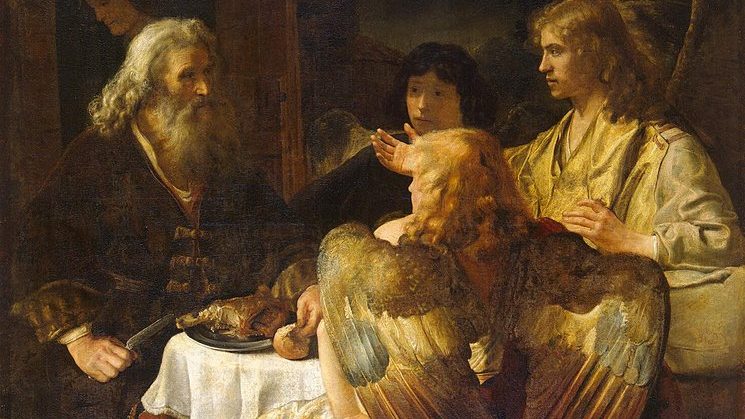
Abraham and the Three Angels by Rembrandt

Turning our attention to Genesis 18,

The LORD appeared to Abraham by the oaks of Mamre, as he sat at the entrance of his tent in the heat of the day. He looked up and saw three men standing near him. When he saw them, he ran from the tent entrance to meet them, and bowed down to the ground.

 He said, “My lord, if I find favor with you, do not pass by your servant. Let a little water be brought, and wash your feet, and rest yourselves under the tree. Let me bring a little bread, that you may refresh yourselves, and after that you may pass on– since you have come to your servant.”

So they said, “Do as you have said.”

 And Abraham hastened into the tent to Sarah, and said, “Make ready quickly three measures of choice flour, knead it, and make cakes.”

(Gen 18:1-6 NRS)

This is middle eastern hospitality in action. This was true not only in Abraham’s time. Many cultures in the middle east still practice the ancient rules of hospitality. Traveling in ancient times was difficult and dangerous. Traveling through a desert presented its own challenges. Hot, dry, and difficult to find water. Abraham is in a place famous for its trees, the oaks of Mamre. Imagine how welcome the shade would have been to travelers.

Abraham sat at the entrance of his tent in the shade in the heat of the day. Three men appeared near his tent. That must have been shocking, to be in your tent and “Holy crap! Where did these men come from?”

Sir, Please, Let Me Serve You

Abraham bowed to them, spoke to the leader as “my lord,” and called himself their servant. Again, this was not at all unusual for that time and place. Saying “my lord” and “your servant” did not mean Abraham recognized the leader immediately as God. It was normal to say this to someone when you offered gifts or hospitality.

The Hebrew word ‘adoni sometimes meant “my lord,” literally. It could also be equivalent to “Sir” (see Translation Notes). Abraham is saying, “Sir, please, do not pass by. Let me show some hospitality to you.” If you see LORD in all capital letters, this is referring to the Divine Name of God (Yahweh). But in this verse, the letters are lowercase.

Abraham tells Sarah they have visitors, and she needs to make some bread for them. Sarah would not have been angry with him for that. In their world, they could have visitors any time, and everyone had their jobs to do when that happened. If you saw people traveling around there, especially in the heat of the day, you knew they would be hot, thirsty, and hungry. He and Sarah flew into action to serve them.

Prepare The Fatted Calf For Them

Abraham ran to the herd, and took a calf, tender and good, and gave it to the servant, who hastened to prepare it. Then he took curds and milk and the calf that he had prepared, and set it before them; and he stood by them under the tree while they ate.

(Gen 18:7-8 NRS)

He didn’t just give them bread and water. He prepared a calf, tender and good, along with curds and milk. Herders like Abraham did not eat meat often. It was reserved for special occasions. When you showed hospitality, you gave your best.

While Abraham was entertaining them, one of the men (presumably God or the Angel of the LORD) revisited the promise of Abraham having a son with Sarah (Gen 17:15-16). God gave Abraham a timeline.

They said to him, “Where is your wife Sarah?”

And he said, “There, in the tent.”

Then one said, “I will surely return to you in due season, and your wife Sarah shall have a son.”

(Gen 18:9-10a NRS)

In due season, the meaning is clearer in the ESV: about this time next year (also NAS, NAB, NIV; see Translation Notes). In the previous chapter, God had told Abraham he and Sarah would have a son of their own at this season next year (Gen 17:21). We were told then that Abraham was ninety-nine, and Sarah was ninety. How much time passed between this passage and Abraham’s last encounter with God in chapter 17? It couldn’t have been long. They are still the same age as in the previous chapter. Was it days or weeks? My guess is they traveled to the oaks of Mamre and were resting there, so it would have been a week or two to travel there.

As Good As Dead

In the New Testament, Paul says at this point Abraham was “as good as dead (for he was about a hundred years old)” (Rom 4:19; see also Heb 11:12).

Paul did not mean he was like, in a wheelchair, barely able to move on his own. He and Sarah were still capable of doing the tasks of living. He bowed, he hastened, and he helped prepare food for the guests. Sarah prepared and baked bread. They weren’t ready for the nursing home. But in terms of his ability to procreate, he was “as good as dead.”

And Sarah was listening at the tent entrance behind him. Now Abraham and Sarah were old, advanced in age; it had ceased to be with Sarah after the manner of women. So Sarah laughed to herself, saying, “After I have grown old, and my husband is old, shall I have pleasure?”

(Gen 18:10b-12 NRS)

It had ceased to be with Sarah after the manner of women (cf. Gen 31:35). Sarah had passed menopause. Remember, she had been barren even during her childbearing years, and now she was past even that.

After I have grown old…shall I have pleasure? They weren’t even having sex anymore, so how was she going to get pregnant (see Translation Notes)? They were still in good shape for their age, better than my grandparents. But should we be at all surprised that Sarah laughed when she heard God say this? Was she laughing because she was surprised, or because it still sounded ridiculous? In other words, is this the first time she has heard this?

What Did Sarah Know And When Did She Know It?

I guess it’s safe to assume Abraham told Sarah what God told him from the previous chapter. He told her about the name changes, because she was introduced as Sarah rather than Sarai. Abraham had circumcised himself and every male of the household, and there was no way he could have hidden that from her. But did he tell her everything?

You know how sometimes when something big happens, but there is one embarrassing or unbelievable detail, you might leave that out when you tell others? Did Abraham leave out that one detail about the two of them having a son? Was he waiting for the right time to spring it on her? We don’t know from the text, but these are some questions you would need to answer to write a fictionalized version of this story.

When Sarah heard this, her reaction was the same as Abraham’s in the previous chapter: She laughed. Perfectly understandable if this is the first time she heard it. If Abraham had told her before, she could have stopped herself from laughing. On the other hand, maybe he did, and she laughed because it still sounded ridiculous. How will God respond?

The LORD said to Abraham, “Why did Sarah laugh, and say, ‘Shall I indeed bear a child, now that I am old?’ Is anything too wonderful for the LORD? At the set time I will return to you, in due season, and Sarah shall have a son.”

But Sarah denied, saying, “I did not laugh”; for she was afraid.

He said, “Oh yes, you did laugh.”

(Gen 18:13-15 NRS)

She Laughs

Sarah and the Three Angels by Marc Chagall

God wasn’t offended when Abraham laughed (17:17ff). Why is God offended at Sarah for laughing? The answer I always heard was that when God made a promise, especially in person, Sarah should not have doubted. But come on, we’re adults here. We all know how babies are made. The text has made it clear. They were in their nineties, and that ship had sailed. And if that’s the reason, again, why wasn’t God offended when Abraham laughed?

No, there was another reason for God to be offended. God was a guest in Abraham’s house (or tent). Remember, in their culture, hospitality to guests was central to their sense of right and wrong. You must be kind and generous, and there was shame if you held back anything from them. Your guest says something, and you laugh at him. Is that kind and generous? Is it hospitable? Even if what he says is 100% certifiably insane, laughing at him was a breach of hospitality.

Not to mention it revealed she was eavesdropping. It probably wasn’t the first time. A stranger visiting your tent was the most exciting thing that could happen in that world. That was how they got their news of what was happening in other places. Of course she wanted to hear what they had to say. I don’t know if eavesdropping would have been a breach of hospitality, but it might have been.

Was God offended at her doubt or her inhospitality? Or maybe something else is going on here.

Why Did Sarah Laugh?

I actually think there was more going on here than God being offended. Let’s compare God’s response to Abraham’s laughter vs. Sarah’s laughter. With Abraham, God repeated the promise and gave his son a name, Isaac. God promised to establish an everlasting covenant with Isaac. Abraham saw then that God was 100% serious, and went home immediately to circumcise himself and every male of his household, because that was what God commanded. And he did it because, as the author of Hebrews says, “he considered him faithful who had promised” (Heb 11:11 NRS).

When Sarah laughed, God said, “Why did Sarah laugh? Is anything too wonderful for the LORD?” As with Abraham, God is telling Sarah this is a promise from the LORD. God is 100% serious about this. And when Sarah denies laughing, God says, “Oh yes, you did laugh.” She is probably doubly embarrassed, first at being called out for laughing, second for being caught in a lie.

But if you’ve been a parent, coach, or teacher, you have probably had moments when your children or students were laughing and joking when you knew they needed to be serious. You may rebuke them mildly, like God here, or you might totally pitch a fit. One way or another, you needed to make clear to them, “This is no joke.”

God doesn’t make promises God can’t or won’t keep. Abraham has already shown he is on board with this plan. Sarah needs to be on board too.

At some time, maybe after he healed from his circumcision, Abraham said, “Sarah? You know how God told us we need to have a son? I think now would be a good time.”

She lifted up his robe and said, “The dead has come back to life!”

The Promise Fulfilled

Sarah and Abraham did indeed have a son. They named him Isaac, as God said (Gen 17:17, 19), because Isaac means “he laughs.” Abraham had laughed when God first told him, and so did Sarah. After he was born, Sarah said,

“God has brought laughter for me; everyone who hears will laugh with me…. Who would ever have said to Abraham that Sarah would nurse children? Yet I have borne him a son in his old age.”

(Gen 21:6-7 NRS)

She laughed again, this time for joy rather than skepticism. And people laughed with her, not at her. The reproach of childlessness was gone. Why did God wait until Abraham and Sarah were both “too old”? A woman who had been barren her whole life, and a man who was “as good as dead” gave birth to a son when he was one hundred and she was ninety-one. Why was it so important for Abraham and Sarah to have a son? The New Testament gives two reasons.

  1. The Gospel of Matthew traces Jesus’ genealogy back to Abraham and Sarah. This was the official beginning of the bloodline that would one day bring the Messiah into the world.
  2. Paul made a point of saying Abraham was “as good as dead” for a reason. It was the first hint that the Messiah himself would be resurrected. The theme of rising from the dead follows Isaac everywhere, as we will see next week in perhaps the most famous episode of Abraham’s story.

Of course, Abraham and Sarah knew none of this. As the author of Hebrews said,

All of these died in faith without having received the promises, but from a distance they saw and greeted them. They confessed that they were strangers and foreigners on the earth, for people who speak in this way make it clear that they are seeking a homeland.

(Heb 11:13-14 NRS)

Seeing From A Distance

Abraham and Sarah lived as strangers and foreigners on the earth. They were promised a homeland for their offspring, but they never received it themselves. They were promised through their seed, all families of the world would be blessed (Gen 12:3). They did not see that happen. But they fulfilled their role in God’s plan to make it happen.

Abraham was seventy-five when God first called him. He was one hundred when Isaac was born. Twenty-five years between the time when God first promised to give him descendants so many they could not be numbered, and the beginning of its fulfillment. Along the way, he and Sarah lost hope at times, they stopped believing at times, and they probably wondered sometimes if Abraham had imagined these encounters with God.

But when God appeared and made it 100% clear exactly what, how, and when the promise would come to pass, they considered the one who promised to be faithful. They trusted that God would not promise something God would not or could not fulfill. That is what faith looks like, according to Abraham and Sarah.

Do not neglect to show hospitality to strangers, for thereby some have entertained angels unawares.

(Heb 13:2 ESV)

Translation Notes

Then one said, “I will surely return to you in due season,[כָּעֵ֣ת חַיָּ֔ה] and your wife Sarah shall have a son.”

And Sarah was listening at the tent entrance behind him

(Gen 18:10 NRS)

In due season. In Hebrew, the phrase is ka`eth chayyah. A literal translation would be “according to the time of life” (KJV), or “when the time revives” (NAS study note). I don’t know what that means, but I like the poetry of it.

NAS translates it, “at this time next year.” Halladay justifies that translation.

Hol2487  חַי

4. var.: Gn 1810•14 2K 416 a year from now.

(pg 101)

God repeats this promise in verse 14, adding “at the appointed time” לַמּוֹעֵ֞ד (WTT) (la-mo`ed) to “at this time next year” (ka`eth chayyah).

My Husband Or My Lord?

“After I have grown old, and my husband is old, shall I have pleasure?”

(Gen 18:12 NRS)

My husband, HEB ‘adoni, lit. “my lord.” In 1 Peter, we read this:

Thus Sarah obeyed Abraham and called him lord. You have become her daughters as long as you do what is good and never let fears alarm you.

(1Pe 3:6 NRS)

This is part of a section where Peter admonishes wives to accept the authority of their husbands. I’m not sure he should have picked Sarah as an example of that. He may have been her lord legally. But as my wife once said to me, if I tried to be her “lord,” I would have my hands full. I don’t think Sarah was the type of woman anyone could easily boss around. Remember, her name meant “princess” or “queen.”

As I said earlier, “my lord” wasn’t always literal. Sometimes it was equivalent to “sir” (18:3). Sometimes a woman’s husband would be called her “lord,” but in that context it means “husband,” not necessarily “lord.”

Paul tells us that by faith in Christ, we have become Abraham’s offspring (Gal 3:29). But Peter also says women can be Sarah’s daughters by doing good and not letting fears alarm you. I think that’s a good takeaway.

Shall I Have Pleasure?

The Hebrew word for pleasure here is `ednah.

Hol6102  עֶדְנָה  (noun common feminine singular absolute) (sexual) pleasure Gn 1812. †

(pg 266)

I think it says a lot about Sarah that when God promises she will bear a son, her first thought is of `ednah, translated “pleasure.” Holladay notes it refers specifically to sexual pleasure. (By the way, I don’t think I will ever look at any woman named Edna the same way again). She was a woman who owned her sexuality and enjoyed it. In the Bible and in many conservative Christian and Jewish traditions, that is the most dangerous woman there is. Stay away from her, they warned their sons, as in Proverbs:

For the lips of a loose woman drip honey, and her speech is smoother than oil; but in the end she is bitter as wormwood, sharp as a two-edged sword. Her feet go down to death; her steps follow the path to Sheol.

(Pro 5:3-5 NRS)

 Sheol is a Hebrew word for the underworld, the place where all souls go after they die. It wasn’t thought of as Hell originally, but it took on that meaning in some translations. So is that last verse saying, her steps follow the “Highway to Hell”?

If Sarah could have sung “Highway to Hell”

Seriously, though, Sarah’s first thought about sex was not childbearing but pleasure. She thought that pleasure was lost to her, so it was probably with some nostalgia she said, “After I have grown old, and my husband is old, shall I have pleasure?”

A Mitzvah Is Not For Pleasure

To orthodox Jews and some longstanding Catholic traditions, that is sinful. The primary purpose of sex was (and is) to conceive and bear children. Any sex that was done for pleasure rather than procreation was a sin. Engaging in any sexual activity that could not result in having children (pulling out, birth control, masturbation, put your dirty little mind to it and you can think of other acts) was and, in some traditions, still is forbidden. That included having sex with an infertile woman. How do they reconcile that with Sarah? Or Rachel? Or Hannah? Or the mother of Samson? Or Elizabeth, mother of John the Baptist?

Not surprisingly, there is extensive discussion on this in Rabbinic Jewish tradition. That may be a topic of a future post. For now the point is the way conservative Western traditions have viewed women’s sexuality is like this:

  1. The man and woman were commanded to be fruitful and multiply (Gen 1:28). It is a mitzvah (command from God) for a husband and wife to have sex, so they can bear children.
  2. The mitzvah is to procreate, not to do it for pleasure.
  3. Men did not trust women who had sex for pleasure, even if it was with their husbands.
  4. Women could not be trusted to control their own desire. So her father controlled it before she was married, and her husband controlled it after.
  5. Having sex for pleasure makes you no better than an animal.

Give Me That Old(er) Time Religion

Sarah enjoyed sex with her husband and saw nothing wrong with that. We must assume Abraham did as well, since he saw no need to “control her urges.” She and Abraham used sex to enhance their relationship apart from childbirth, until they were not able. Even at ninety years old, she remembered it as pleasure. And she thought of it right in God’s presence. Sinner! God must have been furious!

Not exactly. God reprimanded her for laughing at the idea of having a child. God did NOT reprimand her for thinking of her pleasure. God told her in effect, “Yes, even at this age, you and your husband will have pleasure again. This time, you will be fruitful and multiply.”

Christianity and Judaism trace their origins to Abraham and Sarah. It’s a shame that for much of our history, we did not learn from how they approached sex as husband and wife.

The Original Handmaid’s Tale, Part 2: God Hears Hagar

Moira in handmaid's uniform, let them think they control you
Samira Wiley plays Moira on The Handmaid’s Tale on Hulu

Part one of this character study showed how Sarai and Hagar mirror Serena and June in The Handmaid’s Tale. That post ended with Hagar running away from Sarai. Problem was she was running through a desert. Out there in the middle of nowhere, she finds a spring of water. I’m guessing not a moment too soon. And then she receives an unusual visitor.

The angel of the LORD found her by a spring of water in the wilderness, the spring on the way to Shur.

(Gen 16:7 NRS)

Who is the angel of the LORD? It appears a few times in the Bible. Sometimes when God wanted to appear to someone, the angel of the LORD showed up there instead. This Angel seems to be a divine figure who can stand in for God when God’s personal appearance would be impractical. Some Christian commentators believe it was a pre-Incarnate manifestation of Christ.

In the ancient world, people believed no mortal human could look on God’s face and live (v. 13; cf. Exo 33:20). It wouldn’t do if God wanted to give a message to someone, and they died the moment God appeared to them, would it? It seems, though, the Angel could speak to people face to face safely (cf. Gen 32:30; Jud 13:22). Are these direct encounters with God or with the angel of the LORD? It’s hard to know just from the text. But the Angel speaks to Hagar.

And he said, “Hagar, slave-girl of Sarai, where have you come from and where are you going?”

She said, “I am running away from my mistress Sarai.”

The angel of the LORD said to her, “Return to your mistress, and submit to her.”

(Gen 16:8-9)

I know what you’re thinking. This is not God endorsing slavery or Sarai’s harsh treatment. You’ll see that when we talk about the story in its context. Keep reading.

The angel of the LORD also said to her, “I will so greatly multiply your offspring that they cannot be counted for multitude.”

And the angel of the LORD said to her, “Now you have conceived and shall bear a son; you shall call him Ishmael, for the LORD has given heed to your affliction. He shall be a wild ass of a man, with his hand against everyone, and everyone’s hand against him; and he shall live at odds with all his kin.”

(16:10-12)

What are you thinking now? Gee, thanks God (for nothing). Again, context makes all the difference. There’s a reason God says this. Keep reading.

So she named the LORD who spoke to her, “You are El-roi”; for she said, “Have I really seen God and remained alive after seeing him?”

(16:13)

This goes back to what I said about the angel of the LORD earlier. She is surprised (shocked, probably) that she saw God and was still alive. She believes it was God, but we are told it was the angel of the LORD. Which was it? In scenes like this, the text is usually ambiguous about it, like when Jacob wrestled the Angel. Or was it God (Gen 32:30)?

{Fun Fact}

Remember in Raiders of the Lost Ark when Indiana Jones tells his girlfriend to close her eyes and not look? While they kept their eyes closed, everyone else melted in the LORD’s presence like statues at Madame Tussaud’s Wax Museum. How did he know anyone who looked at God would die? My favorite line in the movie: “Didn’t you boys go to Sunday School?” {End Spoiler}

Indiana Jones and his girlfriend don't look
No matter what happens, don’t look!

“God Who Sees Me”

Finally, we should notice that she gives God a name. I can’t think of anyone else in the Bible who both saw God and gave God a name. Jacob asked for God’s name, but the Angel would not give it to him (Gen 32:29). God’s name to the Jews was (and still is) too holy to speak, so this is remarkable. NRSV notes say El-roi means “God of seeing” or “God who sees.” Some translations say “the God who sees me” (see Translation Notes below, if you’re into dissecting Hebrew and Greek).

For Hagar, her reason for the name is that she “has seen God and remained alive.” That stresses her seeing God, so by that reckoning, we might translate it “the God who appeared to me.” In context, either meaning would fit. God has both “seen her” and “appeared to her,” and she lives. This is a God who subverts common expectations.

I like “God who sees (me),” because it pairs well with her son’s name, “God hears.” Putting seeing and hearing together also echoes what God said to Moses when God sent him to deliver the people of Israel:

Then the LORD said, “I have observed (or seen) the misery of my people who are in Egypt; I have heard their cry on account of their taskmasters. Indeed, I know their sufferings, and I have come down to deliver them from the Egyptians”

(Exo 3:7-8a NRS)

God saw Hagar and heard her. God knew her sufferings and answered to her cry. Then the author tells us the name of the well where she saw God still bears the name of this encounter.

Therefore the well was called Beer-lahai-roi; it lies between Kadesh and Bered.

(Gen 16:14 NRS)

NRSV study notes say Beer-lahai-roi means “the well of the Living One who sees me.” Beer is not beer like we think of. It is the Hebrew word for well (sorry). The Living One was sometimes used to refer to God. In an earlier post, I discussed the promise that Abraham and Sarah would have their own son and name him Isaac. A little side note here: After Abraham dies, Isaac lives in Beer-lahai-roi for a time (Gen 25:11). Did he know the history it represented for Hagar and Ishmael?

Did God Really Bless Hagar?

There are still probably two big questions on your mind right now.

  1. Why did God tell Hagar, Return to your mistress and submit to her?
  2. Was verse 12 a blessing or a curse? This story is a perfect illustration of why it is so important to read the Bible in its original context.

Why Did God Tell Hagar to Return to Her Mistress and Submit to Her?

Think about Hagar’s situation here. When the Angel asks her, Where are you coming from and where are you going, she has an answer for the first question (I am running away from my mistress) but not the second. This was obviously an impulsive decision. She had no plan for how to escape beyond running away. What are her options?

  • A. Try to survive alone in the wilderness while pregnant. And when the baby comes, give birth with no one to help her. Then try to figure a way to provide the needs of her and her baby out in a hot dry place with no food and no shelter, and predatory animals who would love to make a meal of them, if she has survived that long.
  • B. Return to her mistress and submit to her.

This was not a blanket approval of slavery. All the Angel is telling her is B is preferable to A. There, the basic needs for her and her baby—food, clothing, shelter, water, and safety from wild animals—will be met. If she is submissive toward Sarai, she will most likely be less harsh with her. This is a survival strategy, one which slaves throughout history adopted. But God/the Angel gives her a reason to survive. God has a destiny and a promise for the son she is carrying.

I will so greatly multiply your offspring that they cannot be counted for multitude. The same promise God gave to Abram’s seed, which he is, a son of Abram’s own issue. God gives him a name, and I talked in an earlier post about the significance of God naming someone.

You shall call him Ishmael, for the LORD has given heed to your affliction. Ishmael in Hebrew comes from shema`, meaning “hear,” and ‘El, meaning “God.” So the name means, “God hears.” If she ever needs to be reminded that God hears her in her affliction, it’s right there in her son’s name.

Now we come to verse 12 and the second question from above.

Was Verse 12 a Blessing or a Curse?

To review, verse 12 says, “He shall be a wild ass of a man, with his hand against everyone, and everyone’s hand against him; and he shall live at odds with all his kin.”

Ladies, how would you feel if God appeared to you while you were pregnant to tell you this? Would you wonder why God was punishing you? Before you judge, remember Hagar’s circumstances were very different from yours. How would she have heard this?

He shall be a wild ass of a man. He will be strong, independent, and able to survive in harsh conditions.

…with his hand against everyone, and everyone’s hand against him. He will bow down to no master. He will enjoy the freedom and autonomy she longs for.

…and he shall live at odds with all his kin. She might not like the idea of him being at odds with her, but who else are his kin? Abram. Sarai by law, though not by blood. Anyone related to Abram. She knows they will not fully accept him, so why shouldn’t his hand be against them?

Legally, he will belong to Sarai. But Hagar will always be his mother by blood. He will feel that tension along with her, and it will come back on Abram and Sarai’s heads. He will not be a compliant child like a “good slave” should. She will be there to teach him the destiny God has for him, and that destiny is freedom from anyone who would make him a slave. What better justice could she ask for?

Nolite Te Bastardes Carborundum

This is Latin for “Don’t let the bastards grind you down,” and it is a line that helps Offred in The Handmaid’s Tale. I can’t help thinking this would have resonated with Hagar.

I can picture the scene. Ishmael is a toddler. Hagar is playing Pattycake—or whatever games they played with little children back then. Sarai comes in and says, “I’ll take him now.” Ishmael lifts up his arms, and she picks him up. Abram tousles his hair affectionately. Sarai carries him out, saying, “What a sweet boy.”

And all the while, Hagar is thinking, “So, my master and mistress, you think he is the answer to your prayers. No, he is the answer to my prayers. You think he is sweet now? Just wait until he grows up,” and she laughs. “Just you wait.”


Do you see now what a difference reading in context makes? To our modern ears, the Angel’s words sound like a curse. But for a slave-girl like Hagar, in the land of Canaan somewhere around 2000 BC, these words were life.

The Angel gave her a strategy for survival—submit to her mistress. That would not be easy for her, but it would ensure both her survival and her son’s. And the Angel gave a promise worth living for—her son would be a free man. For the sake of that promise, she accepted slavery for herself.

Abraham was commended in Hebrews 11 “because he considered him faithful who had promised” (Heb 11:11 NRS). So did Hagar, which again tells me she should have been included in the “heroes of the faith” in Hebrews 11.

Translation Notes (for Bible Geeks Like Me)

So she named the LORD who spoke to her, “You are El-roi”; for she said, “Have I really seen God and remained alive after seeing him?” (Gen 16:13 NRS)

The translation of El-roi is uncertain in the Hebrew. WTM (The standard Hebrew text) includes a note that says ro’i is a noun (Masculine Singular Absolute) and can mean “appearance” or “appearing.” This might give the translation, “God who appears to me.” When Hagar comments she saw God and lived, that would point to God appearing to her rather than seeing her.

BDB (the standard Hebrew lexicon) says it generally means “looking, seeing, or sight.” It translates the name as “God who sees,” which would be appropriate, because God sees Hagar’s affliction.

However, KJV, NAS, and NIV translate it as “the God who sees me.” The entry for Job 7:8, same word and form, says it is a Verb, Qal Participle (Masculine Singular Construct), with a 1st person suffix, which would affirm that translation. It is also how the LXX (Septuagint) translates it.

 ὁ θεὸς ὁ ἐπιδών με  (Gen 16:13 BGT); ho theos ho epidon me.

ἐπιδών verb (participle aorist active nominative masculine singular) from ἐφοράω fix one’s glance upon, look at, concern oneself (with) Lk 1:25; Ac 4:29.* [pg 71]

The Septuagint adds the personal pronoun me, which shows they understood El-roi to mean “the God who looks at me,” or “the God who sees me.” We see another example in Job 7:8.

The eye of him who sees me will behold me no more; while your eyes are on me, I shall be gone.

(Job 7:8 ESV).

Ro’i is translated him who sees me. So it appears we have either “God who appears to me,” or “God who sees me.” The verb could also be Past tense rather than present, so it could also mean “God who appeared to me,” or “God who saw me.”

Handmaid's Tale, Offred and Offglen shopping in the Loaves and Fishes grocery store

Sarai and Hagar: The Original Handmaid’s Tale (Genesis Chapter 16)

When I’m analyzing characters or stories, I don’t necessarily go in chronological order. Last week we were in chapter 17 of Genesis. This week we will look at chapter 16. With the TV version of Margaret Atwood’s Handmaid’s Tale starting a new season on Hulu, I thought this would be an interesting scene for many people.

Genesis Chapter 16

In chapter 15, God promised to give Abram a son “of his own issue,” and to give all the land of Canaan to his descendants. Chapter 16 picks up about ten years later. Abram and Sarai have been trying to have a child, and they are no spring chickens. Abram was 75 and Sarai was 66 when God first made that promise. Sarai never had a child of her own, even when she was young. Now they are 85 and 76, respectively. Sarai is afraid if Abram is limited to her, he will never have a son of his own issue, no matter what God said. To borrow a phrase from Atwood, no matter how many times she said, “Blessed be the fruit,” the LORD was not opening. So she approached her husband.

Handmaid's Tale, Offred and Offglen shopping in the Loaves and Fishes grocery store.
A scene from the Loaves and Fishes grocery store

Now Sarai, Abram’s wife, bore him no children. She had an Egyptian slave-girl whose name was Hagar, and Sarai said to Abram, “You see that the LORD has prevented me from bearing children; go in to my slave-girl; it may be that I shall obtain children by her.”

(Gen 16:1- 2 NRS)

Hagar is Sarai’s slave-girl, also called a handmaid. In Abram and Sarai’s culture, this seems to have been an accepted practice. If a man’s wife was unable to conceive, the man could obtain children through his wife’s slave (presumably, if the wife permitted it). But as we already know, Abram did not weaken in faith when he considered his own body or the barrenness of Sarai’s womb. So he told Sarai, “Just calm down now. God promised us a child, and God is faithful to fulfill God’s promises. We don’t need a plan B.” You know I’m kidding, right?

And Abram listened to the voice of Sarai. So, after Abram had lived ten years in the land of Canaan, Sarai, Abram’s wife, took Hagar the Egyptian, her slave-girl, and gave her to her husband Abram as a wife.

(Gen 16:3 NRS)

…and [Sarai] gave her to her husband Abram as a wife? I doubt that “wife” is a good translation here, because clearly in the rest of the story, Sarai was Abram’s one and only wife. She would not have let Hagar forget that. Perhaps “concubine” is more accurate.

A lot of people look at them in this situation and think, “Why did Abram and Sarai not trust God? God promised Abram would have a son.”

Here is the problem. God told Abram he would have a son “of his own issue,” but God did not specify it would be through Sarai (15:4). It has been ten years since the promise, and still Sarai is barren. He is now eighty-five, and she is seventy-six. Marriage contracts recovered from this period often included a provision that if a wife was not able to deliver a son after ten years, she must supply a handmaid to give him a son. The original audience would have recognized this. They would have thought this was why Sarai was coming to him now with this offer.

What Could Possibly Go Wrong?

He went in to Hagar, and she conceived; and when she saw that she had conceived, she looked with contempt on her mistress. Then Sarai said to Abram, “May the wrong done to me be on you! I gave my slave-girl to your embrace, and when she saw that she had conceived, she looked on me with contempt. May the LORD judge between you and me!”

(16:4-5)

Okay, if I’m Abram, at this point, my first thought is, “Oh, it’s all my fault? And whose idea was this in the first place?” And how she describes the wrong done to me, when you look at it in the Hebrew, reveals a lot about her.

The Hebrew word for “wrong” here is chamas. It is occasionally translated “wrong” in a general sense. But more often, it means specifically “violence.” For example, Jeremiah says this to Babylon after they conquered Jerusalem: “’May the violence done to me and to my flesh be upon Babylon,’ The inhabitant of Zion will say” (Jer 51:35 NAS).

One of the authors of the Psalms says, “Their mischief returns upon their own heads, and on their own heads their violence descends” (Psa 7:16 NRS).

Abimelech, one of Gideon’s sons, killed all seventy of his siblings with the help of the men of Shechem to make himself his father’s heir. But later, the men of Shechem “dealt treacherously with Abimelech … so that the violence done to the sons of Jerubbaal (Gideon) might be avenged” (Jud 9:23-24).

The word for “violence” in all these passages is chamas. Sarai equated the wrong Hagar was doing to her with mass murder.

May the LORD judge between you and me.

People only used this expression when they were 100% sure that the wrong, or the violence, done to them had no cause or justification. The responsibility of the other party was so obvious, they knew God was on their side (cf. 1 Sa 24:12, 15; Exo 5:21; Jud 11:27).

If you invoke God to judge between you and another, you’d better be right, because God will judge justly and with no partiality. I don’t buy for one second that Sarai did nothing to provoke Hagar in this. And Abram bears some responsibility, but certainly not all of it, as she claims. Hagar may have done wrong to her, but Sarai not even considering the wrong she did to Hagar.

Abram gives her the same advice a wealthy slaveowner would give.

But Abram said to Sarai, “Your slave-girl is in your power; do to her as you please.” Then Sarai dealt harshly with her, and she ran away from her.

(Gen 16:6)

“Sarai, dear, did you forget who is the master and who is the slave? You don’t have to take it from her if you don’t want to.”

And Sarai is like, “Oh yeah. Time to remind her who the queen of this household really is.” She strikes back at Hagar, and Hagar runs away.

What Are We To Think of Hagar?

When [Hagar] saw that she had conceived, she looked with contempt on her mistress. Why is she looking with contempt on her mistress? Because she’s just a “B-word, rhymes with witch”? That is a question you really have to think about if you intend to turn this episode into a fictionalized account, especially if you want it to be as good as Atwood’s Handmaid’s Tale. You would have to consider her situation and how that would affect her attitude. You would have to flesh out just how she showed contempt for her mistress in what she said and did. And then you would have to flesh out what Sarai did when she dealt harshly with her. Whatever it was, it would have to be bad enough to make her run away, while pregnant, with nothing but desert around her.

Let’s start with that question, “Why is she looking with contempt on her mistress?” You could go with the B-word explanation, but that would ignore critical details about Hagar’s situation. She is a slave. She has already experienced the dehumanization of being sold or given to Abram and Sarai like a piece of chattel and taken from her home in Egypt (Gen 12:16-13:2). Then she is told her master will come in and lie with her, because her mistress decided that for her. Did they ask her if she would help with their fertility problems? She might have been willing if they had asked, and she saw how desperate they were to have a child.

Today, some women are willing to be surrogates for infertile couples. They negotiate the terms of conception (usually in-vitro, but that was not an option then) and what kind of care or compensation they receive. Hagar never had that chance. You didn’t negotiate with your slaves. You ordered them. “My husband needs to have a son. The LORD has withheld me from having children, so you’re going to do it in my place.” That was the negotiation.

Abram and Sarai saw nothing wrong with this. Your slave-girl is in your power. You can do with her as you please (Gen 16:6). They expected Hagar to accept this, because that was the way it was in their world. Many other slaves had to do the same, and they accepted it. It probably never even occurred to them she might have feelings about this. The most intimate decisions regarding her own body were taken from her, and something in her knew it was wrong. She would not accept the status of being property and not human. Like most slaves, she obeyed out of self-preservation.

The Handmaid's Tale, Madeline Brewer's character Janine, caption reads: Your body is no longer your own.

But when she conceived, that gave her a leg up on Sarai. She finally had a chance to let out the resentment she had kept inside, because, Don’t upset me. You don’t want to hurt the baby I’m carrying. Her resentment was not just at Sarai and Abram. It was at the whole system that did not recognize her rights as a woman or as a human being. Let’s not sugarcoat it. What was done to her was legitimized rape. Should we be surprised she showed contempt for her mistress?

And yes, it was no different for her than for countless other slaves. You could legally do anything to your slave you wished. They did not recognize at that time that slaves were human, made in the image of God, and as such had certain inalienable rights. Hagar was one of those independent souls who, over time, forced us to come to terms with an entire institution whose purpose was to dehumanize others. If you ask me, she should have been on that list of heroes of the faith in Hebrews 11.

Serena and June Anyone?

If you’re familiar with The Handmaid’s Tale, you probably think this saga between Sarai and Hagar sounds like the relationship between Serena and June. June went along with the system in Gilead she was forced into, but she resented it. She resented the system that took away her husband, took her daughter away, made her the handmaid of Serena and Fred Waterford, and in every way possible told her that her only value was her ability to receive Mr. Waterford’s seed, get pregnant, and bear a child for Mrs. Waterford. The child she was forced to conceive would not even be hers. It belonged to Fred and Serena. It was primarily for Serena’s benefit, because she could not have children of her own. June’s family, career, autonomy, and even her name were taken from her, so a wealthy, powerful, childless family could use her womb, and she had no say in it.

There are a few moments of connection between her and Serena, but Serena is mostly harsh with her. She’s a little jealous that June can give her husband something she can’t and takes that frustration out on her. June engages in little acts of defiance, quietly, and mostly behind their backs, but gradually she becomes bolder with it, especially after she conceives. She milks the concern for the baby for all its worth. And she aims some insults right at Serena’s greatest insecurities.

In her introduction to the novel, Atwood does not name this particular scene but rather the episode where Rachel gives her handmaid Bilhah to her husband Jacob, so she can have children (Genesis 30:1-8). But as I described the characters of Serena and June, don’t they sound just like Sarai and Hagar? I’m not knocking Atwood for lifting these characters from the pages of the Bible. On the contrary, I think what she did is a fantastic example of the potential of Biblical Fiction for creating compelling drama.

Biblical Fiction Vs. Christian Fiction

The Handmaid’s Tale is not Christian Fiction, in case you were wondering. There’s too much sex, cursing, and graphic violence for it to be Christian Fiction. Biblical Fiction, you have to understand, is not the same as Christian Fiction. Christian Fiction has strict rules about what kind of worldview and morality your characters can present and endorse. Characters can be morally ambiguous at first, but in Christian Fiction, they usually convert to a Christian worldview and morality by the end. But in this Biblical text all of the characters are morally ambiguous, and there is no “conversion” for any of them. Biblical Fiction does not have to follow the same rules as Christian Fiction, because the Bible doesn’t.

Atwood (perhaps unwittingly) took these characters from the Bible and placed them in a modern dystopian setting with new names. She did not take the Christian approach of turning Abraham and Sarah into heroes and Hagar into a villain. She kept all of their moral ambiguities intact. That is why Atwood’s story works so well. Her approach not only makes the characters more believable and human. It is a more faithful rendering of the Biblical text than the rules of Christian Fiction would allow. It highlights how unjust and dehumanizing the society of Gilead is. June acts like a fiercely independent handmaid would in a society like Gilead, and so does Hagar. The Waterfords act like members of a privileged class would act, and so do Abram and Sarai.

This is getting a little long, so I’ll continue this in the next post.

###

Remember Hagar ran away to escape Sarai’s harsh treatment? What happened to her? The saga continues in the next part of this character study. If you are interested in buying a copy of The Handmaid’s Tale, you can follow my affiliate link here. My “Recommended” page has links to this and other excellent examples of Biblical Fiction.

Handmaid's Tale meme: Grocery store, Blessed be the fruit. May the Lord open.

Character Study—Abraham’s Covenant, Blessing or Curse? (Genesis 17)

Continuing my character study of Abraham, I’m picking up in Genesis, chapter 17. Back in Chapter 15, God made a covenant where God promised to give Abraham a son “of his own issue,” that he would be great, his name would be great, his descendants would be as numerous as the stars in heaven, and God would give all the land of Canaan to his descendants. God appears to Abraham again in chapter 17.

When Abram was ninety-nine years old, the LORD appeared to Abram, and said to him, “I am God Almighty; walk before me, and be blameless. And I will make my covenant between me and you, and will make you exceedingly numerous.”

(Gen 17:1-2 NRS)
map of near east in time of patriarchs

The last time the LORD appeared to Abram, he was 75 years old. Now, he is 99. There has been an interesting development in between. He has had a son of his own issue, as God promised, but not by his wife. Ten years after that covenant and promise, Sarai still had borne no children. She told Abram to go in to her handmaid, Hagar, saying, “It may be that I shall obtain children by her” (16:2). He did, and she did.

Hagar had a son named Ishmael. The slave girl gave Abram a son, but his own wife could not. That led to the slave girl lording over her mistress. If you think this sounds like The Handmaid’s Tale, you’re right. Margaret Atwood got that story from stories like this in the Bible. Yes, I used the plural, “stories.” There are more. But right now, what concerns us is Abram and Sarai, because they still have not had a child together. And it looks like that ship has sailed, because they may have had an active sex life into their eighties, but it is over now (Gen 18:11-12). Sarah has passed menopause. So what is God doing, appearing to Abram again, after twenty-four years, and talking about making Abram exceedingly numerous?

Another thing. Why is God saying I will make my
covenant between me and you
? God already made a covenant with the promise of numerous descendants in chapter 15. This is one of those moments that make some scholars think there were two traditions about the origins of God’s covenant with Abraham. You can make an argument for it, but you can also make an argument that the rivalry between Sarai and Hagar required God to appear again and clarify exactly what God meant. He was supposed to have a child with
Sarai
. But if Abram is ninety-nine years old, that makes Sarai ninety. And God is going to talk now about them having a son together? Sounds like God should have clarified this sooner.

Then Abram fell on his face; and God said to him, “As for me, this is my covenant with you: You shall be the ancestor of a multitude of nations. No longer shall your name be Abram, but your name shall be Abraham; for I have made you the ancestor of a multitude of nations. I will make you exceedingly fruitful; and I will make nations of you, and kings shall come from you.

“I will establish my covenant between me and you, and your offspring after you throughout their generations, for an everlasting covenant, to be God to you and to your offspring after you. And I will give to you, and to your offspring after you, the land where you are now an alien, all the land of Canaan, for a perpetual holding; and I will be their God.”

 (Gen 17:3-8 NRS)

God promises Abram he will have many descendants, so many that he will be the ancestor of a multitude of nations. God promises again to give the land of Canaan to his descendants. And his descendants will inherit the promises of this covenant. Sounds very similar to what God promised in chapter 15, but there’s more this time.

I will make you exceedingly fruitful. This is going to be very important if he expects Abram to have a son at ninety-nine years of age.

No longer shall your name be Abram, but your name shall be Abraham; for I have made you the ancestor of a multitude of nations. This is why we call him Abraham, not Abram. God either giving a name or changing a name is a motif we see a few times in the Bible. A person’s name had great significance in the ancient world. So for God to give someone a new name was almost like being born again.

When God gives someone a name, whether it’s a newborn baby, a man, or woman, the name says something significant about the essence of their identity. Abram meant “exalted father.” That could be a good name for a man who needed to bear sons. But that had not been good enough. People must have started thinking of it as an honorary name, not literally. With Abraham, God takes the promise of fatherhood up a notch, “Father of a multitude.”

Abram couldn’t have children. Abram was ninety-nine. Abram’s body was as good as dead as far as being able to procreate.

This was like God saying, “Forget about Abram. I have made you Abraham, “father of a multitude.” That is what you will be called from now on.”

“So you’re promising I will be the ‘Father of a Multitude’? How are you going to do that?”

“The same way I created the heavens and the earth. By speaking it.”

God is making the same promises to Abraham as in Chapter 15. But this time, God is doubling down. God gave him a new name, a name that says he will be exceedingly fruitful, the father of a multitude of nations. From now on, anytime someone says, “Father of a Multitude,” Abraham will say, “Yes?” So far, he does not seem to be weakening in faith (as Paul said, Rom 4:19).

What Do You Mean by Circumcised?

I wonder how Abraham reacted to what God said next. God tells him to put the mark of this covenant in his own body.

God said to Abraham, “As for you, you shall keep my covenant, you and your offspring after you throughout their generations. This is my covenant, which you shall keep, between me and you and your offspring after you: Every male among you shall be circumcised. You shall circumcise the flesh of your foreskins, and it shall be a sign of the covenant between me and you.

“Throughout your generations every male among you shall be circumcised when he is eight days old, including the slave born in your house and the one bought with your money from any foreigner who is not of your offspring. Both the slave born in your house and the one bought with your money must be circumcised. So shall my covenant be in your flesh an everlasting covenant.

“Any uncircumcised male who is not circumcised in the flesh of his foreskin shall be cut off from his people; he has broken my covenant.”

(Gen 17:9-14 NRS)

“Are you serious, God? Can’t we split some animals in half like last time?” I doubt he was enthusiastic about this, but he obeyed. It’s interesting that the part of Abraham’s body that was “as good as dead” is exactly where God tells him to cut the mark of this covenant. This might have given Abraham the psychological boost he needed to believe that what was dead could come back to life.

So God has made a promise to overcome Abraham’s physical limitations. But if God wants Abraham to have a child by his barren, ninety-year-old wife, he’d better address Sarai’s physical limitations as well.

Sarai’s Turn

God said to Abraham, “As for Sarai your wife, you shall not call her Sarai, but Sarah shall be her name. I will bless her, and moreover I will give you a son by her. I will bless her, and she shall give rise to nations; kings of peoples shall come from her.”

(Gen 17:15-16 NRS)

Just like with Abraham, God gives Sarai a new name. That is why we call her Sarah today. Sarai meant “Princess,” and so did Sarah, according to my study notes. It appears there was no difference in meaning, but I think there must have been a subtle difference that got lost in translation. And I think whatever the difference was, somehow it addressed her infertility.

Last time, God told him he would have a son by “his own issue” but did not say how or by who. He had a son, Ishmael, by his wife’s slave, Hagar. Until now, whatever hope he had for his descendants appeared to be tied to Ishmael. Abraham even says, “Oh that Ishmael might live in your sight” (v. 18). For whatever reason, Ishmael does not seem to be living up to the expectations of being the son of a man in covenant with God.

This time God gets specific. The heirs to Abraham’s covenant are not just Abraham’s issue. They are of Abraham’s issue and Sarah’s womb. Let’s see if Abraham is this paragon of indomitable belief as Paul told us.

He Laughs

Then Abraham fell on his face and laughed, and said to himself, “Can a child be born to a man who is a hundred years old? Can Sarah, who is ninety years old, bear a child?”

 (Gen 17:17 NRS)

Okay, that doesn’t sound like he “did not weaken in faith.” He reacted the same way we would have. “God, you have got to be kidding.” They were not only infertile. They weren’t even having sex anymore (Gen 18:12). How are they supposed to have a child? But God tells Abraham this is real.

God said, “No, but your wife Sarah shall bear you a son, and you shall name him Isaac. I will establish my covenant with him as an everlasting covenant for his offspring after him.

(Gen 17:19 NRS)

I can never read this without thinking about my grandparents, so I’m going off on a personal tangent now.

Off on a Tangent

My grandparents both died at 93. The last several years, my grandfather had dementia. When you walked in to see him, you never knew what you were walking into. He had about 10 different soap operas running in his head, and you didn’t know which one you were in at the moment. One time, he said to my mother, “This woman told me she’s pregnant, and I’m the father.”

She’s like, Oh Lord, what am I supposed to do with this? “Well, you know, this is bad.”

“I know!”

“Rosa (my grandmother) is gonna be really mad.”

“I know!”

This is not real, of course. But you couldn’t tell him that. So my mother says, “Daddy, how old are you?”

“Eighty-nine.”

“Do you think this woman is pulling your leg?”

(Gasp!) “I never thought of that.”

He was eighty-nine, and the idea that he could have impregnated any woman was utterly ridiculous. The idea that he could have impregnated his eighty-nine year old wife was utterly ridiculous. The idea that she could have become pregnant at eighty-nine by any man was utterly ridiculous. And even if they could, that doesn’t mean they should. If he had got her pregnant, that would not have been a blessing. That would have been a curse.

Back to the Text

I really want to go in here now and tell God to stop. Just because you can make Abraham and Sarah parents at this insane age doesn’t mean you should. But Abraham and Sarah were okay with it. In this case, their opinions count more than mine. But I wouldn’t blame Abraham if he was thinking, “Okay, you keep making this promise of a son and many descendants. I have one son, but you still want me to have another? With Sarah? I’m ninety-nine now. She’s ninety. She’s been through menopause, and I can’t even get it up anymore. If this was so important, why didn’t you make it happen sooner? It’s time to put up or shut up.”

God means for Abraham to have a son through his wife, Sarah. He won’t need a surrogate. And God waited until Abraham was ninety-nine and Sarah was ninety to make this absolutely clear. No wonder Abraham laughed. Just as God renamed Abraham and Sarah, God gives a name to their yet unborn son, Isaac. Isaac, by the way, means “he laughs.” This son will remind Abraham that he laughed at God’s promise.

Did He Weaken in Faith?

So was Paul correct when he said this in Romans?

He did not weaken in faith when he considered his own body, which was already as good as dead (for he was about a hundred years old), or when he considered the barrenness of Sarah’s womb. No distrust made him waver concerning the promise of God, but he grew strong in his faith as he gave glory to God, being fully convinced that God was able to do what he had promised. Therefore his faith “was reckoned to him as righteousness.”

 (Rom 4:19-22 NRS)

Paul actually conflated the two episodes of Genesis, chapters 15 and 17, as if they were one. It was in Genesis 15 when Abraham’s faith “was reckoned to him as righteousness” (Gen 15:6). His body was not “as good as dead” yet. We know because he had a child by Hagar in chapter 16. Genesis 17 is when he was “as good as dead (for he was about a hundred years old).” In chapter 15, he “did not waver concerning the promise of God,” but he was seventy-five, not a hundred. When he was a hundred, he did waver concerning the promise of God (Gen 17:18). He even laughed at the promise of God.

he grew strong in his faith as he gave glory to God, being fully convinced that God was able to do what he had promised. It’s not that he had no doubt. Clearly, he did when you read the accounts in Genesis. But he believed the promise of God, because “he was fully convinced that God was able to do what he had promised.” The author of Hebrews says it this way: “… he considered him faithful who had promised” (Heb 11:11).

In spite of his first reaction, he trusted that if God made a promise, God would keep it. That is how he was able to enact God’s promise. He did not believe in his body or his own procreative ability. He trusted God would keep his promise. This is what it means when it says his faith was reckoned to him as righteousness. It wasn’t about what he believed. It was about who he trusted.

What about the Other Son?

There was a lot of bad blood between Abraham’s wife and his “Baby Momma.” His son so far has been a disappointment. This text doesn’t say exactly how Ishmael behaved, but he wasn’t walking before the Lord (17:18). I suppose it wasn’t easy on Ishmael knowing he was his father’s Plan B. Or having two women claiming to be his mother and fighting all the time. God lets Abraham know God won’t abandon his firstborn son.

“As for Ishmael, I have heard you; I will bless him and make him fruitful and exceedingly numerous; he shall be the father of twelve princes, and I will make him a great nation. But my covenant I will establish with Isaac, whom Sarah shall bear to you at this season next year.”

(Gen 17:20-21 NRS)

God did not punish Ishmael for the sins of his parents. God just had a different destiny for him, a destiny apart from Abraham and Sarah. And this time, God told him who should be the mother for his next son and a specific time for the son to be born, at this season next year

Blessed Be the Fruit

Why was it so important for Abraham and Sarah to have a son? They do not know it yet, but Isaac is going to be the channel through which God brings the messiah into the world, so they’d better get busy. Abraham wastes no time circumcising himself, Ishmael, and every male slave of his household, just as God commanded. I imagine after he healed, the flesh between his legs that was “as good as dead” came back to life.

But the situation between Sarah and Hagar deserves more attention. That will be the next character study. And don’t be surprised if you see similarities with Offred and Serena.

Handmaid's Tale meme: Grocery store, Blessed be the fruit. May the Lord open.
Is that Sarah in the background?

Character Study Abraham (Genesis chapter 15)

The 11th Chapter of Hebrews is like the Faith Hall of Fame. It lists people from the Old Testament who accomplished great things “by faith.” I’d like to start this character study of Abraham by looking at his entry in this august chapter.

Abraham receiving the promises of God.

By faith Abraham obeyed when he was called to set out for a place that he was to receive as an inheritance; and he set out, not knowing where he was going.

By faith he stayed for a time in the land he had been promised, as in a foreign land, living in tents, as did Isaac and Jacob, who were heirs with him of the same promise. For he looked forward to the city that has foundations, whose architect and builder is God.

By faith he received power of procreation, even though he was too old– and Sarah herself was barren– because he considered him faithful who had promised. Therefore from one person, and this one as good as dead, descendants were born, “as many as the stars of heaven and as the innumerable grains of sand by the seashore.”

(Heb 11:8-12 NRS)

His list of accomplishments continues, but let’s stop here for a while. In verse 12 (above), the one person referred to is Abraham. He is one of the most interesting characters in the Bible, and the reasons are mostly related to his faith. By faith, or because of his faith, he left his home in Ur of the Chaldees with his father to go to Canaan. His father only made it as far as Haran (Gen 11:31-32).

After his father’s death, he heard God call him to the land of Canaan and obeyed. He and Sarah and all their household went with him, wandering and living in tents, because they had no land to call their own. Abraham did this because he believed God’s promise that his descendants would inherit all the land of Canaan, despite three great reasons not to believe it:

  1. He had no descendants. His wife Sarah was infertile, so they had
    no children.
  2. Sarah was past childbearing age. She was doubly infertile now.
  3. Abraham was past childbearing age, “as good as dead” in terms of
    his procreating ability.

In the face of all this, God promised Abraham to make his descendants “as many as the stars of heaven and as the innumerable grains of sand by the seashore” (Gen 15:5; 22:17).

Paul says of Abraham, “He did not weaken in faith when he considered his own body, which was already as good as dead (for he was about a hundred years old), or when he considered the barrenness of Sarah’s womb” (Rom 4:19 NRS).

Wow, what a model of faith. He did not weaken in faith when he considered his own body, so he had no doubt whatsoever, even though he was a hundred and Sarah, who was ninety, had been barren her whole life. He believed what God said immediately and never doubted for a second. Actually, it appears Paul was engaging in revisionist history, because here is what the original account in Genesis says.

Then Abraham fell on his face and laughed, and said to himself, “Can a child be born to a man who is a hundred years old? Can Sarah, who is ninety years old, bear a child?”

(Gen 17:17 NRS)

What does the Bible really say about Abraham? That would take a whole book to go through. For now, I’ll just focus on the two instances where God promised descendants to Abraham.

Genesis 15

After these things the word of the LORD came to Abram in a vision, “Do not be afraid, Abram, I am your shield; your reward shall be very great.”

But Abram said, “O Lord GOD, what will you give me, for I continue childless, and the heir of my house is Eliezer of Damascus?” And Abram said, “You have given me no offspring, and so a slave born in my house is to be my heir.”

(Gen 15:1-3 NRS)

At this point, he is not called Abraham but Abram. He and his wife are Abram and Sarai. It’s not until chapter 17 that God changes their names to Abraham and Sarah. Abram has already thought about who will be his heir. He has no offspring, so he made a trusted slave his heir. He thinks that is the best he can do. God has just promised him, “Your reward shall be very great,” yet he cannot believe it because he continues childless.

It sounds like he expected God to give him children, and God hasn’t delivered. Let’s go back to chapter 12 when God first appeared to Abram.

Now the LORD said to Abram, “Go from your country and your kindred and your father’s house to the land that I will show you. I will make of you a great nation, and I will bless you, and make your name great, so that you will be a blessing. I will bless those who bless you, and the one who curses you I will curse; and in you all the families of the earth shall be blessed.”

So Abram went, as the LORD had told him; and Lot went with him. Abram was seventy-five years old when he departed from Haran.

(Gen 12:1-4 NRS)

God called Abram when he was seventy-five years old, which should give hope to some of us late-bloomers. God commanded him:

  1. to leave his country, his father’s house, and his kindred
  2. to go to a land God would show him (turned out to be Canaan).

God made promises to Abram:

  1. God will make him a great nation
  2. God will bless him and make his name great, so that he will be a
    blessing
  3. God bless those who bless him, and curse those who curse him
  4. In him, all families of the world will be blessed.

Those are some pretty big promises. But many of them appear to be contingent on his bearing children. Perhaps he could build a great nation, but without descendants, how could it continue? How can his name be great if he has no sons to carry on his name after he dies? All families of the world will be blessed through him, but what about his own family? How can a man with no family of his own bless other families?

These are some of the questions that must have crossed Abram’s mind between the time he left his father’s house in the land of Haran and this scene in chapter 15. God made some great promises, but Abraham still can’t comprehend how God will bring them to pass. Now God has decided it’s time to take on Abram’s questions head on.

But the word of the LORD came to him, “This man shall not be your heir; no one but your very own issue shall be your heir.”

 He brought him outside and said, “Look toward heaven and count the stars, if you are able to count them.” Then he said to him, “So shall your descendants be.”

 And he believed the LORD; and the LORD reckoned it to him as righteousness.

 (Gen 15:4-6 NRS)
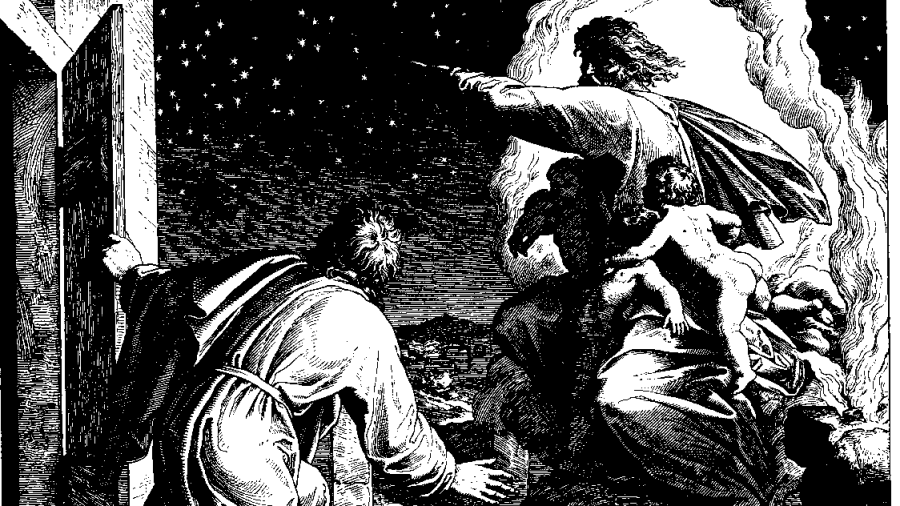
The vision of the Lord directing Abraham to count the stars (woodcut by Julius Schnorr von Carolsfeld from the 1860 Bible in Pictures)
“Look toward heaven and count the stars, if you are able to count them.” Then he said to him, “So shall your descendants be.” (Gen 15:5 NRS)

Abraham’s Righteousness

This is probably the incident Paul was thinking of in Romans 4:19 (above). Abram is not a hundred, and Sarai is not ninety in this scene. We’re not told how old Abram is at this point. We just know it’s between seventy-five and eighty-six, because Ishmael has not been born yet.

In response, we are told Abram “believed the LORD; and the LORD reckoned it to him as righteousness.” This is a very important verse to Paul. It is one of the cornerstone verses for his doctrine of salvation through faith, not by works of the Law (Rom 4:3; Gal 3:6. For a different application, see Jam 2:23).

The LORD reckoned his belief/faith (translations vary) as righteousness. This happened long before the Law of Moses even existed. Therefore, Paul contended, righteousness comes by faith, not by works of the Law. This is the scene we are told Abram indeed did not weaken in faith when he considered his own body. He was not good as dead yet, but he and Sarah had never had children, and her clock was ticking.

So it appears if you want to be righteous before God, you should be like Abram. When God says something, just believe it. Do not weaken in faith; do not doubt; do not consider your circumstances. Abram believed the word of God. The Bible is the word of God. So if the Bible says it, just believe it. Don’t question, don’t doubt. Believe like Abram, and you will be righteous like Abram.

Really?

But I’ve already shown you a couple of chapters later, when God makes the same promise, Abram laughs. Not only that, here’s what happens just in the next verses.

Then he said to him, “I am the LORD who brought you from Ur of the Chaldeans, to give you this land to possess.”

But he said, “O Lord GOD, how am I to know that I shall possess it?”

(Gen 15:7-8 NRS)

How am I to know that I shall possess it? Does that sound like someone who did not weaken in faith? To review, God promises Abram:

  1. He will have an heir of his own issue. In other words, his
    heir will be his son biologically, not by adoption. Abraham believed that.
  2. His descendants will be as numerous as the stars in heaven. Abram
    believed that.
  3. He would possess the land of Canaan. Abram asked God for proof.

Is two out of three good enough? No, with God, it’s all or nothing. You believe everything, or you’re not righteous in God’s eyes. Except God already counted Abram righteous after believing the first two promises. But God can’t do anything unless we believe. I guess Abram will receive the promise of an heir of his issue and many, many descendants. But as for possessing the land of Canaan, he just lost that promise, because he did not believe. You know I’m kidding, right?

No, God’s plans are not derailed because Abram showed a moment of doubt. If you’re trying to make Abram a paragon of belief that never wavers, never weakens, never questions, and never doubts, you are not reading the Bible. That is probably what annoys me most about a lot of Biblical fiction. They think they have to portray characters like Abraham as always believing, always honest, always faithful, and in doing so, they rob them of their humanity. How are we supposed to connect with them if they were too perfect to be human? Thankfully, the Bible does not do that.

Let’s Cut a Covenant, Abram

In order to understand what happens next, you have to know something about blood covenants. In Abram’s world, people would often use covenant ceremonies to seal an agreement. They almost always involved shedding blood in some fashion. In some cultures, they might cut themselves to use their own blood to seal the agreement. More often, the blood would come from an animal. One type of ceremony involved lining up several animals and splitting them in half. Each party in turn would walk between the halves of the animals, their feet bathing in the blood, while speaking their promises in the agreement. This sounds brutal to us today, but it was a brutal world.

I took the time to explain this because when you hear what God tells Abram to do, it sounds strange and brutal to us. However, Abram was already very familiar with this type of ceremony.

He said to him, “Bring me a heifer three years old, a female goat three years old, a ram three years old, a turtledove, and a young pigeon.”

 He brought him all these and cut them in two, laying each half over against the other; but he did not cut the birds in two. And when birds of prey came down on the carcasses, Abram drove them away.

(Gen 15:9-11 NRS)

I wonder how he went about doing this. What kind of blade did they have in the Middle Bronze Age capable of splitting all those animals in two? I’d think you would need steel the quality of a Samurai sword, which obviously was not available then. But since it was a common practice, they must have figured out a way to do it. Of course when you have three dead animals and two dead birds all lined up, that’s going to attract some buzzards, so Abram had to drive them away.

As the sun was going down, a deep sleep fell upon Abram, and a deep and terrifying darkness descended upon him.

(Gen 15:12 NRS)

I love that phrase a deep and terrifying darkness descended upon him. It really creates a mood. Perhaps it foreshadows the night of Passover, when darkness covered the land of Egypt. Abram’s mind must have been conjuring all kinds of creepy thoughts of what might happen next.

God Appears to Digress

Then the LORD said to Abram, “Know this for certain, that your offspring shall be aliens in a land that is not theirs, and shall be slaves there, and they shall be oppressed for four hundred years; but I will bring judgment on the nation that they serve, and afterward they shall come out with great possessions.

(Gen 15:13-14 NRS)

This is definitely foreshadowing his descendants’ bondage in Egypt and the deliverance called Passover. Of course, ancient Israelites listening to this story would know what this was referring to. After telling Abram he would die in peace and in old age (v. 15; he lived to be 175 years old), God tells him,

“And they shall come back here in the fourth generation; for the iniquity of the Amorites is not yet complete.”

(Gen 15:16 NRS)

So Abram’s descendants will be slaves of another nation. God will bring judgment on that nation, they will escape with great possessions, and they shall come back here (the land God is promising to his descendants). Why doesn’t God just give him the land now, so they won’t have to go through slavery and oppression? God says the iniquity of the Amorites is not yet complete.

What happens when their iniquity is complete?

The reason God says he will give this land to Abram’s descendants is because of the iniquity of the current inhabitants, here the Amorites. When Moses writes down the Law for the Israelites, he warns them not to engage in the same iniquities as the Amorites (and a bunch of other nations), or God will drive them out of the land as well (Lev 18:24; 1 Ki 21:26; 2 Ki 21:11).

What iniquity is God talking about? After reading the prophets, I have to say it is mainly injustice and unrighteousness, corruption in religion and government. The natives of the land are all living according to what is right in their own eyes rather than loving their neighbors as themselves. That is what the prophets complained about the most. Verse 16 means if trends keep going as they are, the Amorites will reach a point where they are totally irredeemable. God will give the land to Abraham’s descendants in order to establish a people who live by righteousness and justice (Gen 18:19).

I’m not sure what God meant by the fourth generation. God just said they will be there for 400 years. A generation is normally considered 40 years, so it would take 10 generations for them to come back here. That requires further study.

Abraham’s First Theophany

When the sun had gone down and it was dark, a smoking fire pot and a flaming torch passed between these pieces.

(Gen 15:17 NRS).

This is an example of a theophany. A theophany is defined in Merriam-Webster as “a visible manifestation of a deity.” It means God is appearing in person in a visible form. During the wandering in the Wilderness, God appeared to the Israelites as a cloud by day and a pillar of fire by night. Smoke and fire, so this theophany foreshadowed their wandering in the Wilderness. So far, Abram has only heard God speaking but hasn’t seen God take on any visible form. That changes in this verse. The theophany here is a smoking fire pot and a flaming torch. The text doesn’t specify how Abram heard God’s voice up until now, but this time the voice comes out of the theophany.

On that day the LORD made a covenant with Abram, saying, “To your descendants I give this land, from the river of Egypt to the great river, the river Euphrates, the land of the Kenites, the Kenizzites, the Kadmonites, the Hittites, the Perizzites, the Rephaim, the Amorites, the Canaanites, the Girgashites, and the Jebusites.”

(Gen 15:18-21 NRS)

This ceremony was familiar to Abram as I said before. Of course, you did not promise something in this manner unless you were serious. I think the symbolism said, “If I break the terms of this covenant, may I be split in half like these animals.” I’m not sure, but I think both parties of the covenant usually passed between the halves while declaring their part of the agreement. In this case, God passes through, but Abram does not. God makes promises, but Abram does not. You would expect if God gave so much to Abram, God would expect something in return. I think God did want something from Abram, but God does not say anything about it here. We should revisit that later. For now, though, Abram’s mind must have been blown.

Conclusion

When Paul talks about Abraham in his letter to the Romans, he makes him out to be a model of someone who believes with no doubt, in spite of his circumstances. Because of his unquestioning belief, God considered him righteous.

Hoping against hope, he believed that he would become “the father of many nations,” according to what was said, “So numerous shall your descendants be.” He did not weaken in faith when he considered his own body, which was already as good as dead (for he was about a hundred years old), or when he considered the barrenness of Sarah’s womb. Therefore his faith “was reckoned to him as righteousness.”
(Rom 4:18-19, 22 NRS)

But as we saw, that is not entirely true. God promised him a son of his own issue. Abram believed. God promised his descendants would be as numerous as the stars in heaven. Abram believed, and God reckoned it to him as righteousness. God promised him his descendants would possess the whole land of Canaan. Abram asked for proof.

What? Abram asked for proof? You’re not staggering at the promise of God through unbelief, are you Abram? So God says, “You doubt me? Well, you can forget that promise, Abram. I only keep my promises to those who believe without any questions or doubt.” For a long time, that is how I thought God was. I was taught that if I had any doubt at all, God would not answer my prayers. But that is not what happened to Abram. Instead of rejecting Abram or revoking His promise, God showed Abram something that convinced him God was serious.

So Abram, you asked how you would know your descendants would possess the land? God just appeared in a theophany of a smoking fire
pot and a flaming torch
that passed between the pieces of the animals you slaughtered. You heard from the theophany God would give the land of the Kenites, the Kenizzites, the…all the rest of them, to your descendants, thereby sealing the promise in a blood covenant. Now do you believe?

So yes, Abram did believe God but not without working through some doubt. If Abraham is the model of faith that God reckons as righteous, maybe faith isn’t about believing the word of God with zero doubt no matter what the circumstances are or how impossible it looks to us. Maybe faith is about having a relationship with God where you can be honest. Honest about what you believe, and what you don’t believe. Or maybe, like Abraham, you want to believe but need some help getting there.

Another problem for Paul is Abraham was not ninety-nine years old in this scene. It appears Paul conflates this chapter, where Abraham believes God and it is reckoned to him as righteousness but is seventy-five years old, with chapter 17 where he is ninety-nine and his body is “as good as dead.” So for my next post, I will compare chapter 17 with Paul’s portrayal of Abraham.

The man born blind, a character study

I have a confession to make. I haven’t been good about keeping up my writing, at least fiction. Since I finished a novel manuscript a few years ago, I have hardly written any fiction. I’ve been writing mostly about writing itself and Biblical reflections. I’ve told myself it’s research, because the area I most want to write is Biblical Fiction. In order to help me bridge the gap between fiction and Bible study, I’m going to do a little character study. Fiction requires compelling characters. That is what I’m using this research for, so I can picture the scene and try to get inside these characters’ heads. This will be longer than most of my blog posts so far.

In this study, I’m using one of my favorite unnamed characters in the Bible, the man born blind in John 9. I’m also hoping to make these episodes into a podcast. Sounds exciting, huh? Without further ado…

Who sinned and caused this man to be born blind?

In John chapter 9, Jesus and the disciples encountered a man born blind. Just prior to this, Jesus had an intense debate with the Jewish leaders in the Temple (Joh 8:12-58). This man would have been sitting somewhere begging, because there was very little work a blind man could do. Clearly, this was an organic condition. It doesn’t say whether he was partially blind or completely blind. The impression I get from reading it is he was totally blind. In first century Judaism, if a child was born blind, it had to be punishment for sin. Either the parents sinned, or somehow the child sinned while it was in the womb. This is why the disciples asked Jesus, “Rabbi, who sinned, this man or his parents, that he was born blind?” (Joh 9:2 NRS).

How can a child in the womb sin, you ask? Let’s say, for example, the child’s mother goes into a pagan temple while pregnant. In their minds, the child participates in that sin, even though clearly he/she had no choice in the matter. There were also ways a child could sin in the womb without the parents’ knowledge. That’s all speculation of course. I would even call it superstition. The thing about superstitions is, if you believe it, it’s not a superstition to you. Jesus’ answer says a lot, not only about the fallacy of that belief but also his mission in the world.

Jesus answered, “Neither this man nor his parents sinned; he was born blind so that God’s works might be revealed in him.”

(Joh 9:3)

First, he addresses the question of “who sinned?” As so often happened with Jesus, when they presented a question in the form of “Which is it, A or B?” he answered, “C, none of the above.” The man’s blindness, he tells them, has nothing to do with anyone’s sin, not the man’s or his parents’. Then he told them God did have a purpose in having him born blind. The purpose was that God’s works might be revealed in him.

This is admittedly difficult for many people to take, the idea that God would cause misfortune on someone, because there is some mysterious purpose behind it. However, in this case, that mystery would not remain hidden much longer. God’s works were about to be revealed, not in the man’s blindness, but in what Jesus was about to do for him.

Then Jesus said something else that spoke to the nature of his mission.

“We must work the works of him who sent me while it is day; night is coming when no one can work. As long as I am in the world, I am the light of the world.”

(Joh 9:4-5 NRS).

I think here, he hinted that the miracles and healings he was doing would not continue much longer. Why? Because this was the only time in history when the eternal Word (in Greek logos) walked the earth as a flesh and blood human being (John 1:1-18). That would not last forever. Night was coming. He knew his mission would end at the cross. Until that day, however, he and his disciples had to work the works of him who sent him. Notice he stresses the words work and works. That is going to be important later in the story. For now, let’s continue and see what he does for the man.

Where did you get that mud?

When he had said this, he spat on the ground and made mud with the saliva and spread the mud on the man’s eyes, saying to him, “Go, wash in the pool of Siloam” (which means Sent).

Then he went and washed and came back able to see.

(Joh 9:6-7 NRS)

How did Jesus heal him? He spat on the ground, made mud from the dirt and saliva, spread it on the man’s eyes, and told him to wash in the pool of Siloam. Is there any indication that Jesus was doing this in response to the man’s faith? None whatsoever. The man did not ask to be healed. I bet he didn’t even know it was Jesus rubbing mud on his eyes because, hello! He was blind! He was just sitting in the same spot he had sat begging every day for all of his adult life; and all of a sudden, some fool comes along and rubs mud on his eyes. Why would anyone do this to me? Who is this man rubbing mud on me? What kind of man takes advantage of a blind man like this? Do you think this is funny?

Jesus tells him, “Go wash in the pool of Siloam.”

“Oh, I’m going to wash this off, all right, because that’s what I do when someone covers me with mud. Where did you get the mud from anyway? Wait a minute! Did I hear you spit? Oooohhh! You mangy dog!” he wags his finger at Jesus. “Don’t you go anywhere, because after I wash this mud off, I’ve got some words for you!”

I’m sure after washing the mud off, he would have given Jesus an earful. Except…after he washed his eyes, he saw a shimmering light. “What’s this? I know it’s water. This is what water feels like,” as he dipped his hands in it. I imagine he scooped some up in his hands and let it fall back into the pool. “Is this what water looks like? Wow, this pool is beautiful. I’ve been to this pool many times, but I’ve never seen it before. I’ve never seen anything before! I see people all around. I think they’re people. I don’t know, because I’ve never seen people before. What’s your name?”

“Simon.”

“Simon! I can see you! I can see all the people around here. I can see the sun. I can see the Temple over there, where they won’t let me in because I’m blind. Was blind.” He inhales with mouth and eyes wide open as the realization sets in. “I was blind. But now I see. Where is the man who did this? I’ve got some words for him!”

Is this not the man who used to sit and beg?

He did not understand how he was healed. He did not know it was Jesus putting mud on his eyes until after he was healed. He didn’t even know Jesus was healing him, because Jesus never told him why he was putting mud on his eyes. Jesus had his own reasons for healing this man, whether he believed in him or not. You’ve heard of “faith healing?” Call this a non-faith healing.

Some people around the man noticed him, and they were like, “Look at that man! He can see!”

“So what?”

“He’s the blind man who used to beg over in that corner. I saw him every day as I passed on my way home from the Temple.”

So John tells us,

The neighbors and those who had seen him before as a beggar began to ask, “Is this not the man who used to sit and beg?”

Some were saying, “It is he.”

Others were saying, “No, but it is someone like him.”

He kept saying, “I am the man.”

(Joh 9:8-9 NRS)

I picture this debate going like, “That’s the blind man who sat there and begged.” “It can’t be him. Look, he’s not blind.” “It sure looks like him.” “That’s it. It’s someone else who looks like him.”

And the man is like, “Hey, I’m right here. You can ask me.”

“Are you the man?”

“Yes, I am the man.”

So then John tells us,

But they kept asking him, “Then how were your eyes opened?”

He answered, “The man called Jesus made mud, spread it on my eyes, and said to me, ‘Go to Siloam and wash.’ Then I went and washed and received my sight.”

They said to him, “Where is he?”

He said, “I do not know.”

(Joh 9:10-12 NRS)

Yeah, the man couldn’t point out Jesus in the crowd, because he never saw Jesus. (He was blind, remember?). So they take him to the Pharisees. They are the people who are supposed to know God and the scriptures better than anyone, so maybe they can make sense of this. Because if a man who was blind now sees, God must have had something to do with it. But the Pharisees have already had some controversies with Jesus, and this is not going to change their minds.

The work of a “sinner”

They brought to the Pharisees the man who had formerly been blind. Now it was a sabbath day when Jesus made the mud and opened his eyes.

(Joh 9:13-14 NRS)

Uh oh! That is going to be a problem. Making clay and putting it to use is defined in the Traditions of the Elders as work. Every Jew knew working on the Sabbath was forbidden. That was not a minor commandment. It was one of the Top Ten. Jesus has already gotten into trouble with the Pharisees because he healed a paralytic on the Sabbath in chapter 5. It’s like he’s doing everything he can to thumb his nose at them. But actually, he explained earlier why he needed to do this, even though it was the sabbath, in verses 4-5.

“We must work the works of him who sent me while it is day; night is coming when no one can work. As long as I am in the world, I am the light of the world.”

(Joh 9:4-5 NRS)

This is why he stressed doing the works of God while it is day. By working the works of God, he broke the sabbath. Why? Was it just to antagonize the Pharisees? No. He said, As long as I am in the world, I am the light of the world. But he would not be “in the world” for much longer. Soon, he would be crucified, dead, and buried. He would not be able to contact sick people in such direct fashion after that. So when he saw an opportunity to both heal a man born bind, and teach an important lesson to his disciples, he had to take it, sabbath or not.

Cognitive Dissonance: A great way to create tension in your story

Then the Pharisees also began to ask him how he had received his sight. He said to them, “He put mud on my eyes. Then I washed, and now I see.”

Some of the Pharisees said, “This man is not from God, for he does not observe the sabbath.”

But others said, “How can a man who is a sinner perform such signs?”

And they were divided. So they said again to the blind man, “What do you say about him? It was your eyes he opened.”

He said, “He is a prophet.”

(Joh 9:15-17 NRS)

The Pharisees are experiencing something called Cognitive Dissonance. This is a condition, usually temporary, where the mind is stressed because it’s trying to hold two facts together and knows both of those facts cannot be true at the same time. Fact 1: Jesus opened the eyes of a man born blind. Fact 2: Jesus broke the Sabbath. From fact 1, they should conclude that he was sent from God. From fact 2, they should conclude that he is a sinner. They cannot both be true. Either he was sent from God, or he is a sinner. How they should react to him depends on which side they pick.

For the man, there is no dissonance. He opened my eyes. Only God can do that, so he was sent from God. But…. No buts! He was sent from God. Period.

The first impulse in Cognitive Dissonance is to deny the fact you don’t like. Fake news, the Pharisees say. But they had to investigate. Probably someone suggested, “Why don’t we ask his parents? They should know if he was born blind, because, you know, they were there.” Here’s how that went.

The Jews did not believe that he had been blind and had received his sight until they called the parents of the man who had received his sight  and asked them, “Is this your son, who you say was born blind? How then does he now see?”

His parents answered, “We know that this is our son, and that he was born blind; but we do not know how it is that now he sees, nor do we know who opened his eyes. Ask him; he is of age. He will speak for himself.”

(Joh 9:18-21 NRS)

John says “the Jews” did not believe, but sometimes John refers to the Jewish religious authorities who opposed Jesus as “the Jews.” Most of the authorities continued to oppose Jesus, because they saw him threatening their most cherished traditions. But there is no way everyone who was there “did not believe.” I guarantee you some of the Jews who were there came to faith in Jesus because of this. How could they not? Some of you, if you saw this happen, would come to faith as well. The religious authorities, here represented by the Pharisees, were another matter entirely.

If they could have proven the man really wasn’t born blind, the debate would have been over. But his own parents, who would know, confirmed he was their son, and he was born blind. Their level of cognitive dissonance is off the charts now. What will they do?

Though I was blind, now I see

The Pharisees investigated the case of a man who was born blind and now sees. He claimed he saw because Jesus opened his eyes. That’s a problem for them, because they have already declared “anyone who confessed Jesus to be the Messiah would be put out of the synagogue” (Joh 9:22 NRS). Why? Because he was a “sinner.” Why? Because he healed on the Sabbath, and he claimed to be equal to God (Joh 5:9-10; 17-18). To be fair, no Jew should ever believe any man or woman who claims to be equal to God. But if he is a sinner, how could he have opened the eyes of a blind man? {COGNITIVE DISSONANCE ALERT}.

If they could prove this miracle was fake, there would be no reason for anyone to believe he was the Messiah. But their own investigation proved it was real. {COGNITIVE DISSONANCE ALERT}. What do they do now? We pick up the story at John 9:24-25.

So for the second time they called the man who had been blind, and they said to him, “Give glory to God! We know that this man is a sinner.” {That’s how they resolve their cognitive dissonance}

He answered, “I do not know whether he is a sinner. One thing I do know, that though I was blind, now I see.” 

(Joh 9:24-25 NRS)

This is not only a story of a blind man who receives sight. It’s also a story of willful blindness. They can’t acknowledge Jesus had any role in this miracle, so instead they insist the man give glory to God. I think it’s good to give glory to God when you receive a blessing, but sometimes people use that to avoid giving credit where credit is due. In this case, they “give glory to God” so they won’t have to give Jesus, a “sinner,” any credit for it.

For the man, they could call Jesus a sinner all day. Maybe they were right, maybe they were wrong. There is only one fact he knows for sure. He was blind, and now he sees.

John continues,

They said to him, “What did he do to you? How did he open your eyes?”

He answered them, “I have told you already, and you would not listen. Why do you want to hear it again? Do you also want to become his disciples?”

(Joh 9:26-27 NRS)

I think at this point, the man recognizes the Pharisees are just being willfully blind, and he is not willing to suffer fools gladly. And I wish I could have been there to see the look on their faces when he asked, Do you also want to become his disciples? Continuing, verses 28-29,

Then they reviled him, saying, “You are his disciple, but we are disciples of Moses. We know that God has spoken to Moses, but as for this man, we do not know where he comes from” 

(Joh 9:28-29 NRS)

No one in this story would dispute that God had spoken to Moses. Not this man, not any of the witnesses, and certainly not Jesus. He had already told the Jewish religious leaders,

“Do not think that I will accuse you before the Father; your accuser is Moses, on whom you have set your hope. If you believed Moses, you would believe me, for he wrote about me. But if you do not believe what he wrote, how will you believe what I say?”

(Joh 5:45-47 NRS)

That was a bold claim from Jesus. That Moses, who wrote the Torah, on which all scripture is based, wrote about him. Christians today are so used to hearing Jesus fulfilled Old Testament scriptures that I wonder if we understand how shocking this statement would have been to first century Jews. There was no way they should have believed anyone who said something like this without evidence. In this case, however, that evidence was standing right before them in a man who was born blind and now sees. Let’s see how that evidence responds to the Pharisees’ objections.

Here is an astonishing thing!

The man answered, “Here is an astonishing thing! You do not know where he comes from, and yet he opened my eyes”

(Joh 9:30 NRS)

Okay, I have to interrupt here for a moment to say, I love this man! I think he might be my favorite unnamed character in the Bible. He was a walking, talking “no B.S. zone.” He’s like, “How shocking! You don’t know where he comes from! Forget that he opened my eyes. I thought that proved he was sent from God. But you don’t know where he comes from. Well, that totally discredits him. I was going to become his disciple, but if you don’t know where he comes from, well, I was clearly a fool for thinking that.” You do get he’s being sarcastic, right?

Then he drops the sarcasm and gets to some serious theology, continuing from verse 31,

“We know that God does not listen to sinners, but he does listen to one who worships him and obeys his will. Never since the world began has it been heard that anyone opened the eyes of a person born blind. If this man were not from God, he could do nothing”

(Joh 9:31-33 NRS)

God does not listen to sinners. God listens to those who worship God and obey God’s will. If he were not from God, he could do nothing. You didn’t need any advanced theological training to know this. This was Judaism 101. Shabbas school even. If he were not from God, he could do nothing, so look at what he just did. He opened the eyes of a person born blind.

This was not your run of the mill, ordinary miracle. This was something no one had ever done since the world began. In Jesus’ time, there were others who claimed to be miracle workers and healers. But none of them had done anything close to this. Search through history, and you won’t find anyone who had done this. No angel, no prophet, none of the patriarchs, not Moses, no miracle worker, no healer, no magician, no one has ever opened the eyes of a person born blind. So if he’s a sinner, you tell me how he opened my eyes.

Quite a convincing argument, don’t you think? He’s going toe-to-toe in a theological debate with the best theologians in Jerusalem, and he is crushing it. Did I mention I love this man?

Is this enough to change the minds of the religious authorities?

They answered him, “You were born entirely in sins, and are you trying to teach us?” And they drove him out.

(Joh 9:34 NRS)

So they made good on their threat to throw anyone out of the synagogue who confessed Jesus as the Messiah (9:22). What did they mean that he was “born entirely in sins”? Remember back in Verse 2 when the disciples asked Jesus whether the man sinned or his parents? That was the common belief about children born with blindness, deafness, or some other disability. The child was born in sins, either because of the parents, or because the child somehow sinned in the womb. And again, I’ll remind you Jesus said sin had nothing to do with the man’s blindness (Joh 9:3). But the man would have been treated with that attitude all his life, so I don’t think he felt any great loss when they drove him out [of the synagogue]. And if he was eager to be Jesus’ disciple before, he was all the more eager after that. Time for Jesus to reenter the scene.

Jesus heard that they had driven him out, and when he found him, he said, “Do you believe in the Son of Man?”

He answered, “And who is he, sir? Tell me, so that I may believe in him.”

Jesus said to him, “You have seen him, and the one speaking with you is he.”

He said, “Lord, I believe.” And he worshiped him.

(Joh 9:35-38 NRS)

As I said before, no Jew should have worshiped Jesus, called him Lord, or believed he was the Son of God, or the Son of Man for that matter. Not without evidence, and it would have to be evidence way beyond a reasonable doubt. This man received exactly that, so it was appropriate for him to worship Jesus and believe him when he called himself the Son of Man. He’s like, “Son of Man? Who is he? Just tell me, and I’ll believe. In fact, I’ll believe anything you tell me. I’ll believe anything you want me too. Why shouldn’t I? I was blind, and you opened my eyes.”

This man knew how to put two and two together. If Jesus were not from God, he could not have opened my eyes. I know we are taught not to have any gods except the God of Abraham, Isaac, and Jacob. But he would not ask me to do anything God would disapprove of. If he did, God would not have let him do what he did for me.

Summary

There are a lot of unnamed characters in the Bible. Usually, we don’t get much of their personality. They are mostly props or role-players. This man’s personality leaps off the page. I love how he debates the Pharisees. I keep thinking what must it have felt like if you couldn’t see and someone just started putting mud over your eyes, no explanations. You think he has pulled some kind of cruel joke on you. But then you wash the mud off, and you can see. Even though he was a Jew, John tells his story in a way that his worship of Jesus near the end of the chapter makes sense.

Nothing annoys me more about Christian or Biblical fiction than when someone converts to faith in Christ, but the author does not make it feel authentic. There is nothing inauthentic about this man. In one chapter, he went from blindness, to seeing, to believing, to worshiping, and every bit of it felt real. Like I said, he is a walking, talking “no B.S.” zone. I know it’s not right to call him a fictional character, but I would be proud to have a character like him in one of my novels or short stories.

Sign up

To sign up for updates when I post new content,

[contact-form-7 id=”2760″ title=”Contact form 1″]