
A King Wants to “Friend” Abraham

We first met Abimelech in one of the “wife-sister” episodes. (Follow the link, you can scroll down to the subheading Abimelech King of Gerar: Another Unwitting John?) After sending Hagar and Ishmael away, Abraham encounters him again (Genesis 21:22-34).

At that time Abimelech, with Phicol the commander of his army, said to Abraham, “God is with you in all that you do; now therefore swear to me here by God that you will not deal falsely with me or with my offspring or with my posterity, but as I have dealt loyally with you, you will deal with me and with the land where you have resided as an alien.”

And Abraham said, “I swear it.”

(Gen 21:22-24 NRS)
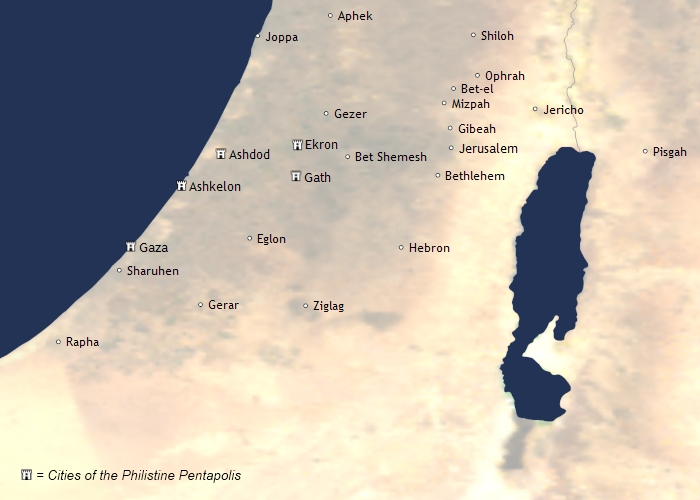
Map of Five Cities of Philistia, et al.
The Bible identifies five Philistine cities: Gaza, Ashdod, Ashkelon, Ekron and Gath. Gerar is identified as part of “the land of the Philistines” in the time of Abraham.

Abimelech was king of Gerar at that time. Why is he so keen to make Abraham an ally, even though he resides there as an alien? He had taken Sarah into his palace, because Abraham told him she was his sister (didn’t mention she was his wife). God appeared to him and told him the only reason God did not kill him was he did not know Sarah was his wife. God told Abimelech to return Sarah to her husband and ask him to pray for God to forgive him. That was how he concluded God is with you in all that you do.

Since God is with Abraham, and he almost lost his life because Abraham had dealt falsely with him, he wants to be sure Abraham understands I have dealt loyally with you, so you will deal [loyally] with me. When he first came there, Abraham thought people in this area had no fear of God. Clearly, they do now. Either he wants to remind Abraham he dealt loyally with him, or he wants to be sure Abraham understands, “You know how you told me Sarah was your sister but didn’t tell me she was your wife? Don’t ever do that again. You may have thought we don’t fear God, but you know better now.”

Yes, Abimelech, and by the Way…

When Abraham complained to Abimelech about a well of water that Abimelech’s servants had seized, Abimelech said, “I do not know who has done this; you did not tell me, and I have not heard of it until today.”

(Gen 21:25-26 NRS)

When Abraham complained to Abimelech… A better translation would be, But Abraham complained to Abimelech… (NAS), or Abraham, however, reproached Abimelech (NAB; see Translation Notes). Abimelech says he didn’t know about it. He also says, you did not tell me. Why? I understand why he wants to be sure Abraham knows he did not order that or even know about it. It was the same defense he gave to God. “I did not know. He did not tell me.” It was true then. I guess we have to assume it is true now as well.
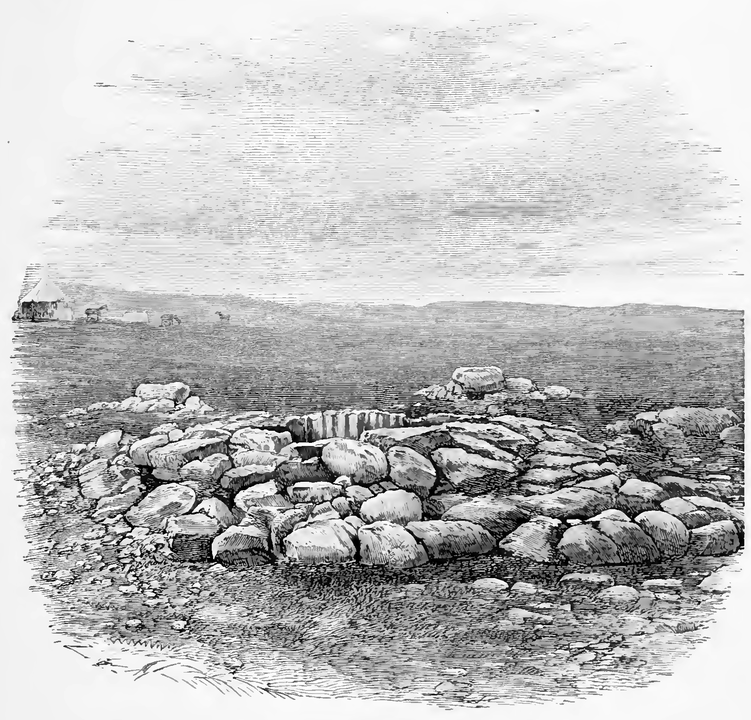
Artist's rendersing of Abraham's Well, 1855
Artist’s rendering of Abraham’s Well, 1855

Certain Details Left out

So Abraham took sheep and oxen and gave them to Abimelech, and the two men made a covenant.

Abraham set apart seven ewe lambs of the flock. And Abimelech said to Abraham, “What is the meaning of these seven ewe lambs that you have set apart?”

He said, “These seven ewe lambs you shall accept from my hand, in order that you may be a witness for me that I dug this well.”

Therefore that place was called Beer-sheba; because there both of them swore an oath.

(Gen 21:27-31 NRS)

It is not clear at first that they are making covenant. Or maybe for them, it was clear when Abimelech asked him to swear to me here by God. I’m not sure how this particular covenant ceremony works. Abraham took sheep and oxen and gave them to Abimelech. Did they cut them in half and each walk between in turn, swearing the terms of the covenant (Gen 15:9-21)? If so, why did Abraham set apart seven ewe lambs of the flock? Maybe they slaughtered them for the covenant.

But then why did he say, “These seven ewe lambs you shall accept from my hand,” as if they were a gift? Did he give them or slaughter them? Which animals were slaughtered and how? That was normally how a covenant would be sealed. Was the agreement sealed with the gift of oxen and sheep, or the gift of the seven ewe lambs?

This is one of the difficulties in reading not just the Bible but any text from a culture that is markedly different from ours. I bet the original audience was so familiar with this type of covenant that the author did not need to explain those details to them. So unless archeologists find some more specific accounts of similar ceremonies, those details are lost to us.

They Invoked the Seven

But however they ratified the covenant, setting apart seven ewe lambs was important to this origin story of how Beer-sheba got its name. In Hebrew, be’er = “well,” and sheba` = 1) seven; 2) oath. The oath was sealed by setting apart seven ewe lambs. This is one of those moments that makes the Hebrew text much more intriguing than the translation. The fact that sheba` is the root of both “take an oath” and the number seven indicates there was probably an ancient connection between seven and giving an oath. One of my professors said in the ancient Canaanite (or other local) pantheon, there was a team of seven gods associated with oaths, sort of like in Greek mythology, there were three fates and three furies, who were for the most part inseparable. To “invoke the seven” meant to make an oath.

First it says Abraham gave Abimelech sheep and oxen in order to secure his claim to the well. Then Abraham says, “These seven ewe lambs you shall accept from my hand, in order that you may be a witness for me that I dug this well.” That’s what makes the details of the ceremony confusing. What did he give to Abimelech? Were any of the animals slaughtered for the ceremony?

Once again, I think I may be confused because the original audience did not need these details explained to them.

From Oral to Written

Maybe there were two accounts of this story, one where Abraham gave an unspecified number of sheep and oxen, and one where he gave seven ewe lambs. The author did not want to choose one and leave out the other, so he put them both in, i.e., looks like another doublet.

The terms of the covenant are 1) they will each deal truthfully and loyally with each other, and 2) Abimelech recognizes this well belongs to Abraham. And once again, they are at peace.

Therefore that place was called Beer-sheba. Abraham and Abimelech get credit for naming the place. Later, as with the wife-sister episode, we have almost the exact same story between Isaac and Abimelech (Gen 26:26-33). Isaac is given credit there for naming the place Beer-sheba, and it is also based on an oath between him and Abimelech of Gerar. Even the name of the commander of his army, Phicol, is the same in the Isaac account. Pharaoh was the title not the name for the king of Egypt. Abimelech could similarly be a title not a name. But could Phicol be the title of the commander of the army? I doubt it.

So the wife-sister episode was not the only case where we have the same story, same characters, but switch Isaac for Abraham. It is extremely unlikely this exact same story happened to both Abraham and Isaac. Again, this looks like a doublet. I attribute this to the fact that these stories circulated orally for a long time, probably hundreds of years, before they were written down. In that time, Abraham could change to Isaac in some localities. Any other differences in those stories could be attributed to the same thing.

Anachronisms

When they had made a covenant at Beer-sheba, Abimelech, with Phicol the commander of his army, left and returned to the land of the Philistines.

Abraham planted a tamarisk tree in Beer-sheba, and called there on the name of the LORD, the Everlasting God. And Abraham resided as an alien many days in the land of the Philistines.

(Gen 21:32-34 NRS)

Beer-sheba was an important location in the Negev Desert. It marked the southern extent of the land of Canaan. The biblical site is believed to have been at Tel Be’er-sheva, which is a few kilometers east of the modern city. Archeological excavations indicate it became a major city in the tenth century BC, with streets laid out in a grid and separate areas for administrative, commercial, military, and residential use. This again is centuries after Abraham. Archeologists found evidence for settlements as early as the fourth millennium BC, but there appears to be a gap in settlement from about 3200-1100 BC.

Tel Beer-sheva archeological site

It appears to be the earliest planned city in the region. “From Dan to Beersheba” became a common expression for the entire cultivated land of Israel. Several wells were dug there, many of them attributed to Abraham and Isaac.

Map of Beersheba and surrounding area
On the banks of the Nahal Beersheva (the main wadi of Beersheba)

The river on the map is called the Nahal Beersheva. It is actually a wadi, so it is dry during the summer months. However, the wells plus a cistern to collect water during the wet months ensure water supplies year round. Its water sources made it a target for conquest, and it was destroyed and rebuilt many times.

The Land of the Philistines

The Philistines did not appear in the land until hundreds of years later. They are not listed among the nations Abraham’s descendants will displace in Gen 15:18-21, and from lists of nations Moses says the Israelites would conquer (Deu 7:1 and 20:17). In the time of the Judges, they were among the deadliest of Israel’s enemies. They are associated with “the sea peoples” in Egyptian texts.

The most commonly held belief is they came from Crete in the twelfth century BC. They settled mostly along the Mediterranean coast in the area today called the Gaza Strip. The most famous Philistines from the Bible are Delilah and Goliath.

This type of anachronism might give us a clue to when the stories were first written down, at a time when the Philistines were active in the area. Another possibility the Rabbis propose is that “the Philistines” Abraham encountered were actually a different people than the ones who dominated the Israelites during the time of the Judges.

Abraham Planted a Tree…

A tamarisk tree most likely refers to the Tamarix aphylla species, typically found in northern Africa and western Asia. It grows needles instead of leaves (the meaning of aphylla) and can grow to a height of fifty feet. It is also called an athel tree, athel pine, or salt cedar (because it excretes salt on the needles, making them sometimes appear white). The shade provided coolness and increased the moisture in the air underneath. As the dew collected on the needles in the morning, they could provide a source of salt. As the moisture evaporated during the day, it would cool the shade even more.

Tamarix aphylla in its natural habitat in Revivim, Israel
Abraham planted a tamarisk tree in Beer-sheba, and called there on the name of the LORD, the Everlasting God. (Gen 21:33 NRS)

Most other times when Abraham called on the name of the LORD, he built an altar. This is the only place where the Bible says Abraham planted a tree. It think it is significant that this takes place after Isaac was born. Planting a tree is something you do not just for yourself but for future generations. Now that he has secured his claim to this well, the tree will provide shade not only for himself but for Isaac, his children, and grandchildren.

…and Called on the Name of the LORD

Abraham…called there on the name of the LORD, the Everlasting God. There is obviously a special meaning to this. Beersheba later became a major cultic center of Israel.
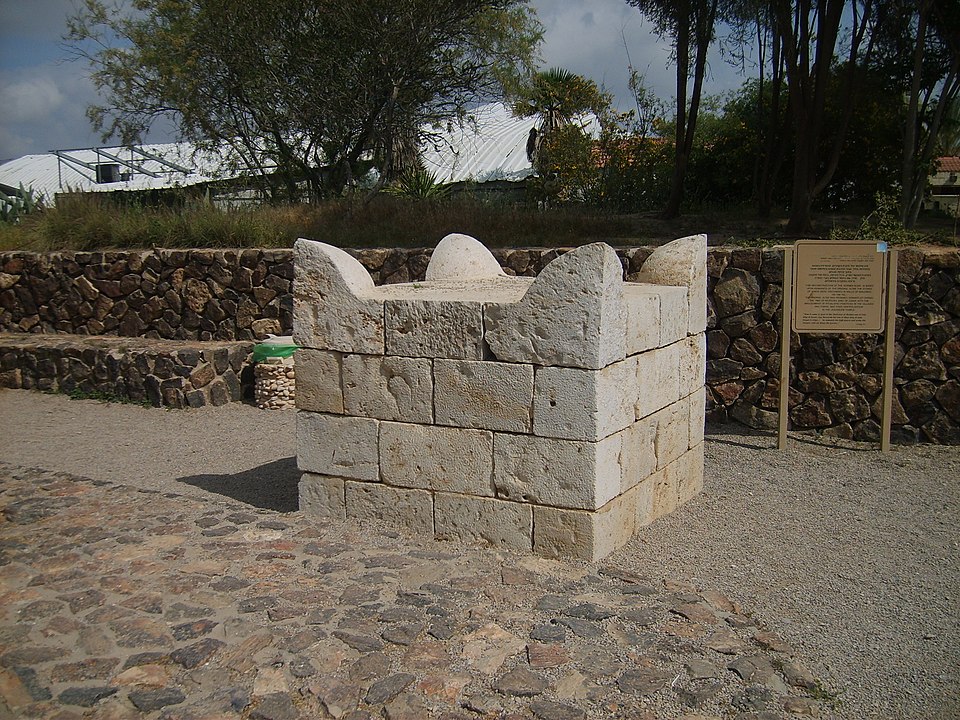
Four-horned altar, replica of one excavated at Tel Be'er Sheva
Replica of a Four-horned altar found at Tel Be’er Sheva

The LORD spoke to Hagar, Isaac, and Jacob there. When Abraham called on the name of the LORD, it was probably under that tree. Calling on the name of the LORD, along with creating physical landmarks to worship the LORD (altars or a tree), may have referred to his actions to make the LORD known to his neighbors. We also have this from the NET translation notes,

Heb “he called there in the name of the LORD.” The expression refers to worshiping the LORD through prayer and sacrifice (see Gen 4:26; Gen 12:8; Gen 13:4; Gen 26:25). See G. J. Wenham, Genesis (WBC), 1:116, 281.

NET, tn 64.

The Everlasting God

In Hebrew, this is ‘el olam (See Translation Notes). Olam does not always mean “eternal” or “everlasting,” but as an attribute of God, I think it is appropriate to translate it that way. A comma separates “the everlasting God” from the LORD. That indicates he uses this phrase to describe the God he has come to know as Yahweh, “the LORD.” I wonder, though, if this could be a name for God, the LORD God Everlasting.

Olam can also be spatial, meaning “the world,” or “the universe.” On that note, I will close with this from Matthew Henry.

In calling on the Lord, we must eye him as the everlasting God, the God of the world, so some. Though God had made himself known to Abraham as his God in particular, and in covenant with him, yet he forgets not to give glory to him as the Lord of all: The everlasting God, who was, before all worlds, and will be, when time and days shall be no more. See Isa. xl. 28.

Commentary on Genesis 21:33.

PSA: Easiest Way to Plant a Tree (or Several) Like Abraham

The earth has become so politicized that too many Christians treat caring for the land, air, and water as completely opposite from worshiping God. How did that happen? Abraham planted a tree AND called on the name of the LORD, probably from under that same tree. Why not? Didn’t God create trees and call them good (Gen 1:12)? You do believe God created heaven and earth and everything in it (plants, animals, land, water, and humans), don’t you?

We’ve cut down a lot of trees in the last century, but here’s an easy way to help replace some of them. The Arbor Day Foundation has a new campaign. For each dollar you donate, they will plant a tree. Their goal is to raise $20 million to plant 20 million new trees. Go to teamtrees.org or #teamtrees, and like Abraham, for just a few dollars you won’t even miss, you can leave something that will benefit the earth, your children, grandchildren, and generations to come.

“How we gonna breathe without them trees?”

Translation Notes

וְהוֹכִ֥חַ אַבְרָהָ֖ם (Gen 21:25 WTT) But Abraham complained…. The vav at the beginning is translated “When” in the NRSV and ESV. That makes it sound like this could have taken place at a later time. But, however, or then makes it clearer that Abraham said this following Abimelech’s request.

The verb yakach is a hiphil perfect 3rd person masculine singular. It means to complain, reprove, or reproach.

Hol3332  יכח  

hif.: pf. –1. set s.one right, reprove: a) abs. Jb 3212; b) w. acc. Is 113; w. l® Is 114; c) w. ±al (+ person) reproach s.one for s.thg Jb 195, w. °el go to law with Jb 133; w. b® requite s.thg 2K 194.

Halladay

The LORD. When the “Lord” appears in all capital letters, it refers to “the divine name,” YHWH, pronounced Yahweh. Most Jews do not speak or write the divine name out of reverence. They will often use the Hebrew word for “Lord” (Adonai) or “the Name” (Ha-shem) instead.


The everlasting God, Heb ‘el `olam. אֵ֥ל עוֹלָֽם׃ (Gen 21:33 WTT).

El is the most common word for “God” in the Hebrew Bible. Olam, translated here “everlasting.” As an attribute of God or part of God’s name, it could refer to either God’s eternal nature or the scope of God’s sovereignty as “the world” or “the universe.”

References

Bible Map: Beersheba

Carolyn Roth, “Abraham Planted Tamarisk Trees,” God as a Gardener (blog), Carolyn Roth Ministries, March 24, 2011, https://godasagardener.com/2011/03/24/abraham-the-tamarisk/

Gill, N.S. “Understanding the Philistines: An Overview and Definition.” Learn Religions, Apr. 17, 2019, https://learnreligions.com/the-philistines-117390  

Tel Beer Sheva National Park (brochure).

Who Was Delilah in the Bible?” Got Questions. Accessed October 31, 2019, https://www.gotquestions.org/Delilah-in-the-Bible.html

Wikipedia

Beersheba

Goliath

Philistines

Tamarix

Ishmael, a Different Destiny

About last week’s post, it occurs to me you might have been confused. I talked about Lot’s daughters and how their actions were complete folly. Then I told you about Genesis Rabbah, a Rabbinic commentary which suggests:

  • Lot may have been fooled the first time his daughters got him drunk, but not the second.
  • Lot’s daughters somehow knew they were part of the bloodline of the Messiah.
  • Lot deliberately isolated his daughters, so he would be their only option for continuing the bloodline.

That is a much different impression you get from reading the English translation. There, it looks like the daughters got him so drunk he did not know what happened, and that they foolishly believed they and their father were the last people on earth. But the Rabbis who put together the Genesis Rabbah saw things in the Hebrew text I would never have seen.

  1. They conclude Lot was not as drunk as we thought because there is a dot over the last word in the verse. According to the Rabbis, the dot over the last word changes the meaning of the end of Genesis 19:33 from “[he did not know when she lay down] or when she arose,” to “[he did not know when she lay down], but he knew when she arose.” That changes Lot from clueless to complicit. (See Translation Notes).
  2. They conclude the daughters knew they were part of the bloodline because the elder said to the younger, “so that we may preserve offspring through our father” (Gen 19:32 NRS), not “so that we may keep a child alive from our father.” They say this means their concern was not just to have a child but to “preserve offspring,” i.e., the bloodline of the Messiah.
  3. The Rabbis point to this verse, “Whoever isolates himself seeks his own desire” (Pro 18:1 ESV). Lot isolated himself with his daughters. They conclude Lot had it in mind to have children through his daughters when he took them to live in a cave in the hills.

The Rabbis make Lot look a lot worse, and his daughters look a lot better, than any English version of this passage. This is maybe the greatest example of “lost in translation” I have ever seen. I’m not sure I agree with all the Rabbis’ conclusions. But considering they had a lot more experience than I do in reading the Hebrew texts of the Bible, they know the editorial marks I don’t, and they know subtleties and nuances in the text I don’t, I can’t dismiss any of it.

All of that is to say if it was confusing how I started out as if I was going to conclude one thing about Lot and his daughters and then went in an entirely different direction, sorry. I wish I could promise that will be the last time I do that, but…anyway, on to the next lesson.

God Brings Laughter for Sarah

When Abraham and Sarah thought their chance at having a son had passed, Sarah told him to go in to her maid, Hagar. Legally, she could claim the son of her handmaid as her own. Ishmael was going to be Abraham and Sarah’s heir. But then, against all odds, Sarah had her own son at ninety-one. She and Abraham named him Isaac. One can only imagine the joy they felt when this dream they had given up on actually came true.

Now Sarah said, “God has brought laughter for me; everyone who hears will laugh with me.” And she said, “Who would ever have said to Abraham that Sarah would nurse children? Yet I have borne him a son in his old age.”

(Gen 21:6-7 NRS)

A joyous moment for Abraham and Sarah. Isaac, whose name means “he laughs,” was the heir God had promised them finally manifest (18:13-15). But what did it mean for Hagar and Ishmael?

How Dare He Play with My Son!

The child grew, and was weaned; and Abraham made a great feast on the day that Isaac was weaned. But Sarah saw the son of Hagar the Egyptian, whom she had borne to Abraham, playing with her son Isaac. So she said to Abraham, “Cast out this slave woman with her son; for the son of this slave woman shall not inherit along with my son Isaac.”

The matter was very distressing to Abraham on account of his son.

(Gen 21:8-11 NRS)

The ceremony for a child being weaned was a big deal back then, maybe comparable to a bar mitzvah today.

But Sarah saw the son of Hagar the Egyptian … playing with her son Isaac. Why would playing with her son make Sarah go to such an extreme as cast out this slave woman with her son? The Hebrew verb tsachaq comes from the same root as “laughter” or “to laugh.” The same root is used for Isaac’s name, meaning “He laughs.” In the form used here, it can mean “playing,” like children often play and have fun together. Or it could mean “laughing at, making fun of, making sport of, or mocking,” as the Philistines did to Samson.

And when their hearts were merry, they said, “Call Samson, and let him entertain us.”

(Jdg 16:25 NRS)

Let him entertain us is the key phrase here. They had already robbed Samson of his strength and blinded him. Now, they wanted to take advantage of his vulnerability and “make sport of him.” In context, that looks like the most likely way to interpret playing with her son Isaac. Have you ever seen a Jewish mother’s wrath when someone messes with her child? You don’t want to be on the receiving end of that.

But in this case, Ishmael is her son too. Or is he? Now that Sarah has a son that came from her own issue, Ishmael is the son of this slave woman. It sounds like Ishmael sensed Sarah never truly accepted him as her son. And between him and Isaac, Isaac has more claim to her, even though legally Sarah is his mother. Maybe he took out his frustration on Isaac and gave Sarah the excuse she wanted to break with him and Hagar, in order to protect Isaac’s inheritance.

The Matter Was Very Distressing to Abraham

But Abraham still thought of Ishmael as his son. He did not want to cast them out. Sarah, though, once she makes up her mind, will not budge. Being a prophet, Abraham would seek a word from God.

But God said to Abraham, “Do not be distressed because of the boy and because of your slave woman; whatever Sarah says to you, do as she tells you, for it is through Isaac that offspring shall be named for you. As for the son of the slave woman, I will make a nation of him also, because he is your offspring.”

(Gen 21:12-13 NRS)

So God tells him to do whatever Sarah says to you. I don’t think that made him feel any better about it, but when your wife and God are both telling you the same thing, you’d better do what they say. I’m just saying.

God promises to make a nation of him also. God will always watch over him because he is your offspring. This moment was foreshadowed when God said to Abraham,

“As for Ishmael, I have heard you; I will bless him and make him fruitful and exceedingly numerous; he shall be the father of twelve princes, and I will make him a great nation. But my covenant I will establish with Isaac, whom Sarah shall bear to you at this season next year.”

(Gen 17:20-21 NRS)

The Child of the Promise

Abraham has to let Ishmael go, but God will not abandon him. God promises again to make Ishmael a nation. But Isaac was the child of the promise. He was the one God would establish God’s covenant with. He was the one Abraham’s offspring would be named for. And as we know today, he was the one through whom the Messiah would come into the world. God had a plan and a destiny for Ishmael too, but it was apart from Abraham and Sarah. And God had also hinted to Hagar the same thing.

“He (Isaac) shall be a wild ass of a man, with his hand against everyone, and everyone’s hand against him; and he shall live at odds with all his kin.”

(Gen 16:12 NRS)

He shall live at odds with all his kin. He was at odds with his half-brother, Isaac, and that put him at odds with Sarah. Their tent was no longer big enough for everyone.

So Abraham rose early in the morning, and took bread and a skin of water, and gave it to Hagar, putting it on her shoulder, along with the child, and sent her away. And she departed, and wandered about in the wilderness of Beer-sheba.

(Gen 21:14)

Beer-Sheba is in the northern part of the Negev Desert. The town is named for a well Abraham is said to have dug (Gen 21:25) and was the southern border of the land Israel occupied when Joshua led them in. It has a wadi that runs nearby in winter but is dry in the summer. Given Hagar’s difficulty finding water, I’m guessing this is the summer.

Bread and a skin of water? That’s all? He sends them into a desert with only a skin of water and bread. Sounds like the exact opposite of the generous hospitality he showed the angels. How much you want to bet that was Sarah? The son of this slave woman shall not inherit along with my son Isaac.

Sarah’s Bad Side

She has shown in the past when you get her angry, she has no pity whatsoever (Gen 16:5-6). “So they don’t have enough food and water to survive a trek through the desert? How is that my problem? I told you the son of the slave would not inherit anything from us.”

When the water in the skin was gone, she cast the child under one of the bushes. Then she went and sat down opposite him a good way off, about the distance of a bowshot; for she said, “Do not let me look on the death of the child.”

And as she sat opposite him, she lifted up her voice and wept.

(Gen 21:15-16 NRS)

If they had died, I’d say the blood would have been mainly on Sarah’s hands. As for Abraham, God told him to do whatever Sarah told him in this matter. I still think he could have pushed for at least two or three water skins, or at least go where they could sell Hagar and Ishmael to someone who wouldn’t cast her out into the wilderness. But then when Abraham died, Ishmael might have come back to claim part of his inheritance. Sarah was having none of that.

“God Hears”

But God had promised Ishmael would not only survive but become a great nation with twelve princes. He cannot die here.

And God heard the voice of the boy; and the angel of God called to Hagar from heaven, and said to her, “What troubles you, Hagar? Do not be afraid; for God has heard the voice of the boy where he is. Come, lift up the boy and hold him fast with your hand, for I will make a great nation of him.”

(Gen 21:17-18 NRS)

And God heard the voice of the boy. This plays off the meaning of Ishmael’s name (“God hears”). We were told what Hagar said, but not what Ishmael said. Still, God heard his voice. Did he say anything, or did he just cry out because he was suffering and afraid? But God speaks to Hagar and promises again to make a great nation of him.

Then God opened her eyes and she saw a well of water. She went, and filled the skin with water, and gave the boy a drink.

(Gen 21:19 NRS)

Then God opened her eyes and she saw a well of water. The well was there, but she didn’t see it. There is a powerful metaphor there. She cried out to God in her distress, and salvation was right there all along. But she couldn’t see it until God opened her eyes.

God Was With the Boy

God was with the boy, and he grew up; he lived in the wilderness, and became an expert with the bow. He lived in the wilderness of Paran; and his mother got a wife for him from the land of Egypt.

(Gen 21:20-21 NRS)

God was with the boy. God kept all God’s promises concerning Ishmael, even though he was not the one God chose to continue Abraham’s line and Abraham’s covenant. Being Abraham’s child was enough to secure a blessing from God.

He lived in the wilderness, and became an expert with the bow. See 16:12.

His mother got a wife for him from the land of Egypt. Hagar was Egyptian, so that was a natural choice.

…and he grew up. Wait a minute! He grew up? I thought he was already grown!

Hmm. Something amiss here.

How Old Was Ishmael When This Happened?

According to the story so far, Abraham had Ishmael when he was eighty-six and Isaac when he was a hundred. So Ishmael was fourteen years old when Isaac was born. This happened when Isaac was weaned, which would make him about two or three. That would make Ishmael sixteen or seventeen when it says he and his mother were cast out. That makes no sense in this story. Did you notice these details?

He…took bread and a skin of water, and gave it to Hagar, putting it on her shoulder, along with the childshe cast the child under one of the bushes.

(Gen 21:14-15 NRS)

The Hebrew word for “child” here is yeled, which can mean “child, offspring, son, youth, or little child.” Since Abraham put him on Hagar’s shoulders and she cast him under a bush, it seems like it should be translated “little child” in this case. But at sixteen or seventeen, he would not have been a little child. He would have been considered already an adult in that society. Could Ishmael have been a midget?

Mickey Abbott from Seinfeld tells George, "It's Little People. You got that? Little People!

Sorry. Could it be Ishmael was a little person? And by the way, what happened to him being “a wild ass of a man”—strong, fiercely independent, and able to survive harsh conditions? He should have been the one finding the well for his mother. Except he wasn’t a man yet. After Hagar gave him water, it says,

and he grew up;

(Gen 21:20 NRS)

So he was a normal size child, and I think it’s safe to assume he grew up to be a normal size adult—after this incident. He was a little child, small enough for Abraham to place him on Hagar’s shoulders, small enough for her to carry on her shoulders, and small enough for her to cast him under a bush. Sixteen or seventeen years old is out of the question. He was more like three or four, possibly five. It looks like we have another doublet.

Another Doublet?

One example of a doublet I’ve already shown is the “wife-sister” episodes (Gen 12:10-20; 20:1-18). This happens when the same story is passed down orally in different locations over several generations. It will essentially be the same story but with some variations in the details. This is the second story of Hagar leaving Abraham and Sarah. In both stories, Sarah drives Hagar to leave, and when it looks like she will die, an angel appears and rescues her at a well. The angel also makes promises from God concerning Ishmael.

It looks like the story of Abraham originally had Ishmael just a year or two older than Isaac. That changed when this author spread out the birth of Ishmael and the birth of Isaac timewise, making Ishmael’s age a serious logistical problem for this episode. Why did the author place it here? Because, despite those problems, this is where it makes the most sense to the story as a whole. The tension between Sarah and Hagar and Ishmael came to a head after Sarah had a son of her own.

Why didn’t the author clean up those details that don’t fit Ishmael for the whole story? My best guess is he did not want to change this tradition, because it was sacred. So he placed it where it had the best dramatic effect. And that applies not only to this episode but to all cases where we find these logistical difficulties. He had more than one version of most if not all these stories about Abraham, and he wanted to put them together into one narrative without changing the traditions he received. The result, anytime you do that, is you will have some inconsistencies in the details.

What Does It Mean?

Ishmael is supposedly sixteen or seventeen when this episode takes place, but the episode itself is told as if Ishmael is at least three years old but no more than five, maybe six. I’ve explained why I think this is the case. But this is an example of why we can’t just say, “Believe the Bible, everything literally, word for word.” Sometimes, the literal word contradicts itself. Which are we to believe literally, that Ishmael was a little child of three to six years old, or that he was a young man of sixteen to eighteen? I’ve shown you they are both in the Bible. I can’t believe both, so which one do you say I have to believe?

In cases like this, I take my sister’s approach and go deeper. What did the story mean to the original audience? Why did the author write it this way? If it really happened, which version is more likely? What if it didn’t really happen? Yes, I do consider that possibility, especially when the details of the story don’t make sense. But whether it happened or not, the fact is this is how the story was passed down to us. Why is it here? What are we supposed to learn from the story itself?

Why is it here? It is an origin story for nations Israel encounters who claim Ishmael as their ancestor (Gen 25:12-18). What are we supposed to learn from it? I see the lesson in what God says to Abraham and Hagar.

Whenever God appears in the Abraham saga, it is for three reasons: to make promises, to keep promises, and to maintain the bloodline of Abraham or the Messiah. We see all of these playing out in this story. God said Ishmael’s destiny would take him away from Abraham and Sarah, and this is the fulfillment. God told Abraham and Hagar Ishmael would become a great nation, and we see the fulfillment here as well. And even though Ishmael is not part of the Messiah’s bloodline, God pronounces blessings over him because he is Abraham’s offspring. So the lesson here, as I said about the wife-sister episodes, is God keeps God’s promises, even if, as in this case, it is to someone who would often be hostile to Israel over the years.

An Allegory

In his letter to the Galatians, Paul uses this story as an allegory (4:21-31). He tells the Galatian Christians through faith in Christ, they became Abraham’s offspring, children of the promise, like Isaac. But when they submitted to the circumcision party, they left the life of the spirit for the life of the flesh, i.e., righteousness by works of the Law. They became children of the slave, like Ishmael. The point he is making is,

So then, friends, we are children, not of the slave but of the free woman.

(Gal 4:31 NRS)

That is why as Gentile Christians, they do not have to become Jewish in order to follow Christ.

What if this story never really happened? Does that negate Paul’s lesson? Absolutely not. (Or in Greek, me ginoito). Because the story itself, as Paul uses it, is an illustration of a spiritual truth, which is why he called it an allegory.

For by grace you have been saved through faith, and this is not your own doing; it is the gift of God–not the result of works, so that no one may boast.

(Eph 2:8-9 NRS)

That is true whether the illustration “really happened” or not.

Translation Notes

Playing with her son Isaac. Gk Vg: Heb lacks with her son Isaac, so it was probably understood given Sarah’s reaction.

מְצַחֵֽק (Gen 21:9 WTT; mitsacheq) verb piel participle masculine singular absolute, from tsachaq:

8119  צָחַק [8120] (Hebrew) (Strong 6711) 2. sport, play Gn 21:9 (E) Ex 32:6 (J); make sport for Ju 16:25  (BDB, 850).

(1905f) מִשְׂחָק (mischaq) object of derision (Hab 1:10)….Sarah insists that Ishmael be driven away because he was “mocking” Isaac al ( Gen 21:9). The RSV innoccuously renders this participle “playing.” Yet in the light of Gal 4:29, on Ishmael’s persecuting Isaac, KJV, ASV, NASB, NIV prefer mocking. Observe that the Hiphil of sahaq (2Chr 30:10) describes the mockery by Israelites of the Northern Kingdom at Hezekiah’s invitation to share in the Passover at Jerusalem. (TWOT)


Yeled = “the child” (Gen 21:14, 15)

Hol3340  יֶלֶד

יֶלֶד: יָֽלֶד; pl. יְלָדִים, cs. יַלְדֵי (4 ×) & יִלְדֵי (Is 574), sf. יְלָדָיו, יַלְדֵיהֶם: — 1. boy, male child: a) Gn 423; b) pl. boys, children Gn 3026; = fetus (in a miscarriage) Ex 2122; (pg 135)


Na`ar = “the boy.” (Gen 21:20)

Hol5604  נַעַר (ca. 230 ×): נָֽעַר, sf. נַעֲרוֹ, נַעַרְךָ; pl. נְעָרִים, cs. נַעֲרֵי, sf. נַעֲרֵיהֶם: marriageable male while still single: — 1. boy, youth Gn 194; — 2. young man, pl. young people Gn 1424; 400 °îš-na±ar 1S 3017; — 3. boy, (man-)servant: of Abraham Gn 223, weapon-bearer 1S 141; pl. Jb 115; can write Ju 814; military, i.e. personal retinue 1S 213•5; (Strong)


Gadal = “he grew up”

וַיִּגְדָּ֑ל (Gen 21:20 WTT; vayyigdal) {verb qal waw consec imperfect 3rd person masculine singular}

Hol1442  גָּדַל (gadal)

1. grow up, become great Gn 218•20; wayy¢lek…h¹lôk w®g¹dôl 2S 510 « h¹lak 4, cf. g¹d¢l; — 2. be great 2S 726, of God 2S 722; — 3. become wealthy Gn 2435; — 4. become important Gn 4140; g¹dôl b®±ênê is valuable for 1S 2624.