Point of view (POV) is an important consideration in how you write your stories. I came across this question in one of my Facebook Writing Groups.
How to write about characters speaking in a different language?
Hey guys, hope ur all well! So I’m working on a ww2 story and in one scene, the British mc gets captured by the enemy soldiers. He is laying on the ground at gun point while the other men are arguing with each other in German about whether to kill him or not
How should I go about this since the POV character doesn’t understand what they’re saying? But I also want to show the readers the intentions of the soldiers arguing with each other (some want to take the boy prisoner, but some want to execute him as a lot of their friends got killed in a recent skirmish)
I was thinking maybe ‘they shouted in German’ or actually translating and writing the German dialogue down. Any suggestions please? Thanks!
My Answer
If the POV character does not understand it, don’t translate it. That takes the reader out of your character’s point of view. He probably can’t even make out the words they’re saying, much less understand them. The character can get a sense of what they are saying through their actions and tone of voice. One of them puts his boot on his back, shouts something angrily in German, and presses the gun muzzle to his head. The other shouts, “Nein,” (most people understand that even if they don’t speak German) and pushes him away. Then they argue. The character knows which one wants to kill him and which is trying to save him.
Remember, only 7% of verbal communication is in the words we say. The other 93% is body language, facial expressions, and tone of voice. The POV character does not have to understand the words to get the gist of it.
Omniscient vs. Character POV
I gave this advice because the poster said the British MC was the point-of-view (POV) character. If he/she was writing in an omniscient POV, it would be fine to give the words in German and translate them, e.g., “Wollen Sie mit mir kommen?” (Do you want to come with me?) the man asked. In an omniscient POV, you have a narrator who knows everything, so they can tell you anything they want you to know.
But if your POV character does not understand German, you can’t give the exact words. So you have to communicate the soldiers’ intent in a way the MC will understand, i.e., body language, facial expressions, and tone of voice.
Most novels today are not written in omniscient POV, and I think for good reason. Here is another example that I think clearly shows the difference. Jerry Jenkins used it in one of his writing tutorials.
In this scene, Mary has just won some election. Here is a brief snippet you might write in omniscient POV.
“Congratulations,” Bob said.
Mary did not believe him.
We have an omniscient narrator telling us what Mary is thinking. But let’s say you are writing the scene from Bob’s point of view. Bob does not know what Mary is thinking. You have to show it in a way Bob will know.
“Congratulations,” Bob said.
“Oh?” Mary raised her eyebrows. “I thought you wanted your wife to win.”
Don’t you feel the tension much more that way? In the omniscient POV, we know Mary does not believe Bob, but Bob does not. In Bob’s POV, Mary shows her disbelief clearly, so Bob knows along with the reader. This is the difference between telling and showing. I added a little body language with Mary raised her eyebrows. But you could have just written Mary said, and it still would have been clear.
“Show Don’t Tell” and POV
Show don’t tell is one of those rules you hear all the time but can be difficult to explain. I think the best way to learn it is to practice using POV characters instead of omniscient POV. In omniscient POV, you can tell all day and get away with it. But if you filter everything through one character’s POV, then you have to show it.
What do you think? Do you have a way of handling characters dealing with foreign languages? Do you prefer to write in omniscient or character POV? Why? Do you agree that character POV makes it easier to show and not tell? Let me know in the comments.
It was very important that Isaac have a wife. That has been done. The next episode is written like an archive record according to my NRSV Study Bible (Genesis 25:1-18). This is an example of how the Bible was not written simply by divine dictation. The authors had written and oral sources they used and maybe edited as well. The archive gives Abraham’s marriage to Keturah, their descendants, his death and burial, and the descendants of Ishmael.
Another Wife, Whose Name Was Keturah
Abraham took another wife, whose name was Keturah. She bore him Zimran, Jokshan, Medan, Midian, Ishbak, and Shuah.
(Gen 25:1-2 NRS)
Another wife, and he had six children with her. I assume this was after Sarah’s death, and after Isaac married Rebekah (Genesis 24:66-67). This would make him over one hundred forty years old. It took one hundred years for him to have one child with Sarah. Now he has six with his new wife in just a few years, relatively.
Not sure why he felt the need for it. He was too weak to travel in the previous chapter, but then he’s healthy enough to marry again and start bearing children to another woman? Again, the details of Abraham’s story are not always consistent. But if we allow that he had another revival of health, like the one that produced Isaac, what will become of these children?
Jokshan was the father of Sheba and Dedan. The sons of Dedan were Asshurim, Letushim, and Leummim. The sons of Midian were Ephah, Epher, Hanoch, Abida, and Eldaah. All these were the children of Keturah.
(Gen 25:3-4 NRS)
The sons of Midian are the most significant of this group. Moses’s father-in-law, Jethro, was a Midianite. Despite that, they often tried to thwart the Israelites during their wandering in the Wilderness (Num 22:4; cf. Jdg 6:1).
Abraham gave all he had to Isaac. But to the sons of his concubines Abraham gave gifts, while he was still living, and he sent them away from his son Isaac, eastward to the east country.
(Gen 25:5-6 NRS)
Abraham gave all he had to Isaac. We saw how stingy Sarah was about giving anything to Hagar and Ishmael, even food and water, when she sent them away. Abraham gave nothing to his other sons as far as inheritance. But he gave them gifts while he was still living. I think, without Sarah to oppose him, he was probably more generous with these gifts than he was with Hagar and Ishmael. But Sarah’s word, “The son(s) of the slave woman will not inherit with my son,” prevailed (21:10).
The sons of his concubines; why does it give the plural, concubines? Hagar was called both Abraham’s wife and his concubine. The same is happening with Keturah. Maybe that means both Hagar and Keturah. Did he give any gifts to Ishmael after Sarah died? As a writer, I would like to play with that possibility and imagine Ishmael’s reaction when he receives the gifts.
An Old Man Full of Years
This is the length of Abraham’s life, one hundred seventy-five years. Abraham breathed his last and died in a good old age, an old man and full of years, and was gathered to his people.
(Gen 25:7-8 NRS)
One hundred seventy-five years was believed to be an above average, but still normal, life span in the age of the patriarchs.
Abraham breathed his last …. There are a number of English expressions that come from the Bible (see v. 17; 49:33). I think this might be one of them.
…and died in a good old age, an old man and full of years. This is the fulfillment of the promise God made him in the covenant. “As for yourself, you shall go to your ancestors in peace; you shall be buried in a good old age” (Gen 15:15 NRS).
…and was gathered to his people, a biblical euphemism for death and burial. Cf. Gen 25:17; 35:29; 49:29, 33.
Isaac and Ishmael Buried Him
His sons Isaac and Ishmael buried him in the cave of Machpelah, in the field of Ephron son of Zohar the Hittite, east of Mamre, the field that Abraham purchased from the Hittites. There Abraham was buried, with his wife Sarah.
(Gen 25:9-10 NRS)
Despite his troubled history with his father, Ishmael was there to bury him with Isaac. In the cave of Machpelah…the field that Abraham purchased from the Hittites. See 23:16-18. He was buried there with his wife Sarah.
There is a lot left out, particularly any tension between Isaac and Ishmael. Compare that with all the detail of how Abraham bought this cave as a family burial plot, or how Abraham’s servant vowed (TMI there), went to Haran, and brought back a wife for Isaac. Those conversations are recorded in detail. There is literally nothing of the conversation between these two half-brothers. The archivists who recorded this were not concerned with that. They were only concerned with the facts: How old Abraham was when he died, where he was buried, and who was there.
After the death of Abraham God blessed his son Isaac. And Isaac settled at Beer-lahai-roi.
(Gen 25:11 NRS)
Beer-lahai-roi, the place where the angel of the LORD saved Hagar when she was still pregnant with Ishmael (16:10-14), is where Isaac settled. Did Ishmael see this as one more thing his half-brother took from him?
The Twelve Princes of Ishmael
These are the descendants of Ishmael, Abraham’s son, whom Hagar the Egyptian, Sarah’s slave-girl, bore to Abraham.
These are the names of the sons of Ishmael, named in the order of their birth: Nebaioth, the firstborn of Ishmael; and Kedar, Adbeel, Mibsam, Mishma, Dumah, Massa, Hadad, Tema, Jetur, Naphish, and Kedemah. These are the sons of Ishmael and these are their names, by their villages and by their encampments, twelve princes according to their tribes.
(Gen 25:12-16 NRS)
This is the fulfillment of God’s promise to Abraham …
As for Ishmael, I have heard you; I will bless him and make him fruitful and exceedingly numerous; he shall be the father of twelve princes, and I will make him a great nation.
(Gen 17:20 NRS)
… and Hagar:
The angel of the LORD also said to her, “I will so greatly multiply your offspring that they cannot be counted for multitude.”
(Gen 16:10 NRS)
Ishmael had twelve sons, who became twelve princes according to their tribes, like Jacob later. The descendants of Ishmael are called Ishmaelites and Hagrites (Psa 83:6; 1 Chr 5:19). The names are also recorded in Chronicles, along with each of their descendants (1 Chr 1:29-43).
The Handmaid and Her Son
Depending on the situation, Hagar is referred to as Abraham’s wife, concubine, or Sarah’s slave girl. It reminds me of how Offred was treated by the Waterfords in The Handmaid’s Tale. Fred sometimes wanted a relationship with Offred and at times engaged in activities outside the bounds of her role as a “concubine,” almost like he wanted her to be a second wife. Serena treated her at best like a concubine and at worst like a slave girl. The impression I get from the texts regarding Hagar is pretty much the same in her relations with Abraham and Sarah.
The Ishmaelites were known as nomads, but they also had villages and encampments, like the Dothraki in Game of Thrones. {Yeah, I’m a nerd. You got a problem with that?}
From Havilah to Shur
(This is the length of the life of Ishmael, one hundred thirty-seven years; he breathed his last and died, and was gathered to his people.)
They settled from Havilah to Shur, which is opposite Egypt in the direction of Assyria; he settled down alongside of all his people.
(Gen 25:17-18 NRS)
Ishmael’s death is recorded in archival fashion similar to
Abraham’s (cf. vv. 7-8). They settled from Havilah to Shur. Just prior
to King David, this territory was settled by the Amalekites (1 Sam 15:7).
The land of Havilah has several possible locations, as this map indicates.
Havilah shown in modern Yemen, Saudi Arabia, and Somalia.
Here, it appears to be the territory in present day Saudi
Arabia and Yemen. It is mentioned as part of the Garden of Eden, where the
river Pishon once flowed (Gen 2:11). A ancient source called Pseudo-Philo said
this land exported jewels to the Amorites, who used them in making their idols.
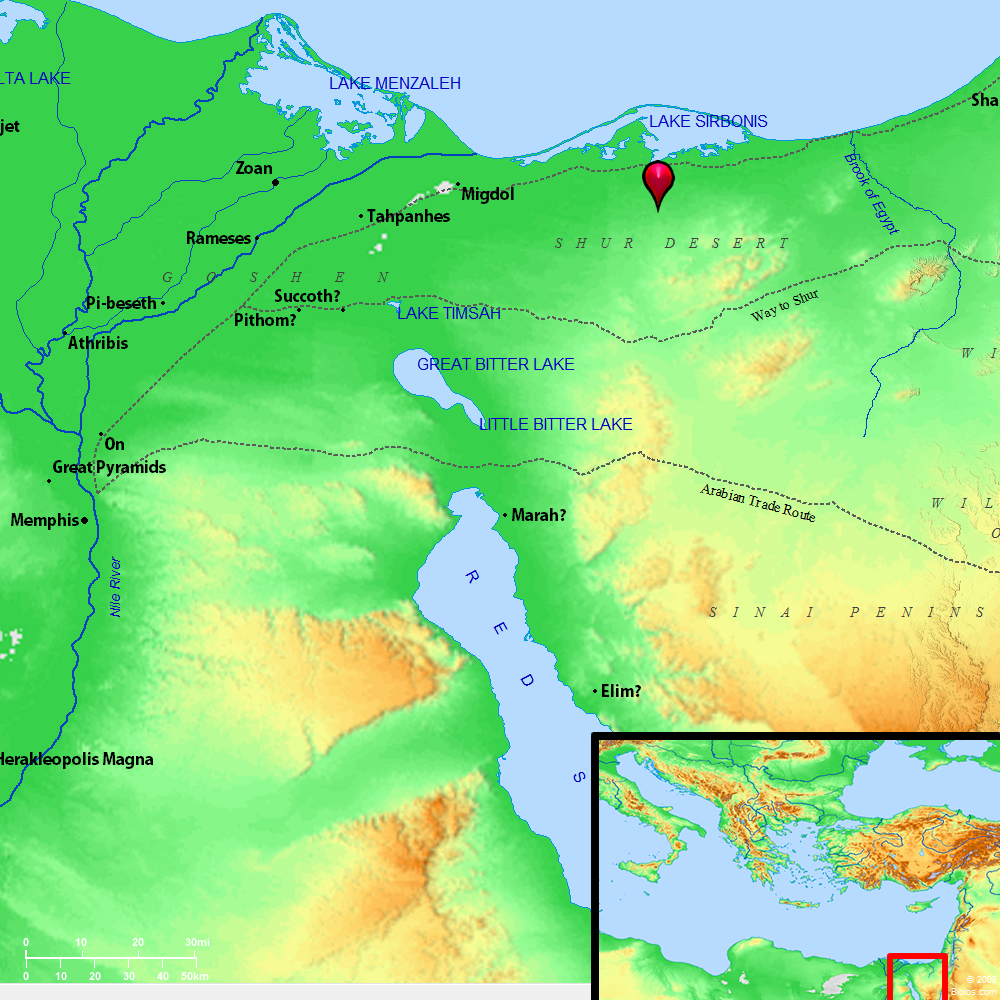
Shur means “wall.” The location is given as opposite Egypt.
They settled from Havilah to Shur, which is opposite Egypt in the direction of Assyria; (Gen 25:18 NRS)
In the direction of Assyria would indicate the northeastern
border of Egypt, as Easton’s Bible Dictionary (1893) says.
Shur is “a part, probably, of the Arabian desert, on the north-eastern border of Egypt, giving its name to a wilderness extending from Egypt toward Philistia (Gen. 16:7; 20:1; 25:18; Ex. 15:22). The name was probably given to it from the wall which the Egyptians built to defend their frontier on the north-east from the desert tribes. This wall or line of fortifications extended from Pelusium to Heliopolis.”
The Egyptians are his people, because his mother was Egyptian.
The land of Shur borders Egypt to the northwest. Isaac and his descendants are
his people, because they have the same father. The land of Havilah borders the
Negeb desert, where Isaac settled. Is this location information only?
There is another possible definition of this sentence. It
could read “He fell down in opposition to all his people,” according to my NRSV
Study Bible note. This is reflected in some translations.
“He settled in defiance of all his relatives” (Gen 25:18 NAS).
“And they lived in hostility toward all the tribes related to them” (Gen 25:18 NIV).
Alongside of, or against His People?
Like the word “opposite” in English, the Hebrew phrase `al-penei can be benign, “alongside,” or “facing towards.” In that sense, it would only mean they share a border, like Georgia is opposite Alabama and South Carolina. Or it can carry the more malevolent sense of being “in opposition to” or “at odds with.” It is used twice in this verse, where the Ishmaelites settled “opposite” Egypt and “all his people.” Did they simply live alongside Egypt and Isaac (later part of Israel)? Or is this referring to the hostile relations they had at times with both Egypt and Israel?
My conclusion is this verse means the Ishmaelites shared a
border with Egypt and Isaac’s land, which would later become part of the nation
of Israel (See Translation Notes). However, there are other texts that indicate
hostile relations between the Ishmaelites and their neighbors. Even the name
Shur (meaning “wall”) refers to a border wall Egypt built for protection against
raids from its neighbors, who could be the Ishmaelites, or alternatively, the Hyksos or the Amalekites (1 Sam
15:7). Kedar and Nebaioth (two tribes of Ishmael) sometimes were hostile to the
nation of Israel (Isa 21:16-17; 60:7; Jer 49:28; cf. Gen 28:9; 36:3).
So perhaps the double meaning of `al-penei is intentional.
During times in their history when relations were friendly or at least neutral,
it would mean “alongside of.” During times when relations were antagonistic, it
would mean “in hostility.”
The End
Abraham’s saga began with a genealogy (Gen 11:10-32) and now ends with a genealogy (25:12-18). “The emphasis here is on the secondary lines of Abraham’s—those displaced by Isaac” (HC Study Bible, 25:1-18 note). We have his children by Keturah and the descendants of Ishmael. This completes the character study of Abraham, Sarah, Hagar, Ishmael, and Lot and his daughters, based on the Biblical material. There are other sources we could consult about them: Rabbinic commentaries, the Koran, archeology, and Ancient Near Eastern Texts (ANET). But the Biblical material has given us quite a bit. There are others I’m not naming, like Isaac and Rebekah, because their stories have not finished.
For Writers: Choosing a POV Character
If I were to make a work of fiction based on these stories, I would look for a Point of View (POV) character. Abraham would be difficult. Even though he’s the main character, and he was there for all of it (except his death and burial), it’s a bit daunting to try to get inside the head of someone who plays such a big role in the Bible. Sarah would be difficult for the same reason, and because after going through this story in detail, I have less sympathy for her overall. Notice, I didn’t say no sympathy. I said less sympathy. I would want to portray them both honestly, flaws and all, not excusing their bad behavior at times, but trying to make the reader sympathize with them in spite of that.
Most of my favorite biblical or historical fiction is not from the POV of one of the big names but rather from someone close to them. Eliezer of Damascus would be a good candidate in that vein. Or one of the unnamed slaves of Abraham or Sarah. Or one of the co-religionists, who followed Abraham and Sarah from Haran because they worshiped the same god. If I chose Hagar or Ishmael, I would have to make the story about them, with Abraham and Sarah as secondary characters, who could recede into the background after they were sent away. I would have a hard time making Hagar the POV character. She is much more fascinating than I realized. But I feel Margaret Atwood has already done a great job capturing all the complexities of her character in June/Offred. {Disclaimer: Atwood never claimed June was based on Hagar, but I say the similarities are undeniable.}
Who would you choose as a POV character? Would you choose more than one (that will make it more difficult to publish today, just so you know)? Personally, I know I couldn’t do Abraham’s whole story from Ishmael’s point of view (He was only with his father for about seventeen years). But he would make a great POV character at least for the time he was with Abraham and Sarah.
“Props” for Ishmael
I think Ishmael would make a fascinating character, because I haven’t seen a serious in-depth story done of him as biblical fiction, and because he is the unwanted stepchild in this story. A troubled childhood has so much potential for character development. It could not have been easy growing up knowing he was his father’s plan B. Plan C, actually, because before he was born, Abraham had made his servant, Eliezer of Damascus, his heir in lieu of a son of his own issue (Gen 15:2). As his stepmother, Sarah probably loved him until Isaac was born. What happens to Plan C when Plan A suddenly becomes reality? If he picked on Isaac a little, it was probably the frustration of losing Abraham and Sarah to their natural son.
That rough childhood prepared him for life in the wilderness (Gen 21:20). All that happened to him, fair or not, made him into the man he became: a wild ass of a man, strong, fiercely independent, and able to survive harsh conditions. Those details alone are enough to create a fascinating character.
Conclusion
I will save any further conclusions for the next post. I
thought I already knew these characters, but they have all surprised me again
and again on this extended in-depth character study. I hope you got something
out of it as well.
Translation Notes
I include these notes for people who (like me) love dissecting the original languages. If that’s not your bag, I put the pertinent information in subheadings and bold text.
Hol8596 שָׁכַן (shakan) Settle or dwell. {verb qal waw consec imperfect 3rd person masculine plural}
It looks like there is a puncta extraordinaria over “Shur.” In some cases, this can indicate a significant difference, as you saw if you read my post on Lot’s Daughters. However, none of the commentaries pointed it out here, so it’s probably not important. My guess is it only calls for a defective spelling (without the vav).
`al-penei, lit. “against the face of.” Halladay’s
lexicon says,
15. in the face of, in the sight of, before 2S 1518; in front of 1K 63; opposite to Gn 2319; against = to the disadvantage of Dt 2116.
(pg 294)
BDB says,
(d) of localities, in front of, mostly (but not always: v. GFM:Ju., p. 351) = east of, 1 K 6:3 the porch in front of, etc., v:3, 7:6, 8:8, 2 Ch 3:17, Ez 42:8; Gn 16:12 על־פני כל־אחיו ישׁכן (cf. 25:18 b), perh. (Di al.) with collateral idea of defiance;
The “collateral idea of defiance” is most significant. He could have been both alongside of his people and in defiance of them.
Hol838 אַשּׁוּר (‘ashur) a proper noun referring either to the city of Asshur or (most likely in this case) the territory of Assyria; “directional heh” at the end makes it “to Asshur” or “to Assyria.”
In the direction of Assyria, lit. “as you go to Assyria” (or “to Asshur”).
Hol975 בּוא (bo’) Go in, come, or arrive. {verb qal infinitive construct; suffix 2nd person masculine singular}
BDB says,
e. † in phr. עַד־בּוֹאֲךָ עַזָּה Ju 6:4 cf. 11:33, 1 S 17:52, 2 S 5:25, 1 K 18:46 (עַד־בֹּאֲכָה) until thou comest to = as far as; so also בּוֹאֲךָ (בֹּאֲכָה) alone, = as far as, or in the direction of, Gn 10:19, 10:19, 10:30, 13:10, 25:18, 1 S 27:8 (all sq. ךָה loc.) 1 S 15:7; so לְבאֹ חֲמָת Nu 13:21, 34:8, Ez 48:1, cf. Ez 47:15 (in a different connexion לָבוֹא אפרתה Gn 35:16, 48:7);
…he settled down alongside of all his people. (Gen 25:18 NRS)
`al-penei, see above.
kal-’echav, lit. “all his kindred.”
The wording is almost the same as 16:12, the only difference being the verb is shakan “to settle” rather than naphal “to fall.” There, the footnote reads:
The same phrase is used of the lands of Ishmael’s descendants in 25:18. It can be translated “in opposition to” (Deut 21:16; Job 1:11; 6:28; 21:31), but here more likely means that Ishmael’s settlement was near but not in the promised land.
-YouVersion, NABRE Gen 16:12 note
He “Fell” or He “Settled”?
Naphal, lit. “he fell (down or upon),” can carry the meaning
of death (1 Sam 31:8; Deut 21:1; Jdg 3:25). In fact, it was translated that way
in the King James Version, … he died in the presence of all his brethren.
(Gen 25:18 KJV). John Calvin commented that was how most
translations read it in his time.
The NRSV is consistent with most modern translations, where the verb is understood to mean “he settled (down),” or perhaps “he fell upon,” as in “he raided” or “he plundered,” rather than “he died.” Though it is a consensus, it appears to be a recent development.
Halladay’s lexicon says naphal can mean “fall,” in both literal and metaphorical senses. This can include “fall upon,” as in “make a raid” or “attack” (Jos 11:7; Job 1:15).
Hol5626 נָפַל (naphal) “abs. make a raid Jb 115; … settle oppositeGn 2518.”
However, with `al-penei, it means “settle opposite.” BDB also believes naphal here means “settle Gn 25:18 (J).”
So while naphal can in certain contexts mean “raid” or “die,” these two Hebrew lexicons believe it carries the benign sense of settling in a place opposite all his people.
This could also apply to Genesis 16:12, which is perhaps best translated, … alongside all his kindred shall he encamp (Gen 16:12 NAB), rather than … and he shall live at odds with all his kin. (Gen 16:12 NRS). See https://www.bible.com/bible/463/GEN.16.nabre, note on v. 12.



 David Anderson