Paperback excerpt: The War on Thanksgiving

This blog post was originally posted December 1, 2016. Then it became part of my book, Dark Nights of the Soul. The holidays are upon us, so I’m posting this excerpt to remind folks not to forget to give thanks during the Christmas season. I want to encourage everyone to shop stores that are closed on Thanksgiving day.


Sometime in December, probably multiple times, I expect to hear about the “war on Christmas,” because someone said Happy Holidays instead of Merry Christmas. Has anyone noticed there has been an ongoing war on Thanksgiving?

I remember when stores would wait until after Thanksgiving to play Christmas music and put up Christmas decorations. Black Friday marked the beginning of the Christmas shopping season. Now, it’s the day after Halloween. This year, on November 1, I was in a discount grocery store. It was sunny and almost 80 degrees outside, not even a hint of snowflakes, and I heard “Sleigh Bells” through the store speakers. I wanted to shout, “This is just wrong, people! It’s still more than three weeks until Thanksgiving!”

And a few years ago, stores started opening on Thanksgiving day. Really? You can’t wait until Black Friday for your big sale?

Good or Bad for Business?

A USA Today article showed the state of the debate from the business side. On one hand, there is the question about whether it makes business sense. Instead of resulting in more sales and profits, the numbers suggest Thanksgiving Day sales dilute the sales and purchases of Black Friday. So you are open on this holiday, but overall you are not making any more money. On the other hand, some believe being closed on Thanksgiving will soon be outdated. Most stores used to be closed on Sunday. Now shopping and running errands on Sunday is normal. Will the same thing happen with Thanksgiving?

“As long as shoppers want to make purchases on Thanksgiving, stores will continue to accommodate them,” one professor said.[1]

Either way, however, it comes down to a business decision. Retailers need to maximize the Christmas shopping season any way they can. If you don’t make it at Christmas, you don’t make it. I understand that. But do you have to make your employees sacrifice a major holiday and the last chance to spend meaningful time with their families before the Christmas rush?

Why Am I Talking about This on a Blog about Faith and Depression?

Because gratitude and giving thanks are powerful antidotes to depression and perhaps the most important (and underrated) acts of faith. Think about a time when you were truly grateful from the bottom of your heart. When gratitude overwhelmed you. Were you depressed then? Did it even occur to you that you could possibly be depressed at that moment? That’s what I mean about it being a powerful antidote. You can’t be depressed when you are truly thankful.

We have a day set aside to give thanks for our blessings and the blessings of this nation: the fourth Thursday of every November. And every year we ignore it, trivialize it, and treat it as a speed bump in our rush to get started shopping for Christmas. Black Friday is threatening to take over Thanksgiving altogether. Taking even one day out of the shopping season to stop, remember our blessings, share them with our families, and be thankful is treated as a waste of time, and even worse, a waste of money.

Isn’t that a perfect metaphor for our lives? We rush and rush to acquire more stuff and buy the love of our families and never stop to be grateful for what we already have. Sounds like the perfect recipe for depression.

So this year I am going to support Thanksgiving by doing my Christmas shopping only at stores that close on Thanksgiving Day. And I will wait until after Christmas before I shop any stores that were open on Thanksgiving. The only way this will change is if consumers prove to these companies that it really makes no business sense to try to make people shop when we should be giving thanks.

If the only prayer you ever say in your entire life is thank you, it will be enough.

-Meister Eckhart (1260-1328)

Grace and peace to you.


[1] Josh Hafner, “To Open or Not? Inside Stores’ Thanksgiving Dilemma,” USA Today, October 19, 2016, https://www.usatoday.com/story/money/nation-now/2016/10/19/open-not-retailers-wage-battle-thanksgiving/92380280/

Last Day Free & Excerpt

My latest Kindle ebook, Dark Nights of the Soul: Reflections on Faith and the Depressed Brain, is still available for free, but only for today. Here is another except. This is a chapter that exposes the voice a clinically depressed person is likely to hear in their brain. Understanding this voice is, I believe, is the most important factor in recovering from depression.

If you want the book, this is the last day you can get it for free.

The Voice…That No One Wants To Hear

Posted October 28, 2016

Do you have a voice in your head? If you have clinical depression, you probably do. A lot of people claim they don’t. In fact, they think hearing voices is a sign of mental illness. Personally, I don’t believe them. I think everyone has a voice or even voices in their heads. And those who say they don’t are either lying or in denial. Then again, I’ve already admitted to having a mental illness, so maybe I’m the wrong person to ask.

I don’t know how the voices in normal brains talk. However, if you have clinical depression, that voice in your head is your worst enemy. It’s the opposite of a motivational speaker. It tries to convince you you’re worthless and no good to anyone. If you pray or try to live by faith, the Voice tries to convince you the reason your life sucks is God is against you, not for you. “God hates me. God has given up on me, and I don’t blame Him. I’m like the tree that bore no fruit, so God has cut me off. I’m cursed. And there is no God anyway, so why do I care?”

If you know that voice, let me tell you something it doesn’t want you to know. That voice is a liar. This is not something I believe. I know it. Let me tell you how.

Medication And The Voice In My Head

Taking medication for depression is still controversial for some people of faith. When a psychiatrist first recommended it for me, I had some reservations. However, he had just told me I tested high for depression in every possible way, so I took his advice. Sometimes I have wondered if it was really working, especially at times when I have been sad, moody, anxious, just fill in the blank with any negative emotion.

I can still say, though, that medication does make a difference for me. I know because a couple of times I have changed medications. When you change from one antidepressant (AD) medication to another, you first have to wean yourself off of your current med. That usually lasts two to four weeks. Then you can start the new one. It can take several days for the new medication to start taking effect. During that transition, those depressed thoughts you had forgotten about can come back, along with other possible side effects.

The first time I switched medications, I had suicidal thoughts. I can’t say it was the first time (for suicidal thoughts, I mean), but it was more frequent and intense than ever. Is the new med not working? I wondered.

My doctor said it was a low dose and suggested trying a “medium” dose. Within a few days, the suicidal thoughts stopped. That medium dose worked for me. But without talking to my doctor, I might have thought it was the wrong medication.

The second time I switched meds was more recent. Bad thoughts came but in a different way. Instead of feeling depressed in the way we usually think of (deep and persistent sadness, suicidal thoughts, etc.), it came in a way I had forgotten about: anger. I was angry much of the day. Angry at family and friends over past slights that my balanced brain had forgiven long ago. Angry at people for the downward spiral the world seems to be in. Unreasonably angry. But when the new medicine kicked in, I was back to being happy. And I am proud to say I did not take my anger out on anyone.

The Decision

Why did I not act out my anger or my suicidal thoughts during those times? Before I started transitioning medications, I made a crucial decision. Until I know if the new med is good for me and until I get my brain normalized again with either the new or return to the old, I will not believe that voice in my head.

I got the idea from the movie A Beautiful Mind. Russell Crowe plays Nobel Prize-winning mathematician John Forbes Nash, Jr., who was found to be paranoid schizophrenic. He had more than just a voice in his head. He had full-on hallucinations of three people telling him all kinds of conspiracies. When he was diagnosed and got medication, the hallucinations disappeared. However, he was having difficulty with the side effects. He told his wife and doctor he wanted to go off the medication.

But those imaginary people will come back.

Yes, but this time he will know they are not real, and he will absolutely refuse to believe them. It was not easy. Those hallucinations had a life of their own. They tried really hard to convince him to listen to them. But he remained resolute. You are not real. I won’t listen to you. I won’t believe anything you say.

Because of past experience with depression, I knew I needed to reject, ignore, and otherwise neutralize those thoughts temporarily. Let’s review what happened in these two instances.

  1. I stopped one AD medication.
  2. The Voice in my head that fuels my depression went from being a surly kitten to a roaring tiger.
  3. When the new AD medication kicked in, the Voice calmed down, the bad thoughts sunk back to a manageable level, and happy thoughts returned.

What is going on? I’ve talked about the chemical imbalances that exist in a clinically depressed brain. It is a medical condition where your brain does not get normal levels of “happy chemicals,” so the “stress chemicals” overwhelm it. Medication helps your brain produce and absorb more happy chemicals. When your brain chemistry is balanced, your emotional state can get back to normal–in a good way.

The Revelation

That last experience changing meds really drove something home for me. The Voice in my head did not bother me when I was on meds. But when I was in that transition phase, the Voice came back with a vengeance. Now that I am on meds again, the Voice is gone. And that’s when it hit me like a revelation of Biblical proportions:

That voice in my head is the product of a chemically imbalanced brain.

If you have that Voice, too, let that sink in. That Voice in your head that tells you, “I’m no good. I’ll never get anything right. I’m a burden to everyone who loves me,” or even worse, “No one loves me. I might as well kill myself.” Or maybe you have that angry voice, like I experienced. And you believe it, don’t you? It is the product of a chemically imbalanced brain.

The problem is not so much the voice itself but that we believe it so readily. In thinking about this, I was amazed at how anything we hear inside our head, we just believe it. We don’t question it; we don’t evaluate it. We just accept whatever it says, even when it has no basis in reality.

“Everyone hates me.”

Oh really? There are 7.5 billion people in the world, and every single one of them hates you? Unless you’re Hitler, that’s not possible. Maybe you just meant everyone in your school or in your town. But still, how many people is that, a few hundred? A few thousand? A few hundred thousand or a few million if it’s a major city? How could every one of them hate you? Simple logic should tell you that’s not even possible. But you believe it. Why? Because it comes from your head, so it must be true, right? Wrong!

That Voice Is A Liar

Are you telling me I’m lying to myself?

That’s exactly what I’m telling you! That voice in your head is the product of a chemically imbalanced brain.

My angry voice said things to me like, “They always disrespect me. They never listen to me. They’re idiots. They don’t care about me, so screw ‘em all.” (That’s as politely as I can say it). And again, it was the product of a chemically imbalanced brain.

And bottom line: Don’t believe a chemically imbalanced brain, even if it’s your own. You’re just as likely to get the truth from a Magic 8-Ball. If it is telling the truth, that’s purely by accident.

{Don’t ask me. I’m a ball.}

I suppose this begs the question, If you can’t believe your own mind, what can you believe? How do you know what the truth is? There is no simple answer to that, and anyone who tells you there is is setting you up for failure. But I will reiterate the four principles I gave you in the introduction.

  1. God is for your recovery and healing, not against it.
  2. God will not kick you when you’re down.
  3. Some kinds of faith are good for recovery, and some are bad. Make sure you know the difference.
  4. With the right help–spiritually, psychologically, emotionally, and perhaps medically–you can live a happy and fulfilling life. You just need to learn how to stop your depressed brain from sabotaging it.

That’s all the truth you need for now.

Grace and Peace to You.

P.S. You can download the book to your Kindle device or app with this link.

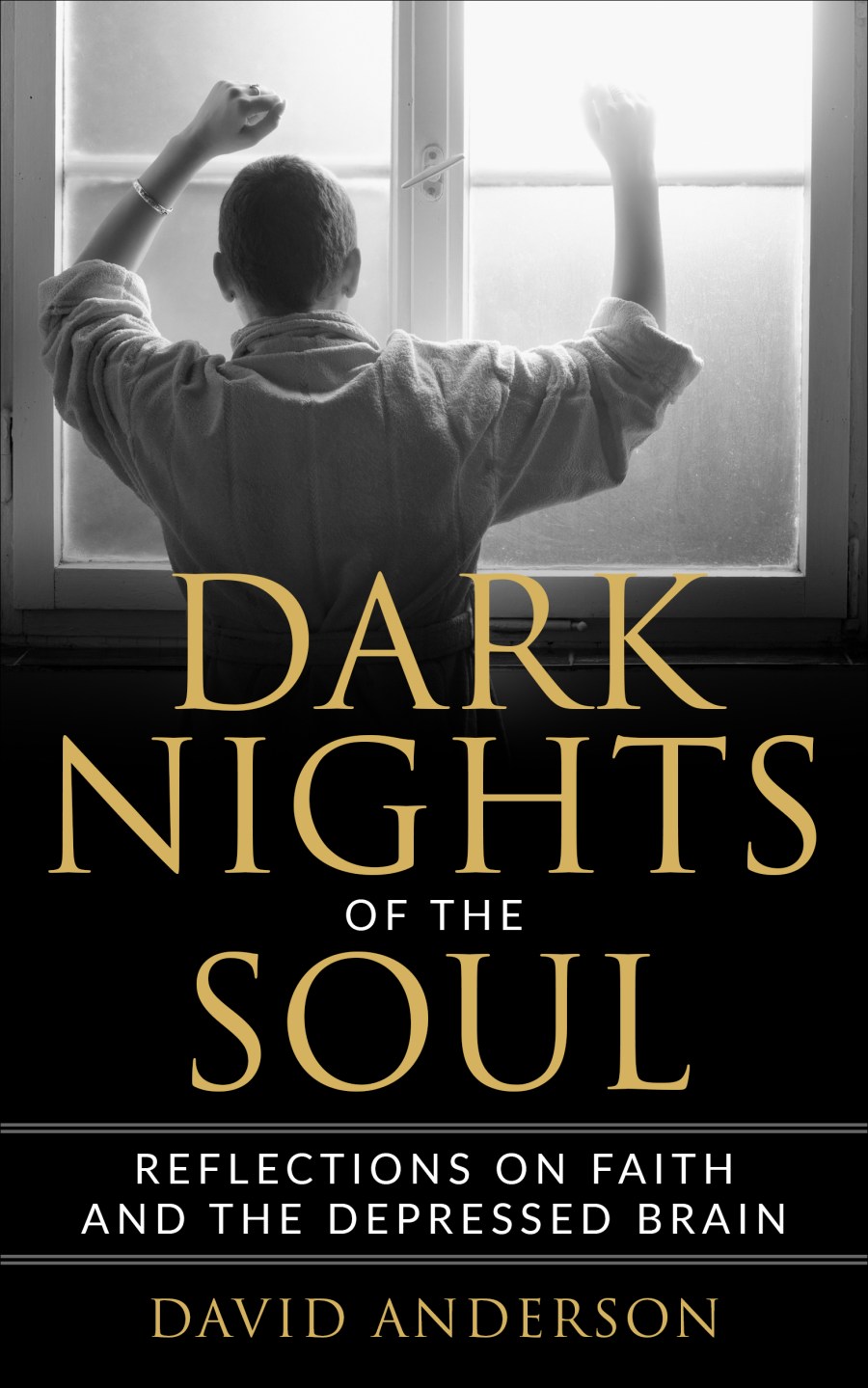
Book cover-Dark Nights of the Soul: Reflections on Living with the Depressed Brain by David Anderson

Book Excerpt: Dark Nights of the Soul

Book cover-Dark Nights of the Soul: Reflections on Living with the Depressed Brain by David Anderson
Free on Kindle until July 28

I have published an ebook on Kindle. It is available for free through July 27. Since I am self-publishing, I can show you an excerpt without asking the publisher for permission. I am the publisher, and I give myself permission. The book is called Dark Nights of the Soul: Reflections on Faith and the Depressed Brain. You can use the link to go straight to the page on Amazon to download it.


Depressed Christian, Part 1

There are a lot of misconceptions about depression that prevent people who suffer from getting the help they need. In my own experience, religion sometimes brought healing and comfort when nothing else would, and sometimes it made my depression worse in ways nothing else could. And so I say I am in recovery from two things: depression and bad faith.

The first misconception is thinking depression is only an emotional state. Typically, people say they’re depressed when they are very sad. So depression in this sense is extreme sadness. Anyone can feel depressed after the death of a family member or friend, loss of a job, divorce or breakup, or some tragic event in their lives. This is situational depression.

But depression in the sense I’m talking about is not that kind of sadness. It is a medical condition. It is not something that happens because of life. It is an ongoing condition of the brain. This is clinical depression.

The Depressed Brain

Did you know that your brain processes more than 100,000 chemical reactions every second?[1] Obviously, that is too much to describe in detail here. For most purposes, you just need to know that an important part of this activity involves the production of chemicals like serotonin and dopamine. I will refer to them generally as “happy chemicals.” You have happy chemicals and stress chemicals. The brain processes them, but most of them are actually produced in the gut. This is why people with depression or anxiety often have gastrointestinal (GI) illnesses as well.[2] Regardless of where they come from, when your brain does not get normal levels of happy chemicals, the stress chemicals affect your mood. You live in a constant, underlying, and invisible state of depression–even when there is no reason for you to be sad. This kind of depression is a medical condition, not an emotional state where you can just “cheer up” or pray your way out of it.

I did not know any of this until I was professionally tested. The psychiatrist summed up the results like this: “You tested high for depression in every possible way.”

It was one of those moments when I knew my life would never be the same. How I viewed myself, life, the world, God, and everything changed forever with that one sentence. I only felt mildly depressed, and I still tested high in every possible way? I never thought it could be that bad. Yet, as the psychiatrist explained it, I saw how it was not only possible but explained a lot about my whole life.

Clinical depression is not about how you feel at any given moment. It means you need help in creating a healthy level of happy chemicals. Without that help, I walked around numb, moody, temperamental, irritable, and looking angry even when I was not. I isolated myself and either dreaded or loathed social interaction. I thought all kinds of bad thoughts about myself, friends, enemies, family, strangers, the world, God, and life itself. I suffered from anxieties for no good reason. I thought no one understood me, so there was no point in talking to anyone.

Of course, I did not feel that way 24/7. It would have been easier to recognize if I did. I had ups and downs just like everyone, or so I thought. My emotional/mood spectrum felt normal to me because it was the only thing I had ever known. This is what it’s like to live with clinical depression and not know it.

If any of this sounds familiar, especially if you can’t identify any good reason for your sadness, irritability, apathy, or hopelessness, you may be one of the millions of people living with undiagnosed depression of some kind. How do you know for sure? Since it is a medical condition, it needs to be diagnosed by a medical or psychiatric professional (See Appendix B). But if people close to you think you are depressed, even when you don’t, you should seriously consider getting tested. I only got tested because my mother and sister urged me. If they hadn’t, I would still be undiagnosed, still moody and depressed, and still thinking it was normal.

Bad Faith

Clinical depression is not about feeling sad or anxious. It’s about living with a brain that does not get enough happy chemicals. It is very important you understand this, because when religion gets mixed up in depression without understanding what it really is, it creates more problems than it solves. An article on Beliefnet said it well: “As we consider the causes of depression, those of us in the church must face the ways we might be responsible for creating it.”[3]

I’ve experienced some of those ways that church/religion/faith–whatever you want to call spiritual life and practice–can be responsible for creating it or making it a lot worse. I thank God from the depths of my soul that He led me out of that and into a church, faith, and spiritual practice that helps my recovery and healing, rather than beats me down for not having “enough faith,” whatever that means. Because the only thing worse than living for ten years (in my case) in a faith or religion that will only acknowledge “spiritual” causes of depression is living in that kind of faith for ten years…and one day.

A New Mission

What I say next, I don’t say lightly. I’m not the type of person who goes around saying, “God told me this. God told me that. God has called me to do this.” So many times I have heard people say things like that and thought, I bet if I could hear God as well as you claim to, right now I’d hear God saying, “Leave Me out of this!”

It’s not that I believe God does not talk to people. I believe God talks to us all the time, but hearing God is tricky. I’ve learned from hard experience that I don’t hear nearly as well as I would like to. Probably because it’s being filtered through a clinically depressed brain.

With that disclaimer, I’m going to go out on a limb and say I believe God is calling me to help others who are in the same position I was. People who know they are depressed and are trying to be happy. People who don’t know it but have a sense that something is wrong with them. People who think it’s normal because they have lived with depression all their lives. And especially, depressed people who have been hurt by religion. I believe I am in a position to help point you to what is helpful–and away from most of what is hurtful. I don’t think I will ever say I am healed of depression. In Alcoholics Anonymous, they call themselves recovering alcoholics, not recovered.

Just recently, I have been able to look at my life today and realize I have come a long way on this road of recovery, though I have by no means come to the end. This journey has been a quest for happiness, purpose, and meaning in spite of a brain that is tilted toward depression, and God has been with me through it all. There are some lessons I have had to learn the hard way. I hope to spare you some of that drama. The greatest happiness, purpose, and meaning comes from helping others, so I pray this will in some way help you.

Grace and Peace to you.

P. S. The book Dark Nights of the Soul: Reflections on Faith and the Depressed Brain is available for $0.99 on Kindle for a limited time.


[1] “How Many Chemical Reactions Occur in the Brain Every Second,” Answers.com, http://www.answers.com/Q/How_many_chemical_reactions_occur_in_the_human_brain_every_second

[2] “The Brain Gut Connection,” Johns Hopkins Medicine, retrieved March 14, 2019, https://www.hopkinsmedicine.org/health/healthy_aging/healthy_body/the-brain-gut-connection

[3] “Christians: Take Depression Seriously,” Beliefnet, July 26, 2016,  https://www.beliefnet.com/wellness/health/emotional-health/christians-take-depression-seriously.aspx

Longest Night Service

 We celebrate Christmas on December 25, but that is not when Jesus was most likely born. The Gospel of Luke says, “And in the same region there were shepherds out in the field, keeping watch over their flock by night” (Luk 2:8).

If Luke is correct, this would place his birth between February and April, when the ewes give birth to their lambs. This is when shepherds had to watch them all night, to be ready to assist the laboring sheep. This begs the question, why do we celebrate on December 25?

In about 312 AD, Constantine became emperor of Rome. He credited a key victory over his rival to a vision of the cross. He wanted to make an official holiday for Jesus’ birth. Mithras, a Persian deity, was also popular in the empire. His devotees celebrated his birthday on December 25. Constantine thought celebrating Jesus’ birth on the same day would help unify the people.

It also corresponded with the winter solstice and the Unconquered Sun celebration. People then like today noticed the days getting shorter until the winter solstice, the longest night of the year. It was as if the sun was weakening over months, maybe dying. Just when hope was at its lowest, the sun would gather its strength, and the days started getting longer again. The sun was still unconquered.


The Longest Night of the Year


Some churches have taken this idea of the longest night and made services around that theme. The idea is to give people who are depressed, lonely, and grieving during the holidays a chance to acknowledge those feelings. In my own denomination (PCUSA), only about 25% of congregations offer this type of service. I have never been to one. Here is what I’ve learned so far.

  • They may be called Blue Christmas or Longest Night services. I think the Longest Night is a more appropriate name. As one pastor said, “When you hear, ‘Come to the Blue Christmas’ service, you might think it is a service where you will get depressed.” That is not the impression they want to give.
  • In some churches, the Advent candles of hope, peace, joy, and love, are extinguished. For the Longest Night, they are replaced by hopelessness, fear, grief, and loneliness. This is not to depress people but to give them a chance to acknowledge these feelings.
  • Some churches have Parish Nurses plan and participate in the services.

Even though many acknowledge the need for a service like this during the holidays, attendance is often low. When one associate pastor of a congregation with 1,500 members proposed the idea, the members overwhelmingly approved it. But at the service itself, only twenty-five attended. Despite putting more effort into publicizing it and explaining the purpose, next year was the same. When asked why, people said they were not depressed, so they did not think this service was for them.

This is less than two percent of the congregation. The percentage of people living with depression is much greater than that. This points to a larger problem, not only in the church but in society as a whole. It is still difficult for many people to acknowledge depression and the feelings associated with it, especially during the  holidays. As one pastor said, “People are really unwilling to self-identify as grieving. People seem to prefer to think of themselves as independent and self-reliant and all those ‘boot strappy’ words that are part of our American ideal.”

Another said, “We as a culture tend to overlook the people who are grieving, who are lonely, especially at this time of year.”

In light of this, churches may have a better response if they focus on healing for others. Most people are more willing to come on behalf of a friend of family member who has experienced loss than for themselves.


Christmas on the Longest Night


Even though it is not historically accurate, Christmas on or near the longest night of the year fits spiritually. On Christmas, we celebrate the eternal Word of God becoming flesh and dwelling among us in the person of Jesus of Nazareth. In him was the same light that was with God in the beginning. And like the unconquered sun, even though the light may be hidden, it has always been and will always be there. The light shines brightest in darkness, and the darkness has not overcome it.

In his flesh, Jesus experienced all the hopelessness, fear, grief, and loneliness you or I ever have. He is present to walk with us through our darkness and pain until we see the light again. Knowing this has not cancelled out the light represented in Advent, Christmas, and Easter services for me. It has made them meaningful at a deeper level.

One pastor said it very well. “The Incarnation is a reason for celebration that God loved us so much that God sent Jesus to be with us, but it is also a reason for celebration that Jesus came to walk with us through the pains of life as well. I wish we could better hold these two messages together.”


Grace and peace to you.


References


Dunigan, E. (Oct. 26, 2018). “Blue Christmas: ‘Tis the season—for depression.” Presbyterians Today


Download a copy of a Blue Christmas liturgy here.


The Holiday Blues


‘Tis that season when you hear “Joy to the World” and “The Most Wonderful Time of the Year” everywhere you go. We think of the holidays as a joyful time, where we get to enjoy our families, food, and gifts. Yet for some, the holidays are a time of stress, sadness, and loneliness. Because of that, I’ve added this chapter on dealing with holiday depression.

Why are the holidays a depressing time for some people? Experts cite a number of reasons.

  • Stress. The parties, the get-togethers, the shopping, the decorating, yes, it’s all fun, but it’s stressful too. Normal irritations can become magnified during the holidays.
  • Pressure to be happy. When you see people around you happily saying “Merry Christmas” or “Happy Holidays,” and stores are playing holiday music to get people in a shopping mood, you feel out of place if you cannot get into “the holiday spirit.”
  • Unrealistic expectations. Comparisons often lead to depression. If you are comparing this holiday to ones in the past, you’ll feel disappointed if this year does not measure up. If your neighbors appear cheerful and have it all together better than you do, remember at home behind closed doors, they are probably as stressed as you.
  • Doing too much. If just the thought of holidays brings stress and anxiety, it’s probably because you have done too much in the past. Maybe it’s time to scale back.
  • Neglecting self-care. If you meditate and exercise, you might be tempted to put that on hold because you feel pressed for time. You might not be getting enough sleep or taking time during the day to decompress.
  • Family strife. Spending time with family is the most important part of the holidays for most people. However, there might be some family you’d rather avoid.
  • Overindulging. If you have depression, WebMD recommends you avoid food and drink that makes your blood sugar spike. This includes most of the holiday treats we love. Sugar highs and the inevitable crashes afterwards are not a recipe for holiday cheer. And of course overindulging in alcohol will not help.
  • Isolation. Being apart from those you love never feels good. But during the holidays, you miss them even more. For those who have just moved to a new city, especially if they are single, they may not have made any friends where they are. They feel alone because they have no one to celebrate with.
  • Grieving. The first holiday after the loss of your spouse or parents or children can be rough. If most of your best holiday memories are with someone who can no longer be with you, the loss you feel will be magnified during the holidays.
  • Seasonal Affective Disorder (SAD). This is a condition where people become more depressed as the days get shorter. The holiday season, from Thanksgiving to New Year’s, is timed perfectly for SAD.
  • Post-holiday letdown. You manage to get your fill of holiday cheer in spite of the stress, and then it’s over. Until next year at least. As stressful as it was, some people miss the activity, the busyness, the holiday cheer, and the people who have gone back home.
  • Overspending. Some people use “retail therapy” to cope with depression, and the holidays present every temptation to overspend. Buying those expensive gifts is a big hit with those you give to. Then the credit card bills arrive.


What you can do


  1. Set expectations low. The lower your expectations, the less you can be disappointed. Don’t expect everything to be perfect, and you won’t have a meltdown when it’s not.
  2. Plan ahead and Prioritize. Make a list of all the things you expect to do for the holidays, then prioritize. Schedule time for the most important things. If you don’t have time for everything on the list, some lower priority items have to go. Do you have to go to every party you’re invited to? Can someone else host the family Christmas party this year? Can you enlist friends and family to help with the preparations? Say no to a few things that are not high on the priority list. People will not be nearly as disappointed as you think.
  3. Set a budget. Know how much money you have to spend on each person before you start shopping. Don’t pressure yourself to buy the best and most expensive version. If you don’t trust yourself, bring a friend who will make you stick to your budget. The best gifts don’t have to cost anything. I honestly believe if I gave my wife a “coupon” for a free massage, she would like that better than a diamond necklace. Remember they want your presence more than your presents.
  4. Maintain healthy habits. Enjoy your treats, but remember to eat healthy, get enough sleep, and avoid overindulging. Keep up your exercise and meditation routines. If you don’t meditate, you should start. A few minutes of meditation can do wonders for stress. Whatever you normally do to de-stress, don’t forget to do it during the holidays.
  5. Manage family encounters. If you dread getting together with some family members, here are some options, listed in increasing severity.
  6. Set aside differences. Don’t get baited into those same old debates. If you argue with the same person every year, you already know what they are going to say. Resolve before you go in you will not waste any more time trying to set them straight. If they start, just say Merry Christmas, and talk to someone else. If there is some past slight you are still sore about, what better time to forgive than the holidays?
  7. Seek out the positive people. Instead of fretting over that relative who is always critical, think of the people you enjoy and seek them out. If you are busy with them, that means less time with negative people. You can ask the person arranging the seating to place you next to someone more supportive. Better to say, “Can you sit me next to this cousin?” than “Don’t sit me next to Aunt Martha.”
  8. Make an early exit. You can always make an appearance, and make sure those who need to see you do so. After a decent amount of time, you can say you have to go because of another commitment.
  9. Avoid certain people altogether. It is better for your mental health to forgive than to hold grudges. But if the pain is too raw, or if you know they are going to make you uncomfortable, then don’t go to the party or to their house unless you have to.
  10. Volunteer. Nothing is more in keeping with the season than helping someone in need. Volunteer at a homeless shelter, soup kitchen, or other community service. Helping others feels good and is often the best antidote for depression. You might even want to make it a new tradition.
  11. Community, Religious, or Social Events. Religious services have always been a part of my holiday tradition. With or without my family, I like being a part of them. If that is not your thing, look for other community and social events open to the public. They present low pressure opportunities to see old friends or meet new people with shared interests.
  12. Call friends and family. One year my sister was working as a missionary in Mexico. We celebrated Christmas as usual—me, my parents, and grandparents. In the afternoon, we used my iPad to call my sister on Skype. My grandparents were thrilled, not only to talk to her but to see her. It is easy these days to set up video chat online. Skype is still popular, though WhatsApp and Viber are more popular now. If you have an iPhone, Facetime is included. Bottom line, for your loved ones who are miles away, if you have a cell phone, tablet, or computer, you can contact them.
  13. Journal your feelings. I started keeping a journal in college. I journaled about things that happened to me, and how I felt about them. During bouts of depression, it was a lifeline for me. Which is why if you read my journals, you would probably think I was a basket case. But studies have shown that journaling your feelings, especially during times of grief or depression, helps people feel less depressed and less anxious. Darlene Mininni, author of The Emotional Toolkit, suggests writing for fifteen minutes three or four days in a row to start. If you don’t know what to write, you can prompt yourself by writing and answering questions like, “Why does this upset me?” or “What do I want to happen now?”
  14. Get counseling. If you can’t shake feelings of sadness, loneliness, or anxiety, it might be time to seek professional help. I’ve listed some websites where you can search for a counselor in your area (Appendix B). But first, you might want to read this guide on what to look for in a therapist. https://www.webmd.com/mental-health/features/how-to-find-therapist#1
  15. Remember to be grateful. The holiday season starts with Thanksgiving. That’s a hint. Begin each day with just a minute or two to think of three things you are grateful for, and the rest of your day is likely to go better.
  16. Plan a post-holiday get-together. This is a way to ease any post-holiday letdown. Set a date to get together with a friend in mid or late January. This will give you something to look forward to after the holidays.


###


In my post called “The War on Thanksgiving,” I said this. “We rush and rush to acquire more stuff and buy the love of our families and never stop to be grateful for what we already have. Sounds like the perfect recipe for depression.”

The point I was trying to make is not to let commercialization take over the real meaning of the holidays. Sure, I buy gifts for whoever I’m spending Christmas with. I enjoy getting presents, but I also enjoy seeing their faces when they open a gift I gave them, especially when my niece and nephew are there. They are still young enough to approach Christmas morning with unbridled joy. Isn’t that what we really want from the holidays? To give and receive joy?

So whatever you do, whether it’s decorating, baking, making the holiday dinners, trimming the tree, eating with family and friends, shopping for gifts, making gifts, volunteering, attending religious services, whatever your traditions are, or if you think it’s time to start a new tradition, do it with the intent of spreading joy. That is the surest way I know to have a happy Thanksgiving, happy Chanukah, merry Christmas, happy Kwanzaa, happy Boxing Day, happy New Year and Dia de los Reyes. And a happy Festivus for the rest of us.


References


Kerr, M. Medically reviewed by Legg, T. J., Ph.D., PMHNP-BC. Holiday depression. Healthline Newsletter. Retrieved from https://www.healthline.com/health/depression/holidays#1

Mann, D. Emotional survival guide for the holidays. WebMD. Retrieved from https://www.webmd.com/depression/features/emotional-survival-guide-for-holidays#1

Mayo Clinic Staff. Stress, depression and the holidays: Tips for coping. Retrieved from https://www.mayoclinic.org/healthy-lifestyle/stress-management/in-depth/stress/art-20047544

Minnini, D., PhD, MPH. (2006). The Emotional Toolkit. St. Martin’s Press. Available in libraries or at https://www.overdrive.com/media/1571599/the-emotional-toolkit

WebMD staff. Medically reviewed by Bhandari, S., MD. “Foods to avoid if you have anxiety or depression.” Retrieved from https://www.webmd.com/depression/ss/slideshow-avoid-foods-anxiety-depression

WebMD staff. Medically reviewed by Goldberg, J., MD. “Holiday depression and stress.” Retrieved from https://www.webmd.com/depression/holiday-depression-stress#1


The War on Thanksgiving


Sometime in December, probably multiple times, I expect to hear about the “war on Christmas,” because someone said Happy Holidays instead of Merry Christmas. Has anyone noticed there has been an ongoing war on Thanksgiving?

I remember when stores would wait until after Thanksgiving to play Christmas music, put up Christmas decorations, and Black Friday marked the beginning of the Christmas shopping season. Now it’s the day after Halloween. This year, on November 1, I was in a discount grocery store, it was sunny and almost eighty degrees outside, not even a hint of snowflakes, and I heard “Sleigh Bells” through the store speakers. I wanted to shout, “This is just wrong, people! It’s still more than three weeks until Thanksgiving!”


Good or bad for business?

A USA Today article showed the state of the debate from the business side. On one hand, there is question about whether it makes business sense. Instead of resulting in more sales and profits, the numbers suggest Thanksgiving sales dilute the sales and purchases of Black Friday. So you are open on this holiday, but overall you are not making any more money. On the other hand, some believe being closed on Thanksgiving will soon be outdated. Most stores used to be closed on Sunday. Now shopping and running errands on Sunday is normal. Will the same thing happen with Thanksgiving?

“As long as shoppers want to make purchases on Thanksgiving, stores will continue to accommodate them,” one professor said.

Either way, however, it comes down to a business decision. Retailers need to maximize the Christmas shopping season any way they can. If you don’t make it at Christmas, you don’t make it. I understand that. But do you have to make your employees sacrifice a major holiday and the last chance to spend meaningful time with their families before the Christmas rush?


Why am I talking about this on a blog about faith and depression?

Because gratitude and giving thanks are powerful antidotes to depression and perhaps the most important (and underrated) acts of faith. Think about a time when you were truly grateful, from the bottom of your heart. When gratitude overwhelmed you. Were you depressed then? Did it even occur to you that you could possibly be depressed at that moment? That’s what I mean about it being a powerful antidote. You can’t be depressed when you are truly thankful.

We have a day set aside to give thanks for our blessings and the blessings of this nation: The fourth Thursday of every November. And every year we ignore it, trivialize it, and treat it as a speed bump in our rush to get started shopping for Christmas. Black Friday is threatening to take over Thanksgiving altogether. Taking even one day out of the shopping season to stop, remember our blessings, share them with our families, and be thankful is treated as a waste of time, and even worse, a waste of money. Isn’t that a perfect metaphor for our lives? We rush and rush to acquire more stuff and buy the love of our families and never stop to be grateful for what we already have. Sounds like the perfect recipe for depression.

So this year I am going to support Thanksgiving by doing my Christmas shopping only at stores that close on Thanksgiving Day. And I will wait until after Christmas before I shop any stores that were open on Thanksgiving. The only way this will change is if consumers prove to these companies that it really makes no business sense to try to make people shop when we should be giving thanks.


If the only prayer you ever say in your entire life is thank you, it will be enough.

-Meister Eckhart (1260-1328)


Announcement


As a multi-passionate writer, I have many projects in the works. One of them is a book called The God Wrestler. Some of my most intense struggles with depression have been over issues of faith and religion. Each time I walked away feeling like Jacob when he wrestled the angel, limping, but I came through it in one piece. The angel pronounced this blessing on him.

 Gen 32:27-28 So he said to him, “What is your name?” And he said, “Jacob.”

28 Then the man said, “You shall no longer be called Jacob, but Israel, for you have striven with God and with humans, and have prevailed.”

Right now it is in the final stages of editing, making a cover, and everything that needs to be done to make it ready for publication. The book is the product of wrestling with God, the Bible, and my own demons of depression. (The demons are metaphorical, not literal). It is short, about 25,000 words. I could have made it a lot longer, but I thought people would be more likely to read a relatively short book. At this length, it says enough to make an impact but won’t be intimidating like War and Peace.

Because the holidays can be depressing to some people, I wanted to offer something to help. So I will post chapters specifically to address depression during the holidays.

Whether you struggle with depression or love someone who does, I pray something from this project will help you through the holidays and beyond. If what I went through helps anyone find happiness and meaning for their lives in spite of being depressed, it will all have been worth it.

Grace and Peace to you.